Oregon Gave You the Most Progressive End-of-Life Laws in America. The Official Form Is 11 Pages of Legalese with No Instructions. One Wrong Witness Invalidates Everything.
Oregon pioneered the POLST in 1991 and passed the first Death with Dignity Act in 1997. The state legalized human composting in 2023. Oregon does more for patient autonomy than almost any other state — and then hands you an 11-page statutory form (OHA 3905) with seven sections, dual-witness rules, and legal footnotes in 9-point type, and expects you to figure it out.
The form is free on the Oregon Health Authority website. So is the confusion. The witness rules alone trip up families every week: under ORS 127.515, you need two adult witnesses or a notary. But Witness B cannot be a relative, cannot be entitled to any part of your estate, and cannot work at the facility where you receive care. Choose the wrong person and the document is invalid — the hospital's legal team will reject it when it matters most. And the form does not tell you any of this. It just gives you a signature line and a footnote.
Meanwhile, your Healthcare Representative's appointment is not active until they sign Section 7 of the form. Most families do not know this. The representative thinks they have authority. The hospital says they do not. A crisis becomes a legal dispute at the worst possible moment.
And the advance directive is only one piece. If you have a serious illness, the directive alone cannot stop EMTs from attempting resuscitation — you need a physician-signed POLST. If you want human composting or water cremation, the statutory form has no field for that — you need a legally binding supplemental directive. If your home has crossed Oregon's $1 million estate tax threshold (the lowest in the nation, with no spousal portability), your healthcare planning is happening in a vacuum unless it connects to your financial exposure.
The Oregon Advance Directive & Living Will Kit is a Clinical Compliance System that bridges the gap between Oregon's free statutory forms and the $300-to-$1,000 attorney packages that most middle-class families cannot justify. It walks you through every section of the updated post-SB 199 form, audits your witness selection before you sign, coordinates your directive with the POLST Registry and local clinical portals, and connects your healthcare planning to the estate and Medicaid realities that Oregon families specifically face.
What's Inside the Clinical Compliance System
A 12-chapter guide, 8 standalone printable tools, and the Advance Directive Quick-Start Checklist — covering every step from documenting your healthcare values through coordinating with emergency systems and protecting your estate, built specifically for Oregon's unique statutory framework:
Section-by-Section Guide to the OHA 3905 Form
The statutory advance directive has seven sections. Most people fill in Section 1 (your name and contact), guess at Section 2 (appointing a representative), skip Sections 3 and 4 (the medical instructions that actually matter), and miss Section 7 entirely (the acceptance signature that activates the whole document). The guide walks you through each section in plain language — explaining what "advanced progressive illness" means versus "terminal condition," how to write Quality of Life values in Section 4 that protect your dignity during cognitive decline, and why leaving Section 3 blank does not mean "do everything" — it means your representative decides with no guidance.
Witness Execution Audit
The dual-witness rules under ORS 127.515 are strict and specific. Only one witness can be a relative. The second witness must be completely impartial — no blood relation, no marriage connection, no inheritance interest, no employment at your care facility. The guide includes a Witness Selection Checklist that catches disqualifying relationships before you sign, not after a hospital rejects your form in a crisis. If you choose notarization instead of witnesses, the guide covers that path too.
Healthcare Representative Coordination
Appointing a representative is more than writing a name on a line. Your representative must understand the scope of their authority — including the ability to admit you for up to 18 days of dementia-related behavioral care even if you object during an episode of incapacity. They must sign Section 7 to activate the appointment. They must know Oregon's default surrogate hierarchy under ORS 127.635 — the fallback order (guardian, spouse, adult children, parents, siblings) that takes over if you never appoint anyone. The guide helps you brief your representative so they are prepared, not blindsided.
POLST Coordination & Emergency Distribution
Your advance directive is a values document. A POLST is a medical order signed by your physician — it is what first responders actually follow. Having an advance directive without POLST coordination is like having car insurance without keeping the card in the glove box. The guide explains when a POLST is appropriate (serious illness or advanced frailty, not healthy adults), how to coordinate both documents so they do not contradict each other, how to upload your directive to MyChart portals at OHSU, Providence, Legacy, Samaritan, and Kaiser, and how to file with the Oregon POLST Registry so emergency responders can retrieve your orders at 3 AM.
Green Burial & Alternative Disposition Planning
Oregon legalized natural organic reduction (human composting) under House Bill 2574 and clarified rules for alkaline hydrolysis (water cremation). But the statutory advance directive has no field for these preferences. The guide includes supplemental directive language — legally binding instructions that authorize your healthcare representative to arrange human composting or water cremation, including the specific authorization for out-of-state transport to licensed facilities in Washington State, since composting operators do not yet operate directly in Oregon.
Death with Dignity Act Orientation
Oregon's Death with Dignity Act allows terminally ill patients to request medication to end their lives. It cannot be requested through an advance directive. It cannot be activated by a Healthcare Representative. The patient must make two verbal requests separated by 15 days and one witnessed written request — personally, while possessing capacity. Many families confuse the advance directive with DWDA eligibility. The guide draws a clear, legally accurate line between the two, so your comfort care and natural death preferences are documented without false assumptions about what the directive can or cannot trigger.
Oregon Estate Tax & Medicaid Recovery Context
Your advance directive protects your clinical decisions. It does not protect your assets. But if you are documenting healthcare wishes without understanding Oregon's financial landscape, you are planning in a vacuum. Oregon's estate tax exemption sits at $1 million — the lowest in the nation — and it is not indexed for inflation. There is no spousal portability, meaning a surviving spouse cannot inherit the unused exemption without prior trust planning. The guide separates healthcare planning from estate exposure, explains when Form OR-706 applies, and covers Medicaid Estate Recovery exemptions under ORS 416.350 — including the protections for surviving spouses and disabled children who remain in the family home.
Who This Kit Is For
- Oregon residents creating an advance directive for the first time — who need more than the bare statutory form but cannot justify $300 to $1,000 for an elder law attorney to fill out the same document
- Adult children managing an aging parent's care — who need to get a valid directive executed before surgery, a nursing home admission, or a cognitive decline crosses the capacity threshold, and who want a clear framework to prevent sibling disputes over medical authority
- Patients navigating a new diagnosis — who want to document comfort care preferences, POLST coordination, and Quality of Life values while they still have the legal capacity to do so
- Eco-conscious planners in Portland, Eugene, or Bend — who want legally binding instructions for human composting or water cremation, including the out-of-state transport authorization that standard forms do not cover
- Homeowners who have crossed the $1M estate tax threshold — who are discovering that Oregon's low exemption applies to their rapidly appreciating home, and who need to connect healthcare planning to estate protection before the two become an expensive tangle
- Healthcare professionals and social workers — who guide patients through advance care planning conversations and need a structured, Oregon-specific resource to hand families after the clinical discussion ends
Why the Free Form Is Not Enough
The Oregon Health Authority publishes the statutory advance directive for free. So do hospital systems like OHSU, Providence, Kaiser, and Samaritan Health. Here is what actually happens when families try to complete these forms without guidance:
- The OHA form is 11 pages of statutory language with no instructions. Section 3 asks you to choose between "withhold life support," "provide all available treatments," and "provide only artificial nutrition and hydration" for three different clinical states — without explaining what any of those terms mean in practice. Families guess. Guessing creates ambiguity. Ambiguity creates disputes at the bedside.
- Hospital portals upload your form but do not help you complete it. OHSU, Providence, and Samaritan offer advance directive integration with patient records. They do not explain the witness rules, the representative activation requirement, or the difference between an advance directive and a POLST. Their job is to store the document, not to make sure it is correct.
- National platforms like LawDepot and FormSwift charge recurring subscriptions and miss Oregon's specifics. "Free" trials require credit cards and convert to $39-per-month memberships. Their templates use generic language that may not reflect Oregon's post-SB 199 statutory revisions. They do not cover the POLST Registry, the $1M estate tax threshold, or the green burial authorization framework.
- The Oregon State Bar provides general information without step-by-step tools. Their advance directive page explains the law accurately but offers no checklists, no witness selection audit, no distribution roadmap, and no integration with clinical portals. It is a legal article, not a planning system.
- Elder law attorneys provide comprehensive service at a price that excludes most families. A standard advance directive package from an Oregon elder law firm costs $300 to $1,000. For a high-asset estate with trust planning needs, that investment makes sense. For a middle-class family that needs a properly executed directive and POLST coordination, the attorney fee exceeds the complexity of the task.
The free form gives you the document. The Clinical Compliance System gives you the audit, the coordination, and the distribution roadmap that makes the document actually work when your family needs it.
— Less Than Thirty Minutes With an Oregon Elder Law Attorney
A single consultation with an Oregon elder law attorney costs $300 to $400 per hour. A standard advance directive package runs $300 to $1,000. National document platforms charge $39 or more per month in recurring subscription fees. This kit costs less than thirty minutes of professional legal time and gives you the complete Oregon-specific system — every section of the OHA 3905 form explained in plain language, a witness execution audit, POLST coordination guidance, clinical distribution instructions, green burial authorization templates, and estate tax orientation.
Your download includes the complete 12-chapter guide, 8 standalone printable tools (Witness Selection Checklist, Treatment Preferences Worksheet, Healthcare Representative Briefing, POLST Coordination Reference, Clinical Distribution Checklist, Green Burial Authorization Templates, Estate Tax & Medicaid Reference, and Post-Death Administrative Roadmap), and the Oregon Advance Directive Quick-Start Checklist. Instant download, no account required.
30-day money-back guarantee. If the kit does not give you clarity on how to complete, execute, and distribute your Oregon advance directive correctly, email us for a full refund. No questions asked.
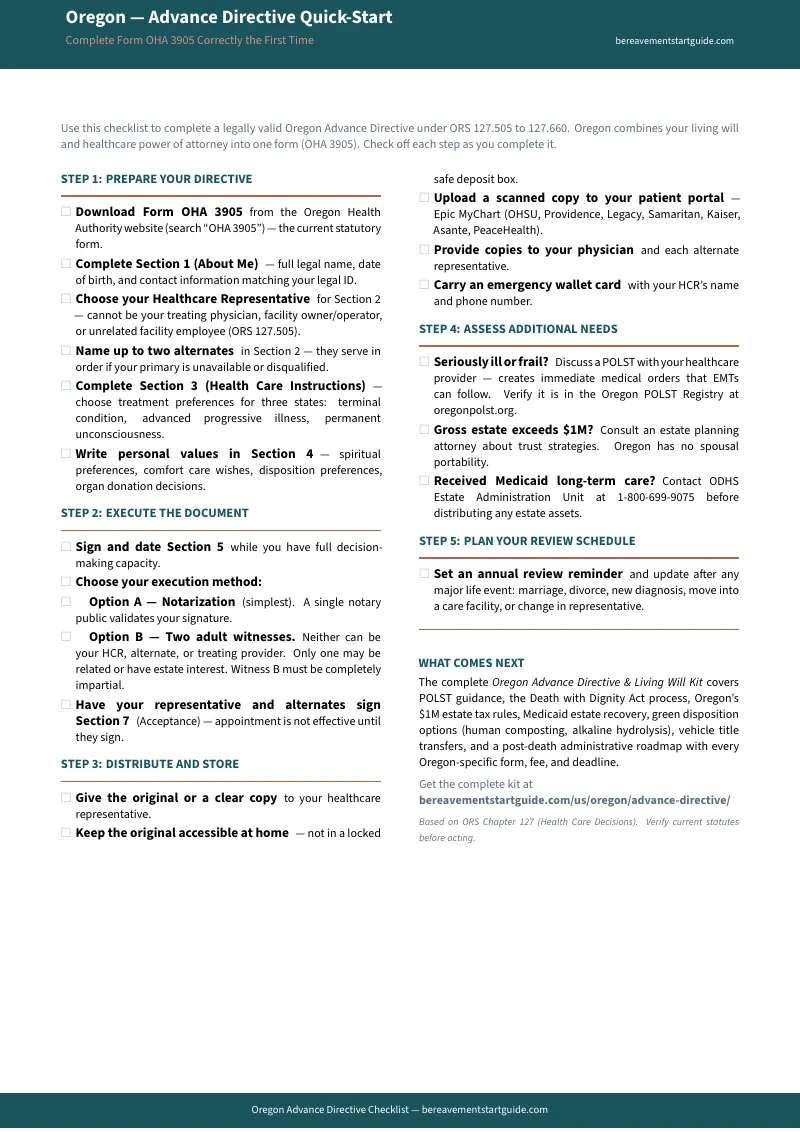
Not ready for the full kit? Download the free Oregon — Advance Directive Quick-Start — a one-page overview covering the key steps to get your advance directive started, the witness requirements, and the critical Section 7 activation step that most families miss.
Oregon gave you the right to control your own medical care. This kit makes sure that right actually works when your family needs it.