
Pennsylvania Taxes Every Inherited Dollar. Your Family Doesn't Have to Pay More Than Necessary.
Most states exempt small estates from inheritance tax. Pennsylvania doesn't. Your children owe 4.5% on the first dollar they inherit. Your siblings owe 12%. An unmarried partner or close friend? 15%. And if your surviving step-parent remarries after your biological parent dies, you lose the 4.5% rate entirely — reclassified to 15% overnight.
Meanwhile, Pennsylvania is one of the few states that still doesn't allow Transfer-on-Death deeds for real property. Your house goes through probate at the Register of Wills unless you structure around it. And your Power of Attorney? It needs a capitalized statutory notice, two witnesses, a notary (who can't be one of the witnesses), and a signed agent acknowledgment page — miss any one, and financial institutions can legally refuse it.
The Pennsylvania Basic Estate Planning Kit is the state-specific execution protocol that walks you through every requirement, form, and deadline — not generic templates that ignore the rules Pennsylvania actually enforces.
What's Inside the Kit
- Inheritance Tax Pre-Triage Workbook — Organize every asset by REV-1500 beneficiary class (0%, 4.5%, 12%, 15%) so your executor files accurately and claims the 5% early-payment discount within 90 days of death. Catches the one-year joint account rule that turns convenience accounts into fully taxable transfers.
- Will Execution Protocol — Pennsylvania requires the testator's signature at the physical end of the document; any text below the signature is legally void. The kit walks you through proper execution under 20 Pa.C.S. § 2502, self-proving affidavit attachment under § 3132.1, and the codicil process for updates.
- Power of Attorney Compliance Package — Includes the exact statutory notice that must appear in all capital letters, the agent acknowledgment page, and instructions for the two-witness-plus-notary ceremony required under Act 95. Gets accepted by banks the first time, not rejected on a technicality.
- Real Property Probate-Bypass Blueprint — Since House Bill 2124 (TOD deeds) was laid on the table in 2026, the kit covers your three legal alternatives: joint tenancy with right of survivorship (JTWROS), life estate deeds, and trust-based transfers — with the inheritance tax and control implications of each clearly compared.
- Medicaid Recovery Protection — Pennsylvania DHS can only recover long-term care costs from the probate estate. Assets in survivorship, trusts, or beneficiary designations are exempt. The kit covers the 5-year lookback period, the caregiver child exemption (two-year residency requirement), and the 45-day DHS claim window your executor must not miss.
- Blended Family Inheritance Planner — Addresses the remarriage stepchild tax trap, the spousal elective share (one-third forced share), intestacy gaps that leave stepchildren and unmarried partners with nothing, and testamentary trust structures that protect biological children while providing for a surviving spouse.
- Healthcare Directive & Living Will — Pennsylvania-specific advance directive covering medical decision authority, end-of-life preferences, organ donation wishes, and healthcare agent designation with proper execution requirements.
- Digital Assets Plan — RUFADAA-compliant instructions for cataloging online accounts and specifying fiduciary access, so your executor doesn't face locked accounts and lost assets.
Who This Kit Is Built For
- Homeowners who discovered Pennsylvania has no TOD deeds and need a real property strategy that actually works under state law
- Parents of minor children who need guardian nominations and testamentary trust protections — because intestacy leaves that decision to a judge
- Blended families facing the stepchild remarriage trap, the spousal elective share, and the gap between what they intend and what Pennsylvania law actually does
- Adult children of aging parents worried about Medicaid estate recovery claiming the family home — or about personal liability if they distribute assets before resolving state claims
- Anyone named as executor who wants to understand the inheritance tax filing timeline, the county Register of Wills process, and the Model Forms of Account before they're under the clock
- Out-of-state transplants whose existing estate plans were built for a different state's rules and may not survive Pennsylvania scrutiny
Why Not Just Use Free Resources?
State and county websites provide blank forms. The Pennsylvania Bar Association publishes general educational brochures. Neither gives you a cohesive execution sequence.
A Power of Attorney form without the statutory notice? Invalid. A will template without the signature-placement rule? Partially void. An asset inventory that doesn't distinguish probate from non-probate assets for inheritance tax and Medicaid purposes? Worse than useless — it creates a false sense of security.
National legal tech platforms (LegalZoom, Trust & Will) generate documents, but their templates don't address the stepchild remarriage tax reclassification, county-level Orphans' Court variation, or the strict Model Forms of Account your executor may need to file. They charge $149–$499 for documents that may not comply with Pennsylvania-specific requirements.
This kit combines the forms, the execution instructions, the compliance checklists, and the state-specific strategy in one coordinated package — for .
100% Satisfaction Guarantee
If the kit doesn't help you organize your Pennsylvania estate plan, email us for a full refund. No forms to fill out, no waiting period.
Start Protecting Your Family Today
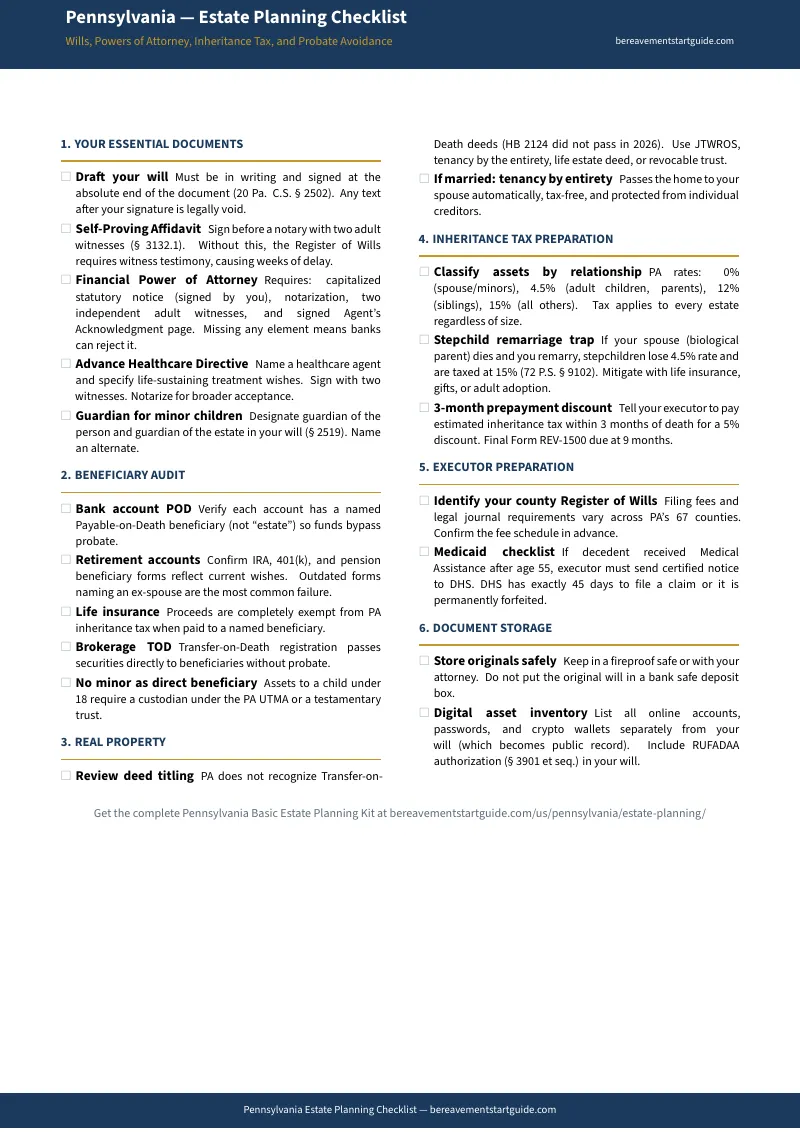
Download the free Pennsylvania Estate Planning Checklist to see exactly what a complete plan requires. When you're ready for the step-by-step execution protocol, the full kit is waiting.