Your Parent Is in the Hospital. The Bank Says No.
Your mother fell last Tuesday. She's in the ICU, sedated, and her mortgage payment is due in six days. You call her bank with the power of attorney she signed three years ago — and they refuse it. The form is missing the Act 95 statutory notice page. It predates the 2014 amendments. It doesn't include the Agent's Acknowledgment that Pennsylvania now requires before you can exercise any authority.
You're not locked out because the document is fraudulent. You're locked out because it was drafted wrong. And now the only path to accessing her accounts is an Orphans' Court guardianship petition — public, expensive, and weeks away from a hearing date.
This is the most common power of attorney failure in Pennsylvania, and it's entirely preventable.
The Pennsylvania POA Compliance System
The Pennsylvania Power of Attorney Kit is not another blank template that leaves you guessing about execution rules. It's a step-by-step system that covers every decision, signing requirement, and bank-acceptance tactic specific to Pennsylvania law — from choosing the right agent to invoking the state's mandatory 7-business-day compliance window when a financial institution refuses your documents.
The kit covers both financial and healthcare authority: durable financial POA execution under Act 95 of 2014, healthcare directive integration, "hot powers" for inheritance tax planning, bank acceptance enforcement under 20 Pa. C.S. Section 5608.1, real estate recording procedures, Medicaid asset-shielding strategies, and the guardianship-avoidance roadmap that explains exactly what happens if you lose capacity without a valid POA in place.
What You Get
- Complete Power of Attorney Guide — 15 chapters covering Pennsylvania POA execution (Act 95 requirements), the hot powers that enable inheritance tax planning, bank acceptance enforcement, healthcare directive integration, real estate recording, Medicaid planning, vehicle title transfers, revocation procedures, and the critical differences between POA and Orphans' Court guardianship. Every chapter includes Pennsylvania statute citations so you can verify everything yourself.
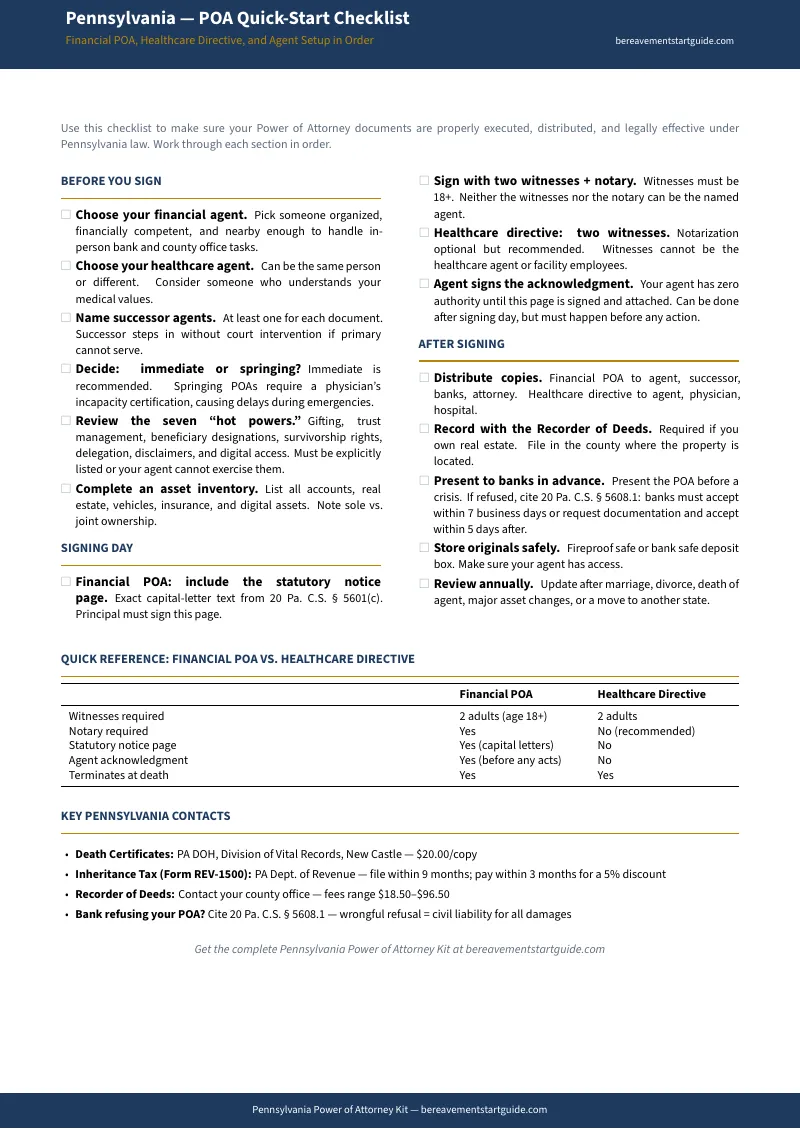
- Quick-Start Checklist — 18 action items across 5 sections: document preparation, execution and signing, financial institution notification, healthcare directive coordination, and distribution. Check off each item as you complete it.
- 5 Standalone Printable Worksheets:
- Agent Selection Scorecard — Compare candidate agents across trustworthiness, availability, financial literacy, geographic proximity, and willingness to serve
- Asset Inventory for POA Planning — Map every bank account, retirement account, insurance policy, real estate parcel, and vehicle to determine which assets require agent authority
- Hot Powers Decision Checklist — Walk through each special power (gift-giving, trust creation, beneficiary changes, asset transfers) and decide which ones to grant based on your tax and estate planning goals
- Document Distribution Tracker — Record where you delivered copies: banks, brokerages, insurance companies, healthcare providers, Recorder of Deeds, family members
- Inheritance Tax Estimator — Calculate the potential tax exposure for each beneficiary class (4.5% children, 12% siblings, 15% others) and identify which transfers your agent should prioritize
Who This Is Built For
- Adult children managing aging parents who need immediate authority over individually owned retirement accounts, insurance policies, and bank accounts — and who just learned that marriage and family ties grant zero automatic access in Pennsylvania
- Retirees planning their estates who want to properly execute their own POA without paying $500 to $1,500 in attorney fees — especially those with non-spouse heirs who face 4.5% to 15% inheritance tax on every dollar they inherit
- Real estate buyers and sellers who cannot attend a closing in person and need a POA that will survive title company scrutiny and county Recorder of Deeds filing requirements
- Families concerned about financial abuse who want built-in co-agent oversight, transparency clauses requiring the agent to provide bank statements to other relatives, and clear instructions for Orphans' Court remedies
- Anyone whose existing POA was rejected by a bank, brokerage, or title company because it predates Act 95 or is missing the mandatory statutory notice and Agent's Acknowledgment pages
Why Not Just Download a Free Template?
Free Pennsylvania POA templates are everywhere — and most of them are invalid. Generic forms pulled from legal template sites frequently omit the Act 95 statutory notice page (which must appear in exact capital-letter format), skip the mandatory Agent's Acknowledgment, or use pre-2014 language that banks are trained to reject. Government agency forms like the PSERS pension form (F248) or the Revenue Department's REV-677 are narrowly scoped to a single institution — they don't function as general durable financial powers of attorney.
A free template gives you a blank form. The kit gives you the execution framework, witness eligibility rules, bank acceptance enforcement tools, and tax planning worksheets that make the document actually work when your family needs it.
Why Not LegalZoom or an Estate Attorney?
LegalZoom charges $39 to $49 for basic documents and then upsells a monthly attorney-consultation subscription. Nolo bundles their POA inside a $99 to $139 software suite, forcing you to buy an entire estate planning package for a single document. Local Pennsylvania elder-law attorneys charge $500 to $1,500 for a standard POA engagement — with office visits and scheduling delays that can stretch weeks.
The kit doesn't replace an attorney for complex multi-state estates or irrevocable trust structures — and it tells you exactly when professional counsel is necessary. But for the vast majority of Pennsylvania families who need compliant, enforceable documents with clear execution instructions, the kit provides immediate protection at a fraction of professional fees.
And if you do hire an attorney later, the asset inventory, hot powers checklist, and agent selection scorecard you've already completed become your intake package — saving hours of billable consultation time.
— Less Than One Hour of Attorney Time
Pennsylvania elder-law attorneys charge $250 to $500 per hour. A basic POA review appointment starts at $200 before the attorney drafts a single word. The kit gives you the same foundational framework — Act 95 execution, hot powers planning, bank acceptance tools, and healthcare directive integration — for less than the cost of walking through the door.
30-Day Money-Back Guarantee
Download the kit, review the guide and worksheets. If the plain-English instructions don't clarify the exact steps needed to execute a valid Pennsylvania power of attorney and enforce bank acceptance — or if you decide to hire a local elder-law attorney for a custom engagement instead — email us within 30 days for an immediate, full refund.
Important notice: Bereavement Start Guide is a publisher of educational resources. This kit assists individuals in understanding Pennsylvania's power of attorney statutes and organizing their estate planning decisions. It does not provide personalized legal, financial, or tax advice, does not act as a law firm, and does not establish an attorney-client relationship. For complex assets, multi-state property, or custom trust structures, consultation with a licensed Pennsylvania attorney is recommended.