Your Family Has No Legal Authority. Rhode Island Made Sure of That.
In 46 states, if you lose the ability to make your own medical decisions, your spouse, adult children, or parents can step in automatically. State law creates a default hierarchy that gives family members the legal authority to direct your care without going to court.
Rhode Island is not one of those states.
Rhode Island is one of only four states — alongside Massachusetts, Minnesota, and Missouri — with no default family surrogate consent law. If you are incapacitated without a valid Durable Power of Attorney for Healthcare on file, your spouse of forty years has no more legal authority over your medical care than a stranger. Your adult daughter cannot authorize surgery. Your son cannot refuse a treatment you would never have wanted. The hospital's risk management team will refuse to follow family instructions because no Rhode Island statute shields them from liability.
The only alternative is a court-appointed guardianship — filed in one of Rhode Island's 39 municipal probate courts, costing $5,000 to $15,000 in legal fees, taking weeks or months, and stripping your fundamental rights in a public proceeding.
The Rhode Island Advance Directive & Living Will Kit is a Surrogate Gap Closure System — the step-by-step operational guide that walks you through Rhode Island's two-document framework, the distinct signing rules for each, and every coordination step with MOLST and COMFORT ONE. You close the gap before the crisis, for a fraction of a single attorney consultation.
— Less Than 15 Minutes with an Attorney
A comprehensive estate plan with advance directives from a Rhode Island elder law attorney runs $1,500 to $5,000+. A standalone directive engagement costs $150–$400 and takes weeks to schedule. Neither typically covers the MOLST ordering process, the COMFORT ONE bracelet program, or the artificial nutrition opt-in trap.
The kit covers everything the attorney would — and several things most attorneys don't walk through — for a one-time fee that's a fraction of a single billable quarter-hour.
What the Kit Covers
- The Two-Document Framework — Rhode Island doesn't use a single advance directive form. You need two separate instruments under two different chapters of the General Laws: the Durable Power of Attorney for Healthcare (R.I. Gen. Laws § 23-4.10-2) and the Living Will Declaration (§ 23-4.11-3). The kit walks through both — their distinct purposes, different activation triggers, and the separate execution rules that trip up most families
- The Surrogate Consent Gap Explained — why Rhode Island families face a unique legal vulnerability. In 46 other states, your family has automatic authority. Here, without a DPOAH, the only path is court-appointed guardianship. The kit explains what this means for your planning decisions and why the DPOAH is the single most important document you can complete
- Agent Selection and Briefing Protocol — who is legally barred from serving as your healthcare agent: your treating physician, healthcare facility employees, nursing home operators, and their staff. The difference between the DPOAH's broad medical authority and the Living Will's narrow end-of-life instructions. A structured conversation guide covering core values, specific interventions, and HIPAA authorization
- The Artificial Nutrition and Hydration Opt-In — Rhode Island's Living Will requires you to explicitly check a box authorizing the withholding of tube feeding and IV fluids. If you miss this box, medical providers are legally required to continue artificial feeding even if every other life-sustaining treatment has been withdrawn. The kit walks through this decision and explains why missing it can override your stated wishes
- Witness Eligibility Checklists (Both Documents) — the Living Will requires two witnesses with no notary alternative. The DPOAH allows two witnesses OR notarization. In both cases, witnesses cannot be related to you, cannot be your agent, and cannot be healthcare providers or facility employees. The kit includes a separate eligibility checklist for each document so you execute both correctly the first time
- MOLST — Medical Orders for Life-Sustaining Treatment — the clinical order form that converts your preferences into immediate, actionable medical orders. Paramedics follow MOLST, not your advance directives. The kit covers when MOLST is appropriate, the signing process with your physician, and how it coordinates with your existing documents
- COMFORT ONE — Rhode Island's Unique DNR Program — the statewide out-of-hospital Do Not Resuscitate program that uses a standardized bracelet and form. Hospital DNR orders stop at the facility door. COMFORT ONE extends protections to your home, nursing facility, and during ambulance transport. The kit covers qualifications, the ordering process, and coordination with MOLST and advance directives
- The Pregnancy Suspension — both the DPOAH and Living Will are automatically suspended under Rhode Island law if you are pregnant and the fetus could develop to live birth. This applies regardless of what the documents say. The kit explains this statutory override and planning considerations for women of childbearing age
- Cross-State Portability — Rhode Island recognizes out-of-state directives under its reciprocity statute, but an out-of-state form may not cover the artificial nutrition opt-in, the two-document structure, or the COMFORT ONE program. The kit explains the gaps for snowbirds and recent transplants
- Estate Planning Integration — Rhode Island has a $1.77M estate tax exemption (indexed) and an automatic statutory lien on all real property upon death — even for non-taxable estates. The kit explains how your healthcare directives connect to your financial power of attorney, the 39 municipal probate courts, and why coordinating these documents eliminates the gaps that lead to emergency guardianships
- Medicaid Estate Recovery — how Rhode Island's Medicaid long-term care recovery program interacts with advance directive planning, including critical timing issues around living will activation
- Organ Donation and Anatomical Gift — registration options including driver's license notation, how organ donation interacts with end-of-life treatment decisions, and the important distinction that donation preferences do not override your directive's treatment instructions
- Revocation Procedures — the specific methods for revoking each document (physical destruction, written revocation, oral revocation for the Living Will; written notice for the DPOAH), notification requirements, and what to do with distributed copies
- Special Situations — blended families, estranged family members, adults with disabilities, military families, skilled nursing facility residents, and the MAID (Medical Aid in Dying) legal landscape in Rhode Island
Who This Is For
- Adults helping aging parents who need both documents completed before a diagnosis closes the capacity window — and who need to understand why Rhode Island's missing surrogate law makes this more urgent than in most states
- People facing scheduled surgery who need a legally valid DPOAH and Living Will executed and distributed before a pre-op appointment at Rhode Island Hospital, Miriam Hospital, or any other facility
- Unmarried partners — without a DPOAH, no one in your household has automatic medical decision-making authority. Rhode Island's surrogate consent gap means a court-appointed guardian could be a stranger. The DPOAH is your only protection
- Family caregivers managing a parent's cognitive decline who need to complete both documents while the parent still has legal capacity — and understand the MOLST process for when the condition progresses
- Snowbirds splitting time between Rhode Island and Florida (or another state) who need to understand which documents control when and what gaps an out-of-state directive leaves
- People who downloaded a free form that doesn't distinguish between Rhode Island's two required documents, doesn't explain the different witness rules for each, and doesn't mention the artificial nutrition opt-in that can override their treatment wishes
Why Not Just Use a Free Form?
The form is not the problem. Knowing which form — and executing it correctly in Rhode Island's unique two-document, no-surrogate legal environment — is the problem.
- Generic advance directive templates treat the directive as a single document. Rhode Island requires two separate instruments with separate witness requirements. A template that doesn't distinguish between them leaves you partially covered
- National platforms (Five Wishes, LegalZoom, Trust & Will) produce competent multi-state forms. They don't cover Rhode Island's surrogate consent gap, the artificial nutrition opt-in trap, the Living Will's no-notary restriction, the COMFORT ONE bracelet program, or the automatic real estate lien. You're paying for a template with your state's name inserted
- Elder law attorneys are the most accurate option for complex situations — and cost $1,500–$5,000+ for a comprehensive plan. Not realistic when you need valid documents before a scheduled procedure
Free resources give you a blank form. The kit gives you the complete Rhode Island-specific execution system — a 16-chapter guide, 7 standalone printable worksheets and reference cards (witness eligibility checklist, agent selection worksheet, distribution tracker, revocation log, master planning worksheet, forms directory, and MOLST/COMFORT ONE reference), plus a 20-item quick-start checklist. 9 PDFs total.
100% Satisfaction Guarantee
If the kit doesn't give you the clear, actionable Rhode Island-specific guidance you need to complete your advance directives with confidence, email us for a full refund. No time limit, no questions.
Close the Surrogate Gap Today
Rhode Island will not let your family step in for you. The DPOAH is the only document that bridges that gap — and it only works if it's executed correctly under Rhode Island's specific rules.
Download the kit, print the checklist, and complete both documents in a single afternoon. Your family shouldn't have to petition a probate court to make medical decisions for you.
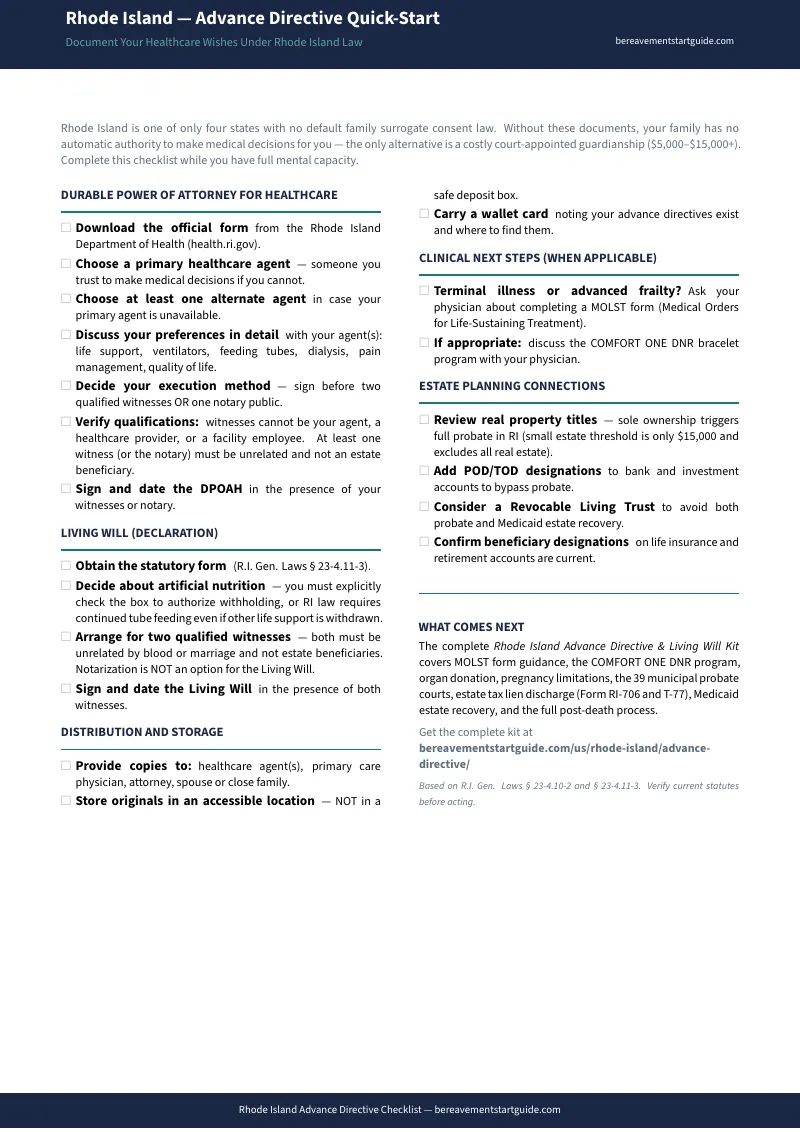
Not ready for the full kit? Download the free Rhode Island Advance Directive Quick-Start Checklist — a one-page reference covering every critical step, witness eligibility rules for both documents, and distribution targets. The full kit is there when you need the detailed instructions behind each step.