The State Gave You a Form. It Didn't Tell You How to Make It Work.
South Dakota's Living Will Declaration form is available free from the Department of Health. It's a clean one-page document — and it leaves out almost everything that matters.
It doesn't explain that EMS first responders are legally required to perform CPR unless they see a Comfort One form or state-issued bracelet on your wrist. It doesn't mention that South Dakota has no standardized DPOA-HC form — so you're on your own choosing one that hospitals will actually accept. It doesn't warn you that under SDCL 43-46-1, Medicaid can reach your family farm through a surviving joint owner's liability even though South Dakota is a "probate-only" recovery state. And it says nothing about how to disqualify a specific family member from the default medical decision-making hierarchy before a crisis turns a disagreement into a circuit court petition.
The South Dakota Advance Directive & Living Will Kit is a Prairie Compliance System — it takes you from blank forms to legally valid, properly witnessed, hospital-filed directives that work for ranching families, trust settlors, and everyone navigating South Dakota's unique combination of rural geography, dynasty trust law, and agricultural estate complexity. No attorney. No subscription. No second attempt because a witness was disqualified.
— Less Than 20 Minutes with an Elder Law Attorney
South Dakota elder law firms charge $500–$1,500 for an advance directive package. National platforms like LawDepot and FormSwift charge recurring monthly subscriptions ($39–$49/month) for generic templates that don't address Comfort One coordination, the MOST form under SDCL 34-12H, or the joint tenancy trap that catches most farm families. Court clerks can't give legal advice. Hospital intake forms cover admissions, not estate recovery.
The kit covers everything a local attorney would — and several things most attorneys skip — for a one-time fee that's a fraction of a single consultation.
What the Kit Covers
- Complete DPOA-HC and Living Will Execution System — South Dakota's two-document framework (SDCL 59-7-2.1 for healthcare agent designation + SDCL 34-12D for treatment instructions) explained in plain English, with the different witness and notarization requirements for each document so you never confuse which rules apply to which form
- Healthcare Agent Selection and Authority Guide — who is legally eligible, the difference between immediate and springing authority under SDCL 59-12-8, how to structure successor agents, and a conversation framework covering values, interventions, feeding decisions, and comfort care boundaries
- Witness Eligibility Checklist — every disqualification rule laid out as a print-and-bring reference. Witnesses cannot be the healthcare agent, a healthcare provider, a relative, a creditor, or an heir. Includes remote electronic witnessing under SDCL 18-8-4 for rural residents who can't easily find local witnesses
- Comfort One and MOST Coordination Guide — how the legal planning documents (DPOA-HC and Living Will) work alongside the clinical medical orders (Comfort One out-of-hospital DNR under SDCL 34-12F and MOST under SDCL 34-12H) that first responders actually follow. When you need both, how to request them, and how to ensure they don't contradict each other
- Default Surrogate Hierarchy and Family Disqualification — the full statutory priority list under SDCL 34-12C-3, what happens when same-class family members disagree (deadlock under SDCL 34-12C-4 forcing circuit court intervention), and exactly how to document a preemptive disqualification to prevent an estranged relative from making your medical decisions
- Medicaid Estate Recovery Defense — South Dakota's "probate-only" recovery under SDCL 28-6-23, the joint tenancy trap under SDCL 43-46-1 that catches most farm families, the six-month surviving spouse petition, the undue hardship waiver for income-producing farms and ranches, and the small estates affidavit threshold
- Farm and Ranch Succession Considerations — how agricultural operations with seasonal decision-making urgency, equipment financing, leased grazing allotments, and multi-generational land create unique advance directive planning needs that generic forms ignore entirely
- Organ Donation Documentation — how to integrate donation preferences within the advance directive framework under SDCL 34-26-52, the specific execution requirements for electronic donations, and coordination with the South Dakota Lions Eye Bank and LifeServe Donor Services
- Document Storage and Distribution System — why the original should never go in a safe deposit box, how to distribute copies to your agent, primary physician, and hospital systems (Avera Health, Monument Health, Sanford Health), and a tracking sheet for every copy
- Medical Aid in Dying Legal Clarity — MAID is not legal in South Dakota, but patients retain the absolute right to refuse or withdraw life-sustaining treatment under SDCL 34-12D and request intensive palliative care. The kit explains the legal boundaries and available alternatives
- Review, Update, and Revocation System — when to update (the 5 Ds: Death, Divorce, Diagnosis, Decline, Decade), the three statutory revocation methods under SDCL 34-12D-18 including oral revocation directly to a healthcare provider, and the reminder schedule
Who This Is For
- Ranching and farming families who need the operation to keep running if the principal operator is hospitalized — with healthcare authority and farm decision-making covered before harvest season, not after an accident in a remote pasture
- Adult children managing an aging parent's care who need to get a DPOA-HC and Living Will completed before cognitive decline closes the window — and before the default surrogate hierarchy creates a deadlock between siblings
- Dynasty trust settlors and nonresident property owners who chose South Dakota for its trust advantages and now need a South Dakota-compliant advance directive to prevent a medical emergency from exposing trust-held assets to local probate court disputes
- Seniors on fixed income who understand the necessity of end-of-life planning but need an affordable alternative to $500–$1,500 attorney fees — without the confusion of filling out blank government forms alone
- Anyone who downloaded the free statutory forms and got stuck on the witnessing requirements, the difference between the Living Will and the DPOA-HC, or what to do about Comfort One and MOST coordination
- Families concerned about Medicaid estate recovery who want to understand how joint tenancy, the surviving spouse petition, and the undue hardship waiver interact before a long-term care situation exposes the family farm
Why Not Just Use the Free Forms?
The statutory forms from the Department of Health and regional hospital networks are technically valid. But they ship with zero execution guidance. No witness eligibility rules. No Comfort One coordination. No explanation of why EMS can't follow your Living Will at home. No Medicaid estate recovery context. No family disqualification instructions. No farm succession considerations.
National platforms charge recurring monthly subscriptions for generic multi-state templates that don't cover South Dakota's Comfort One program, the MOST form, the joint tenancy liability trap, the remote electronic witnessing option, or the unique rural challenges of executing directives in counties with no local notary. They give you a form. The kit gives you the execution system that makes the form legally valid and hospital-ready.
The Guarantee
If your physician, hospital, nursing facility, or notary public rejects the instructions in this kit for any compliance reason, email us for an immediate, no-questions-asked refund.
Start Today
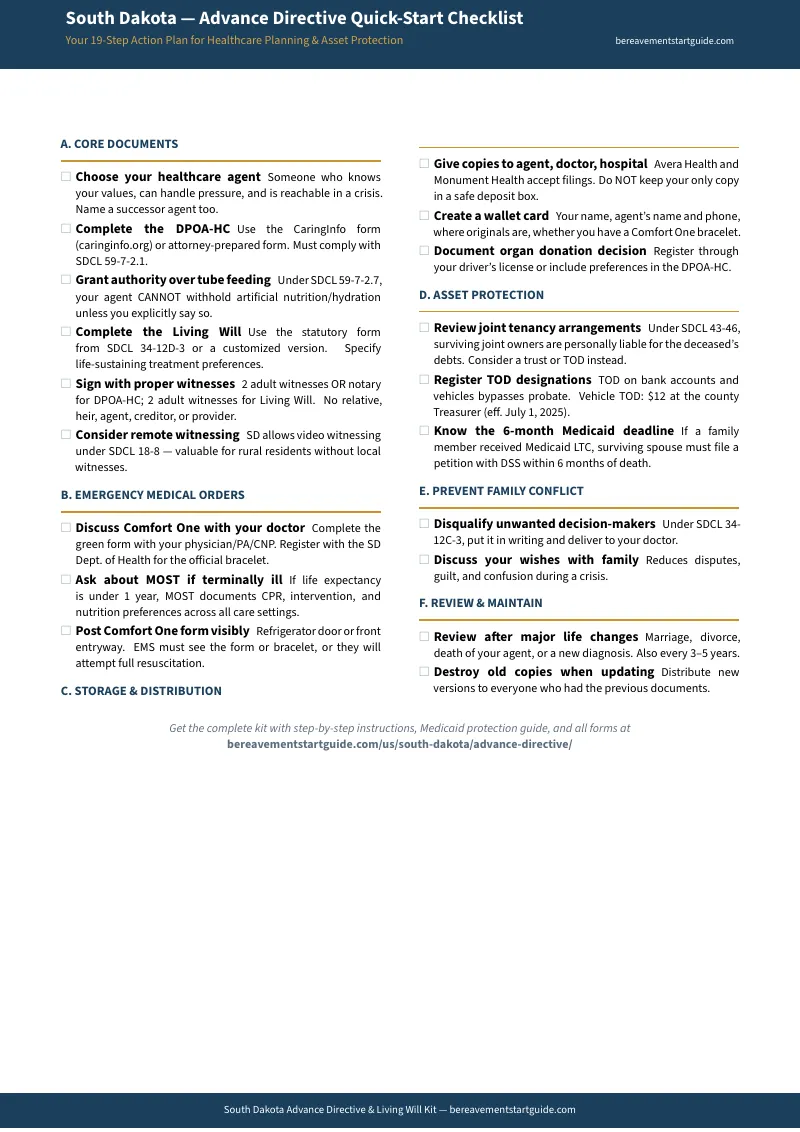
Download the free South Dakota Advance Directive Quick-Start Checklist to see every step at a glance — from healthcare agent selection through hospital filing. When you're ready for the full execution system — the 12-chapter guide, 10 standalone printable references (witness eligibility checklist, agent selection guide, Comfort One coordination, Medicaid recovery defense, family disqualification guide, farm and ranch reference, execution requirements, contacts directory, document distribution tracker, and post-death administration reference), plus the quick-start checklist — the complete kit is available for .
Disclaimer: Bereavement Start Guide is a publisher of self-help educational templates and resource guides. The materials in this kit are designed to comply with South Dakota Codified Law but do not constitute legal or medical advice. For complex estate planning, contested family dynamics, or specific medical instructions, consult a licensed South Dakota attorney or healthcare provider.