Your Father's Bank Just Refused His Power of Attorney. The Agent Says the Document Is "Stale." The Form You Downloaded Omits Every "Hot Power" Tennessee Law Requires. And Without Those Three Missing Clauses, Your Family Is One Diagnosis Away from a $5,000 Court Conservatorship.
Your mother had a stroke last Tuesday. She can still recognize you, still nod when you explain what needs to happen, but the neurologist says the window for signing legal documents is weeks, not months. You found a free power of attorney template online, printed it, and drove it to her bank. The teller looked at it for ninety seconds and handed it back. "We can't accept this." No durability clause — so it dies the moment your mother becomes incapacitated, which is the entire reason you need it. No notarization — so it cannot be recorded with the county Register of Deeds if you need to sell her house. And no mention of the nine "hot powers" that Tennessee law excludes from every general grant of authority — meaning your mother's agent cannot make a single gift, change a single beneficiary designation, or do a single dollar of TennCare spend-down planning, even with "full authority" checked on the form.
You called an elder law attorney in Nashville. The consultation fee is $300. A basic POA package runs $500 to $1,000. A trust-centered estate plan starts at $3,500. And your mother's capacity is on a clock that does not pause for scheduling delays.
The Tennessee Power of Attorney Kit is a Statutory Compliance System built entirely around the Tennessee Uniform Power of Attorney Act (T.C.A. Title 34, Chapter 6) and the Tennessee Health Care Decisions Act (T.C.A. Title 68, Chapter 11, Part 18) — mapping every statutory power, every execution requirement, every institutional acceptance procedure, and every asset protection strategy into one step-by-step sequence. It diagnoses which of the 22 statutory powers and 9 restricted "hot powers" your agent actually needs, walks you through the exact notarization and witnessing formalities that make your documents legally enforceable, and includes a bank pre-acceptance checklist so your financial institutions recognize the document before a crisis forces your family into a courtroom.
What's Inside the Statutory Compliance System
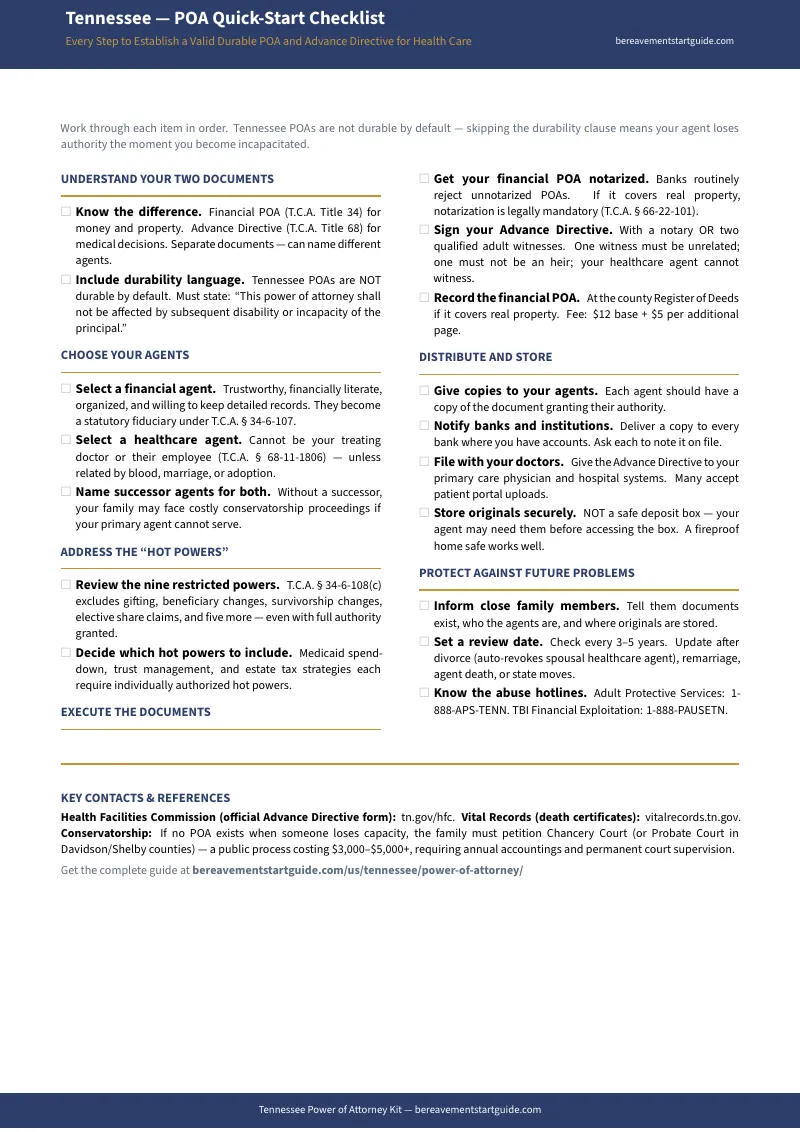
A 15-chapter guide, an 18-item printable action checklist, and 8 standalone worksheets and reference sheets (10 PDFs total) — covering every POA type, healthcare directive, execution formality, and institutional acceptance procedure under Tennessee law:
Chapters 1-3: Tennessee POA Fundamentals and the Durability Trap
Why Tennessee POAs are not durable by default — and why that single missing clause is the #1 reason families end up in conservatorship court. The execution requirements: written document, competent principal, explicit durability language under T.C.A. § 34-6-102. The 22 statutory powers you can incorporate by reference under § 34-6-108 — and the 9 restricted "hot powers" under § 34-6-108(c) that are completely excluded from every general grant, including gifting, trust amendments, beneficiary changes, and waiving the spousal elective share. Immediate vs. springing powers — why springing POAs create dangerous delays when banks demand medical certifications before releasing a single dollar.
Chapters 4-6: Healthcare Directives and Choosing Your Agent
The Tennessee Advance Care Plan — the state's unified model form that combines the healthcare agent appointment and living will into one document. Execution requirements: notarized OR signed by two qualified witnesses with strict disqualification rules. Who cannot serve as healthcare agent. The surrogate decision-maker hierarchy when no advance directive exists. How to choose agents who can handle both the emotional weight and the meticulous record-keeping that Tennessee's fiduciary duty statute requires under § 34-6-107.
Chapters 7-9: Bank Acceptance, Real Estate, and Revocation
Why Tennessee banks reject valid POAs — and the two statutory remedies that force acceptance: § 34-6-109(20) authorizes your agent to execute any bank-specific forms on your behalf, and § 34-6-109(17) gives the agent standing to pursue a mandatory injunction with the bank liable for attorney fees. Real estate recording requirements under § 66-22-101 — notarization is mandatory, and the original must be filed with the county Register of Deeds. How to properly revoke a POA and why recorded revocations must be filed in the same county as the original.
Chapters 10-13: Post-Death Settlement, Asset Protection, and TennCare Planning
What happens when the principal dies — automatic termination, good faith protection, and the transition to the executor or administrator. Tennessee's probate venue quirks: only Davidson and Shelby counties have dedicated Probate Courts; the other 93 counties route through Chancery Court. The $50,000 small estate affidavit limit — and why it excludes real estate entirely. Tennessee Investment Services Trusts (TISTs) for self-settled asset protection. TennCare estate recovery: how to move assets out of the probate estate using joint titles, POD designations, and irrevocable trusts so the family home is shielded from nursing care cost recovery. The spousal elective share (10-40% based on marriage duration) and the year's support allowance.
Chapters 14-15: Forms Directory, Resources, and Step-by-Step Execution
The official Tennessee Advance Care Plan form location, key state contacts, when professional help is genuinely necessary, and the complete before-signing-day-after-signing execution sequence — so nothing is missed and no formality is skipped.
Who This Kit Is For
- The caregiver child whose parent is declining. Your father can still understand what he is signing, but the neurologist says the cognitive window is closing. You need documents executed correctly on the first attempt because a second chance may not exist. Once capacity is permanently lost, the only path is a court-appointed conservatorship — public, expensive, and invasive.
- The proactive couple planning before a crisis. You own a home in Knox County, have retirement accounts at a local bank, and want your spouse to manage everything seamlessly if something happens. You compared the $500+ attorney fee against doing it yourself and want to know whether a self-executed POA provides the same legal protection. It does — if the durability clause, hot powers, and notarization are all handled correctly.
- The family protecting assets from TennCare recovery. Your parent may need nursing home care within the next five years. You need a POA that explicitly grants gifting authority under § 34-6-110 and the hot powers under § 34-6-108(c) so the agent can restructure asset titles, establish POD designations, and move property out of the probate estate before death — legally shielding the family home from TennCare estate recovery.
- The real estate closer who cannot attend. The closing is next Thursday. Your spouse is deployed, traveling, or hospitalized. The title company needs an original, notarized POA with express real estate authority, recorded with the Register of Deeds in the county where the property sits. A generic online template will not survive the title company's review.
- The new Tennessee resident updating out-of-state documents. You moved from another state and your existing POA may not align with Tennessee's statutory framework — different terminology, different execution requirements, different hot power restrictions. Tennessee does not require you to re-execute, but banks and hospitals strongly prefer documents drafted under local law.
Why Generic POA Templates Fail in Tennessee
Every document in this kit is drafted under the Tennessee Uniform Power of Attorney Act. Here is why that matters — and why the free forms from national websites do not survive first contact with a Tennessee bank, title company, or hospital:
- No durability clause means the document self-destructs at the worst possible moment. Under T.C.A. § 34-6-102, a Tennessee POA is not durable by default. Without explicit durability language, the agent's authority terminates the instant the principal becomes incapacitated — which is precisely when families need the document most. Generic templates from national sites frequently omit this clause because other states handle durability differently.
- Missing hot powers mean zero authority for the actions that actually matter. Under T.C.A. § 34-6-108(c), nine critical powers are completely excluded from the general statutory grant — even if you check every box on a template. Gifting, trust creation, beneficiary changes, and spousal elective share claims must each be individually and explicitly authorized. A form that says "I grant my agent full authority" gives the agent zero power for TennCare planning, trust management, or estate coordination.
- No notarization means no bank acceptance and no real estate recording. While Tennessee law does not technically require notarization for basic validity between principal and agent, every major bank and financial institution refuses unnotarized POAs as a fraud-prevention measure. And any POA used for real property must be notarized to be recorded with the county Register of Deeds under § 66-22-101. An unnotarized document is legally valid but practically useless.
- No guide covers Tennessee's 95-county venue split. Only two Tennessee counties (Davidson and Shelby) have dedicated Probate Courts. The other 93 route probate through Chancery Court, each with its own Clerk and Master, local filing rules, and fee schedules. Generic guides written for states with unified court systems do not prepare you for this.
- Attorney websites explain the problem. They withhold the solution. Nashville and Memphis elder law firms publish detailed articles about POA complexity — agent duties, hot powers, bank rejection. The content is accurate. It is also deliberately incomplete — designed to funnel you toward a $500 consultation, not to empower you to handle it yourself. For the vast majority of Tennessee families executing a standard durable financial and healthcare POA, an attorney is not required — if the statutory requirements are followed precisely.
Free resources give you one form at a time — a financial POA from one source, a healthcare directive from another — with no sequencing, no cross-referencing, and no way to verify that your execution formalities satisfy both statutes simultaneously. The Statutory Compliance System maps every power, every execution requirement, and every institutional acceptance procedure into one integrated sequence — so your documents survive their first encounter with a Tennessee bank teller, hospital administrator, or Register of Deeds.
— Less Than One Hour of an Elder Law Attorney's Time
A Tennessee elder law attorney charges $500 or more for a basic POA package — $3,500+ for a comprehensive estate plan. You are not paying for magic words on a page. You are paying for their hourly office overhead. The Statutory Compliance System delivers the same structural code compliance — T.C.A. § 34-6 powers, hot power authorizations, execution checklists, bank acceptance procedures, TennCare asset protection strategies — at a fraction of the cost. One-time purchase. Instant download. No subscription. No recurring fees.
If the kit does not meet your expectations, email [email protected] and we will make it right.
Get Started Today
Download the free Tennessee POA Quick-Start Checklist to see the 18 items you need to address — then decide whether the full kit is right for your family. The checklist covers what to do. The full kit covers how — with chapter-by-chapter instructions, execution checklists, and the bank pre-acceptance strategy that eliminates institutional rejection before a crisis forces your hand.