
Your Estate Plan Has a New York Problem
You know you need a will. You probably know you should have a power of attorney. But in New York, knowing you need these documents and actually getting them right are two very different things.
A power of attorney that doesn't have two disinterested witnesses? Banks will reject it — and they're legally allowed to. A will signed by one witness instead of two? The Surrogate's Court will throw it out. A co-op apartment without a coordinated transfer plan? Your family could lose it to a forced below-market sale while probate drags on for months.
New York's estate planning laws are among the most formalistic in the country. And the consequences of getting them wrong aren't theoretical — they're measured in frozen bank accounts, rejected documents, and families scrambling for an emergency attorney at the worst possible time.
The New York Estate Planning Blueprint
The New York Basic Estate Planning Kit is a complete, self-directed system built specifically around New York's current statutes — including the 2021 Power of Attorney overhaul, the 2024 Transfer on Death Deed law, and the 2026 estate tax exemption threshold.
This is not a bundle of generic forms with "New York" pasted on top. Every checklist, every execution instruction, and every coordination strategy is designed for the specific rules that apply in this state — from the GOL § 5-1513 POA requirements to the SCPA 2402 probate filing fee schedule to the co-op board approval process that trips up families across the five boroughs.
What's Inside — 12 PDFs
- Complete 13-Chapter Guide — asset inventory, wills, POA, health care proxy, real property transfers, co-op strategies, beneficiary designations, Medicaid recovery, estate tax, digital assets, special situations, death certificates, probate, and professional escalation triggers.
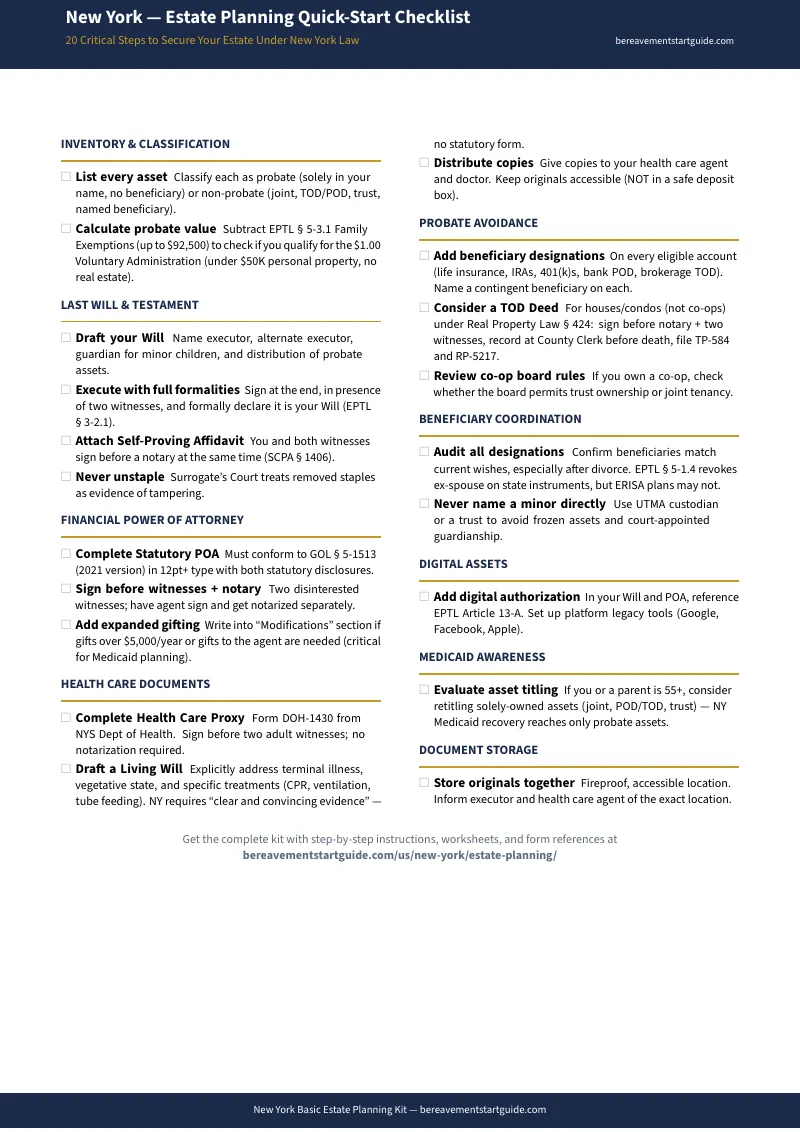
- Printable Quick-Start Checklist — 20 action items across 9 sections to track your progress from start to finish.
- Asset Inventory Worksheet — classify every asset as probate or non-probate, with the SCPA § 2402 fee schedule so you know exactly what your family's court costs would be.
- Will Execution Checklist — exact EPTL § 3-2.1 signing-day requirements, including the two-witness/30-day rule, self-proving affidavit, and the "publish" step that trips up most people.
- POA Execution Checklist — the 2021 GOL § 5-1513 requirements: substantial conformity standard, $5,000 gifting threshold, two-witness plus notary execution, and the 10-business-day bank acceptance rule.
- Advance Directive Checklist — Health Care Proxy (Form DOH-1430) plus Living Will drafting guidance to meet the "clear and convincing evidence" standard from In re Westchester County Medical Center.
- Beneficiary Audit Worksheet — account-by-account coordination check covering bank accounts, retirement, life insurance, real property, co-op shares, and digital assets. Catches the conflicts that override your will.
- Medicaid Recovery Protection Reference — New York's probate-only MERP framework, caregiver child and sibling exemptions, lookback periods, and planning strategies including MAPTs and Spousal Refusal.
- Estate Tax Cliff Reference — the 2026 $7.35M exemption, the 105% cliff rule, no-portability warning, three-year gift clawback, and the "Santa Clause" charitable bequest strategy.
- Digital Asset Planning Checklist — EPTL Article 13-A account-by-account planning with platform legacy tool setup (Google, Facebook, Apple) and cryptocurrency key documentation.
- Probate Process Guide — the 6-step Surrogate's Court process for executors: petition filing, distributee notification, letters and marshaling, 7-month creditor period, estate tax, and closing.
- Forms & Resources Reference — every form number, agency contact, and URL in one printable sheet: planning documents, court forms, tax forms, vital records, and vehicle transfer.
Who This Kit Is For
- New York residents creating their first estate plan and wanting to get it right under state-specific rules
- Families updating documents drafted before the 2021 POA reform or the 2024 TOD Deed law
- Co-op owners in NYC who need to protect their apartment from probate-related forced sales
- Adult children helping aging parents coordinate incapacity documents and Medicaid recovery protection
- Transplants from community property states (California, Texas, Washington) who need to understand how New York's separate property rules affect their existing plans
- Anyone whose taxable estate falls below $7.35 million — roughly 95% of New York households
Why Free Government Forms Aren't Enough
You can download a blank Health Care Proxy from ag.ny.gov. You can pull a POA template from nycourts.gov. But those sites give you isolated, uncoordinated PDFs — they do not explain execution requirements, they do not warn you about coordination conflicts between your will and your beneficiary designations, and they do not address the co-op transfer process that affects most downstate homeowners.
The difference between having forms and having a plan is the difference between a stack of papers in a drawer and documents that actually work when your family needs them. This kit bridges that gap — every step is sequenced, every execution requirement is spelled out, and every common coordination mistake is flagged before you make it.
Satisfaction Guarantee
If the kit doesn't give you a clear, actionable path to securing your estate plan under New York law, email us and we'll make it right. No complicated process, no hoops.
— Less Than One Hour of Attorney Time
New York estate planning attorneys charge an average of $370 per hour. The full kit costs less than a single billable hour and gives you the same operational framework — asset classification, document execution, coordination checklists — that a basic engagement would cover. Start with the free checklist to see the action items, then get the full kit for the detailed instructions, legal context, and step-by-step execution guidance behind each one.