Your Out-of-State Will Probably Doesn't Work in Texas. Your Family Will Find Out the Hard Way.
You moved to Texas. You bought a house. You updated your driver's license. But your estate plan still thinks you live in a common-law property state — where whoever's name is on the title owns the asset. Texas doesn't work that way. In Texas, everything acquired during your marriage is community property, owned 50/50 by both spouses regardless of whose name appears on the deed or account. Your existing will, trust, and beneficiary designations were designed around a legal framework that no longer applies to you.
If you're in a blended family, the stakes are higher. Under Texas intestacy law, if you die without a will and have children from a prior relationship, your surviving spouse does not inherit your half of community property. It goes entirely to those children — creating involuntary co-ownership between your spouse and your kids from a previous marriage. Your spouse can't sell the house, refinance the mortgage, or access the bank accounts without their consent. Your children can't evict your spouse from the homestead. Everyone is stuck.
Attorneys in Houston, Dallas, and Austin charge $500 to $2,500 for a basic estate plan. Elder law firms bill $300 to $900 per hour. The free statutory will forms on TexasLawHelp.org are valid — but they are rigid templates that do not coordinate with your bank accounts, real estate deeds, or retirement beneficiary designations. If you make a single handwritten correction on a signed statutory form, the entire will is voided under Texas law.
The Texas Estate Coordination System
This kit consolidates every Texas-specific estate planning decision — community property characterization, will execution requirements, non-probate transfer mechanisms, medical directives, and guardian designations — into one plain-English manual with fillable worksheets. It is not a form generator. It is a coordination system: the guide walks you through each document, explains the Texas-specific rules that make it different from every other state, and the worksheets ensure your will, deeds, beneficiary designations, and powers of attorney all point in the same direction.
The result: your largest assets bypass probate entirely, your executor operates under Independent Administration with zero court oversight, and your family handles your estate in weeks instead of months — without hiring a lawyer for the routine work.
Independent Administration — the Texas Advantage Nobody Mentions
In most states, probating a will means monthly court hearings, judicial approval for every transaction, and executor bond premiums. Texas is different. If your will includes the correct statutory language, your executor operates under Independent Administration — free to sell property, pay debts, distribute assets, and close accounts without asking a judge for permission. This mechanism gives your family the administrative freedom of a revocable living trust without the $2,000–$5,000 setup cost and the hassle of retitling every asset. The guide explains the exact language your will needs and why most online templates get it wrong.
The Community Property Trap for Relocators
If you moved to Texas from a common-law state, your existing estate plan was built around the assumption that whoever holds title owns the asset. Texas rewrites that assumption on the day you establish domicile. Your separate property brought from out of state stays separate — but any income earned, retirement contributions made, or assets purchased after the move become community property by default. Without a written Community Property Conversion Agreement under Texas Family Code § 4.203, you may forfeit the double step-up in tax basis that could save your heirs tens of thousands of dollars on capital gains.
MERP Protection — Keep the Home Out of the State's Reach
If you or a parent received Medicaid long-term care benefits, the Texas Medicaid Estate Recovery Program (MERP) can file a claim against the probate estate to recoup those costs — including the family home. But MERP can only reach assets that pass through probate. The guide covers two proven mechanisms that route the home around the probate estate: Lady Bird Deeds (Enhanced Life Estate Deeds), which let you retain full lifetime control without triggering the five-year look-back, and Transfer on Death Deeds under Texas Estates Code Chapter 114. A side-by-side comparison table shows when each mechanism is the better choice — including the TODD's two-year creditor hold that most guides fail to mention.
What You Get — 7 PDFs
- The Complete Texas Estate Planning Guide (guide.pdf) — 12 chapters covering community property rules, will execution requirements under Estates Code § 251, Independent Administration, non-probate transfers (TODDs, Lady Bird Deeds, POD/TOD designations), MERP protection, homestead rights, guardian declarations, digital asset planning, and a step-by-step action checklist
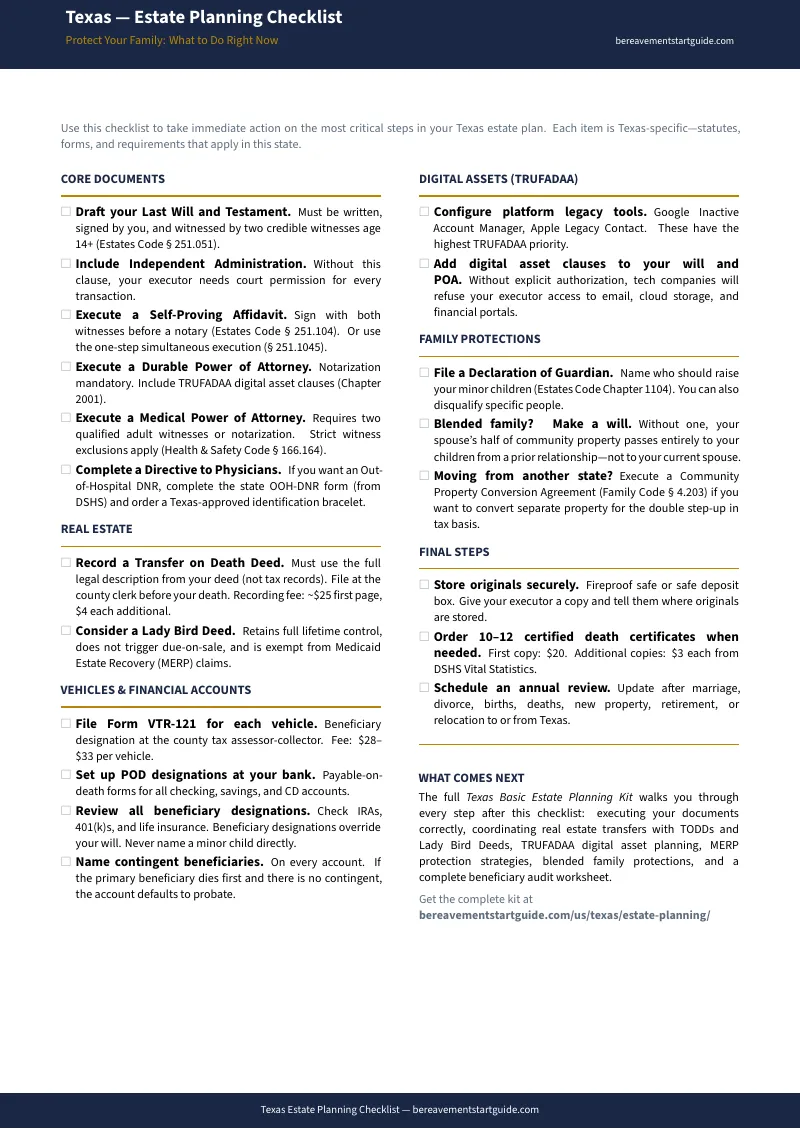
- Estate Planning Checklist (checklist.pdf) — a printable 20-item checklist covering every critical action from asset inventory through document execution and storage
- Community Property vs. Separate Property Worksheet (community-property-worksheet.pdf) — trace, classify, and document every asset so your will accurately reflects Texas characterization rules
- Non-Probate Transfer Tracker (non-probate-transfer-tracker.pdf) — a master worksheet to verify that every bank account, retirement account, vehicle, and piece of real estate has a proper beneficiary designation, survivorship agreement, or transfer-on-death mechanism in place
- Medical Directive Reference (medical-directive-reference.pdf) — explains why Texas uses an Out-of-Hospital DNR with physical identification instead of a POLST, how to obtain the OOH-DNR form and state-issued bracelet, and the requirements for a valid Directive to Physicians and Medical Power of Attorney
- Blended Family Planning Guide (blended-family-planning-guide.pdf) — the intestacy trap, homestead life estate rights, and strategies for protecting both your spouse and your children from a prior relationship without forcing them into involuntary co-ownership
- Will Execution Requirements (will-execution-checklist.pdf) — the exact witness, signature, and self-proving affidavit rules under Texas Estates Code §§ 251.051–251.104, including the holographic will option and why handwritten corrections void a typed will
Who This Is For
- Married couples who moved to Texas from a common-law state and need to realign their existing estate plan with community property rules — especially those who own real estate, have retirement accounts, or want to secure the double step-up in basis
- Blended families where one or both spouses have children from a prior relationship and want to prevent the intestacy co-ownership trap while protecting the surviving spouse's homestead rights
- Parents of minor children who need to name legal guardians, designate standby trustees, and ensure their children are never subject to a court-appointed guardian
- Seniors and caregivers planning for Medicaid long-term care who need to protect the family home from MERP recovery claims using Lady Bird Deeds or Transfer on Death Deeds
- Anyone creating their first estate plan who wants to avoid the $500–$2,500 attorney fee for a straightforward estate but still needs Texas-specific legal guidance — not generic 50-state templates
Why Free Templates Fall Short in Texas
The free statutory will forms published by the Texas Supreme Court are legally valid. But they solve exactly one problem — creating a basic will — while leaving every other piece of your estate plan uncoordinated. They do not include Independent Administration language. They do not help you set up Transfer on Death Deeds or Lady Bird Deeds to bypass probate. They do not coordinate your will with your bank account POD designations, your retirement account beneficiaries, or your vehicle title transfers. And if you make a handwritten correction after signing, the entire will is voided.
National platforms like LegalZoom and Trust & Will charge $99 to $549 for generic 50-state templates. They will not warn you about the community property conversion gap, the TODD two-year creditor hold, or the fact that Texas requires an Out-of-Hospital DNR with a physical bracelet instead of a standard POLST form. Their customer support representatives are not trained on Texas Estates Code Section 114.106 or Texas Family Code Section 4.203.
This kit fills the gap: Texas-specific legal guidance at a fraction of the cost, with coordination worksheets that ensure every document, designation, and deed works together as a single system.
What This Kit Does Not Do
This kit is an educational and administrative tool — not legal representation. It does not constitute legal, tax, financial, or medical advice, and purchasing it does not create an attorney-client relationship. For business succession planning, taxable estates above the federal exemption, contested family dynamics, multi-state real property, or irrevocable Medicaid asset protection trusts, you need a licensed Texas estate planning attorney. The guide tells you exactly when that threshold is reached and what to bring to the consultation — so you save hours of billable time at $300–$500 per hour.