You Have Three Days. The Rituals Expect a Lifetime of Preparation.
A death in Korea triggers a three-day cascade of obligations that move faster than grief allows. Within the first hours, you need a funeral hall slot, a cremation reservation — which in Seoul and Busan can mean a multi-day wait that breaks the traditional timeline — and a chief mourner who can manage bowing protocols, altar setup, and condolence money accounting while the rest of the family is still processing what happened.
The problem is not that information doesn't exist. It is that the information is scattered across monastic liturgical texts in classical Korean with Hanja, commercial funeral hall portals designed to upsell you, government booking systems that offer zero cultural context, and online forums full of contradictory etiquette advice about which hand goes on top when you bow.
This guide is a Korean Funeral Navigation System — a single, structured workflow that walks you through the entire process from the moment of death through the 49th-day memorial ceremony, in the order you will actually face each decision.
What the Guide Covers
- First-hours protocol — the exact sequence from pronouncement of death through death registration, body transport to the funeral hall, and cremation slot booking on the e-Haeneul platform, with document timelines and administrative office procedures
- Three-day funeral navigation (samiljang) — how the traditional three-day timeline works in practice, what happens on each day, and what to do when metropolitan cremation delays force you to extend to four or five days and the funeral hall costs start compounding
- Body preparation and purification rituals — the yom washing ceremony, traditional hemp shrouding, the ipkwon encoffining process, and the spiritual significance behind each step
- Bowing mechanics and etiquette — the full protocol for keunjeol deep bows at the altar, gender-specific hand placement, the difference between bowing to the deceased and bowing to the chief mourner, and modern simplified alternatives for visitors unfamiliar with the traditional form
- Mourning attire hierarchy — the armband and hairpin system, how the number of stripes identifies the chief mourner versus other descendants, which side the insignia goes on depending on the deceased's gender, and the colonial-era history behind these seemingly ancient customs
- 49-day memorial cycle (sasipgujae) — the seven weekly ceremonies, the role of Ksitigarbha Bodhisattva and the Ten Kings in Buddhist cosmology, the final bongsong clothing-burning ceremony, and which services most modern families actually attend versus skip
- Altar setup and food offerings — correct rice bowl placement with the vertical chopstick, symbolic fruit arrangements, the oshinchae prohibition on garlic and onion, incense and oil lamp maintenance for the 49-day home altar, and daily ritual timing
- Interfaith family dynamics — how to handle tensions when Christian family members refuse to bow or participate in altar offerings, the sequential-ceremony compromise that lets both traditions coexist, and gentle scripts for mediating between traditional elders and religious objectors
- Cost control — worked examples for both a standard hospital funeral hall ceremony and a simplified temple-only service, funeral director negotiation scripts, how to identify unnecessary upsells like unauthorized armbands and duplicate spirit tablets, and how the sangjo mutual-aid system works
- Diaspora coordination — how overseas relatives can manage logistics remotely, delegation frameworks, international ash transport regulations, and how to adapt the rituals when the funeral happens outside Korea
Who This Is For
- Secular Korean families who have lost connection with traditional Buddhist practice and need to plan a funeral without a lifetime of temple community knowledge to draw on
- Diaspora relatives coordinating from outside Korea — managing the administrative timeline, the cultural expectations from domestic elders, and the language barriers that make every phone call to the funeral hall an ordeal
- Interfaith families navigating tensions between Buddhist, Confucian, and Christian obligations when different generations and in-laws hold conflicting views about bowing, altar offerings, and memorial practices
- Professional planners and celebrants serving Korean communities who need a consolidated, English-language procedural reference for Korean Buddhist mortuary protocols
Why Free Tools Fall Short
Government portals like e-Haeneul give you the booking system for cremation slots, but they tell you nothing about the cultural context. You will know how to reserve a time window but not that metropolitan three-day completion rates have fallen below 70 percent, or what the financial and social consequences of extending the funeral timeline actually look like.
Commercial hospital funeral halls walk you through their package options, but their revenue model depends on upsells. The "standard" package includes items you may not need, and the "recommended" altar setup comes with add-ons that can double the cost without adding anything the deceased's family would have chosen independently.
Online forums provide fragments of genuine experience — someone explains the correct bowing sequence, someone else shares condolence money norms — but the advice is unverified, contradictory, and mixes regional variations as though they were universal rules. Following the wrong bowing protocol in front of elderly relatives is the kind of mistake that lives in family memory for decades.
This guide sits in the gap between all three: a single consolidated workflow that covers the cultural, spiritual, legal, and financial dimensions together, structured in the order you actually face each decision.
What You Get
The complete guide is a printable PDF — designed to be used offline, handed to different family members so everyone has clear instructions for their role, and brought to the funeral hall negotiation as an independent reference. The package includes:
- The full guide — 14 chapters covering every stage from the first hours after death to the long-term memorial obligations beyond the 49th day
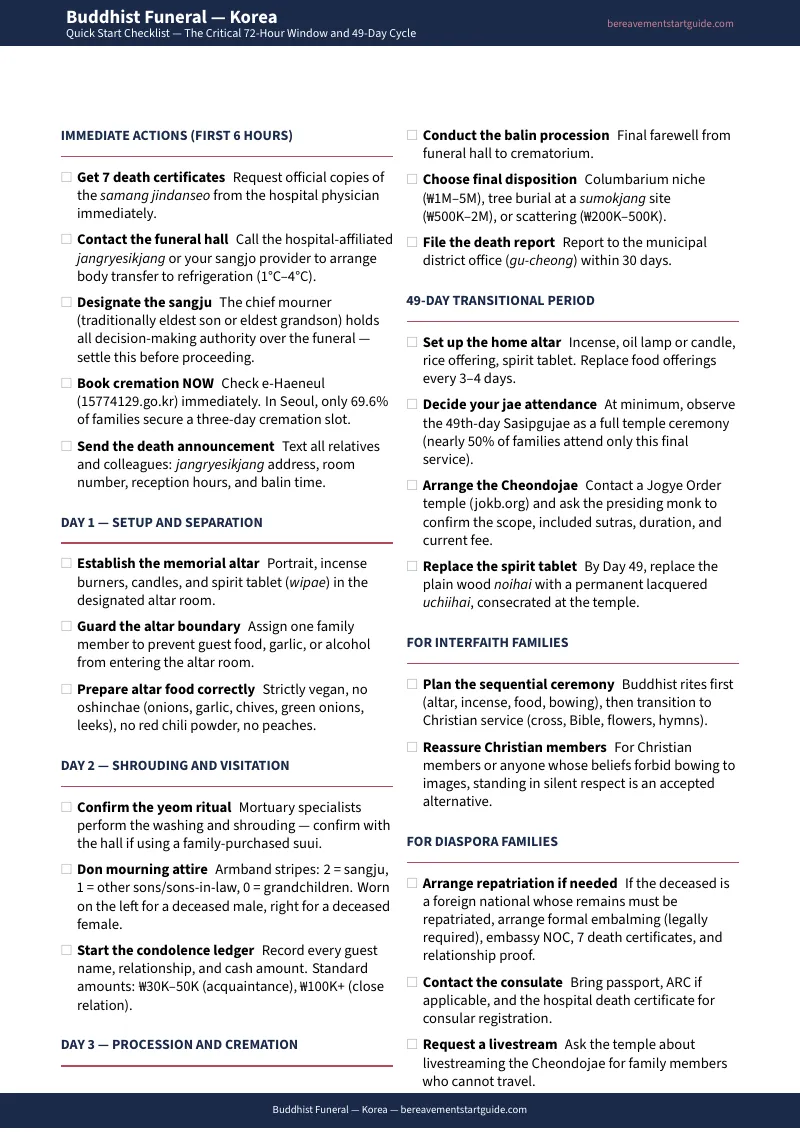
- Quick-reference checklist — 25 action items in chronological order for the first week and 49-day cycle
- Three-day samiljang timeline planner — day-by-day action sheet with task assignments across family members
- Funeral hall comparison worksheet — side-by-side form for evaluating itemized quotes from hospital funeral halls, with an upsell identification checklist
- Condolence money ledger — registry for every bujo contribution with return-gift tracking
- 49-day jae schedule tracker — pre-formatted calendar from the first weekly ceremony through the final bongsong, with temple contact details
- Interfaith ceremony planner — structured planner for families holding both Buddhist and Christian services, with conversation scripts
- Altar setup guide — reference card listing permitted and prohibited items for the Buddhist altar
Satisfaction Guarantee
If the guide does not help you plan the funeral with more clarity and less unnecessary cost, email us and we will refund your purchase — no questions, no forms, no waiting period.
Start Planning With Confidence
Download the free checklist to see the task sequence at a glance. When you are ready for the full guide — with the interfaith navigation framework, the worked cost examples, the complete bowing protocol, the 49-day altar instructions, and the full set of planning worksheets — get the complete toolkit from your landing page.