Your Parent Just Had a Stroke. The Bank Says You Cannot Access Their Accounts Without a Court Order.
You assumed someone in the family had the authority to handle this. Nobody does. Your parent's checking account is frozen. The mortgage payment is due next week. The nursing facility needs a deposit before they'll hold a bed. And the bank teller — who isn't being difficult, who is following the law — says the only thing they can accept is a valid Power of Attorney or a court-issued guardianship order.
You don't have a Power of Attorney. So now you're looking at a Texas guardianship proceeding: attorney fees of $3,000 to $10,000, mandatory physician evaluations, a formal court hearing where a judge decides who controls your parent's finances, ongoing court-supervised accounting of every dollar spent, and annual reports to the probate court for as long as the guardianship lasts. All while the bills pile up and your parent lies in a hospital bed unable to sign anything.
A Durable Power of Attorney executed last month — last year — last decade — would have prevented every bit of this. One document. One notarized signature. Complete private authority to manage finances, handle real estate, and make healthcare decisions — without ever setting foot in a courtroom.
The Texas Incapacity Defense System
This is not a blank form with "Texas" in the header. At its core is what we call the Texas Incapacity Defense System — a complete, statute-verified execution package that covers every document, every signing requirement, and every institutional enforcement tool you need to protect your family from the guardianship court system.
Free government PDFs give you the raw statutory forms — the same ones county clerks hand out with zero instructions. National template sites give you a questionnaire that has never heard of a Texas Out-of-Hospital DNR, doesn't know that Texas requires individual initialing of "Hot Powers," and can't help your agent when the bank refuses to honor the document. The Incapacity Defense System gives you the forms and the execution blueprint — which powers to grant, how to sign and notarize, how to record for real estate, and how to force bank acceptance using the statutory enforcement mechanism most Texans don't know exists.
What's Inside — and the Exact Problem Each Part Solves
The Statutory Durable Power of Attorney (Financial)
The Texas Estates Code provides a statutory form for financial powers of attorney — but the form itself is a legal minefield without instructions. Six categories of authority (gifting, trust creation, beneficiary changes, retirement accounts, insurance, and delegation) require individual initialing to activate — the "Hot Powers" under § 751.031. Leave them blank and your agent cannot execute a Lady Bird Deed, change a life insurance beneficiary, or move retirement assets. Initial them without understanding what they authorize and you've given your agent sweeping financial control with no guardrails. The kit explains each Hot Power in plain English, tells you which ones most families need and which ones to leave unchecked, and provides custom "Special Instructions" templates to limit agent authority to exactly what your situation requires. Solves: the family whose POA was rejected at the title company because nobody initialed the "Real Property" line, and the family whose agent made unauthorized gifts that triggered a five-year Medicaid penalty.
The Medical Power of Attorney
Texas Medical POA law requires specific witness qualifications that most families get wrong. At least one of your two witnesses cannot be a relative, a beneficiary of your estate, someone with a claim against your estate, your attending physician, or an employee of your physician or healthcare facility. Get the witnesses wrong and the document is invalid — and you won't find out until the ICU nurse rejects it during a crisis. The kit includes a Witness Qualification Audit Sheet that walks you through every statutory disqualification before anyone signs. Solves: the spouse who had her sister and her mother-in-law witness the Medical POA, not realizing both were disqualified as relatives and potential estate beneficiaries.
The Texas Out-of-Hospital DNR
If you're using a POLST form in Texas, EMS will ignore it. Texas is one of the states that does not recognize POLST — emergency medical services personnel are legally required to perform full resuscitation unless they see an official Texas Out-of-Hospital Do-Not-Resuscitate order. The kit includes the statutory OOH-DNR form with instructions for securing physician signatures, meeting the neutral witness requirements, and ordering the state-approved identification bracelets (plastic from the Texas Medical Association or metal from approved vendors like MedicAlert) that ensure your wishes are honored at the scene — not overridden because the paper form was in a drawer at home. Solves: the family that assumed a standard advance directive would prevent unwanted resuscitation, then watched their parent undergo aggressive CPR because the paramedics had no legal authority to stop.
The Section 751.203 Agent's Certification
Your POA is valid. You signed it. You notarized it. And the bank teller says they need to "send it to legal for review" and asks you to fill out the bank's own proprietary form. Under Texas Estates Code § 751.202, banks are prohibited from demanding their own in-house forms. Under § 751.201, they must accept a validly executed statutory POA. But knowing the law and enforcing it are different things. The kit includes a pre-formatted Agent's Certification under § 751.203 — a sworn document your agent signs and presents to the institution, triggering a mandatory 10-business-day acceptance deadline. A bank that refuses without valid statutory grounds under § 751.206 faces court-ordered liability for attorney's fees and damages. Solves: the adult child who spent three weeks arguing with a bank about a $200 utility payment while the parent's home was about to lose electricity.
The Community Property Protection Guide
You're married. You own everything together. So you assume you can manage your spouse's finances if something happens. You cannot. Texas is a community property state, but community ownership does not grant management authority during incapacity. If your spouse is incapacitated without a POA, you must petition a probate court for a judicial declaration of incapacity to become a "community administrator" — a process that requires a formal court hearing, a verified inventory of all community assets under § 1353.051, and court-supervised accounting after 15 months under § 1353.052. And that only covers community property. Your spouse's separate property — inherited assets, pre-marriage holdings, personal injury awards — requires a full guardianship proceeding, which is even more restrictive and expensive. A Durable POA covers both, privately, without court involvement. Solves: the husband who discovered he couldn't sell the family car — titled in his wife's name as separate property — to pay for her assisted living deposit.
The Real Estate Execution Guide
Using a POA for a real estate transaction in Texas has a specific procedural requirement that trips up even experienced agents: the POA must be recorded in the county clerk's office within 30 days of the deed filing under § 751.151, and the "Real Property" Hot Power category must be individually initialed on the statutory form. Miss either requirement and the title company refuses to close, the deed is unrecordable, and the transaction dies. The guide walks through real estate POA execution step by step — from identifying the correct Hot Power category to recording the document with the county clerk before the deed filing. Solves: the family that lost a real estate closing because the POA was signed but never recorded, and the title company refused to insure the chain of title.
Medicaid Planning: Lady Bird Deeds, the Look-Back, and MERP
Families use POAs to execute asset transfers that protect the family home from Medicaid Estate Recovery after death. But this strategy is governed by a strict five-year look-back period — any gifts or transfers for less than fair market value during the 60 months before a Medicaid application trigger penalty periods of ineligibility. The guide covers the critical distinction between Transfer on Death Deeds (which your agent cannot sign under the statute) and Lady Bird Deeds (which your agent can sign with proper POA authority), the MERP "probate-only" recovery rule that makes non-probate transfers immune, and the gifting powers that must be explicitly initialed on the statutory form before any Medicaid planning can begin. Solves: the agent who transferred the parent's home into a child's name without understanding the look-back period, disqualifying the parent from 18 months of nursing home coverage.
The Complete Execution Blueprint
A POA that sits in a drawer protects nobody. The blueprint is the chronological "do this first, do this second" sequence that takes you from agent selection through document signing, notarization, county recording (for real estate), and institutional delivery. It includes the Witness Qualification Audit Sheet, notary block formatting, the Agent's Certification preparation, and a distribution checklist so every bank, brokerage, insurance company, and healthcare provider that needs a copy of your POA receives one before a crisis forces them to reject an unfamiliar document under time pressure. Solves: the family that executed a perfect POA and then left it in a safe deposit box that the agent couldn't access without — a power of attorney.
Who This Is For
- The adult child whose parent is declining — you can see the trajectory, and the window for legal documents is closing. Your parent can still sign. Next month, next year, that may not be true. And without a POA, you're looking at a guardianship proceeding that costs more than the bank accounts you're trying to protect.
- The married couple who assumed they were covered — community property does not mean community management. If one spouse is incapacitated, the other spouse cannot touch sole-management property, separate property, or even community assets at some institutions without a POA. The kit gives both spouses reciprocal protection.
- The senior on a fixed income who refuses to pay $800 for an attorney to notarize a form — estate planning attorneys charge $400 to $1,500 for a basic POA package. For a straightforward situation — one principal, one agent, standard financial and medical powers — a self-guided kit provides everything you need at a fraction of the professional fee.
- The real estate buyer or seller who cannot attend the closing — you need a recorded POA with the Real Property Hot Power initialed, and you need it before the closing date. The kit walks through the exact steps that prevent title company rejections.
- The executor who is already handling one estate and realizes nobody set up the POA for the surviving parent — probate taught you what happens without legal documents. The kit lets you fix the gap before a second crisis creates a second court case.
Why Free Tools Fall Short
Free POA advice for Texas comes in four varieties, and each one fails in a specific way:
Government forms (TexasLawHelp.org, Texas DSHS, Texas State Bar) provide the raw statutory PDF — which is legally valid. But the form doesn't tell you which Hot Powers to initial. Doesn't explain the witness disqualifications that can invalidate your Medical POA. Doesn't include an Agent's Certification for bank enforcement. And doesn't mention that Texas doesn't recognize POLST. You get a blank form and a complete absence of execution guidance.
National template sites (LegalZoom, RocketLawyer) charge $39 to $249 for an online questionnaire that generates a generic document — then push monthly subscription upsells. Most don't include the Texas OOH-DNR because their national template assumes all states recognize POLST. None include the § 751.203 Agent's Certification. And their customer support cannot answer a question about Texas community property rules or the 30-day real estate recording requirement.
Estate planning attorneys charge $400 to $1,500 for a full POA package. That fee includes professional judgment, custom drafting, and malpractice insurance — essential for complex situations (blended families, business succession, contested capacity). But for the straightforward married couple or the adult child who needs documents executed this week, the attorney fee is disproportionate to the document complexity.
Funeral home pre-planning packets include basic medical directives as part of their pre-need services. These documents cover end-of-life wishes but provide zero authority over bank accounts, real estate, or financial management during a lifetime incapacity. And funeral homes deal with families after death — when all POA authority has already terminated.
Free resources give you raw forms and attorney marketing. The kit gives you the complete Texas POA execution system — every document, every signing requirement, every enforcement tool — assembled, statute-verified, and ready to execute tonight.
100% Satisfaction Guarantee
If the kit doesn't give you what you need to execute a valid Texas Power of Attorney, email [email protected] and we'll make it right — no complicated refund process, no justification required.
Less Than a Single Hour of Attorney Time
Estate planning attorneys charge $200 to $500 per hour. LegalZoom charges $39 for a basic POA and pushes premium plans to $249. Texas guardianship costs $3,000 to $10,000 — minimum.
The kit costs — once, no subscription, no hourly rate. The complete 12-chapter guide plus 9 standalone printable tools: Hot Power Decision Worksheet, Witness Qualification Audit, OOH-DNR Reference Sheet, Agent's Certification for bank enforcement, Bank Presentation Checklist, Community Property Quick Reference, MERP Defense Worksheet, Agent Selection Worksheet, and the step-by-step Execution Timeline that takes you from agent selection to institutional delivery.
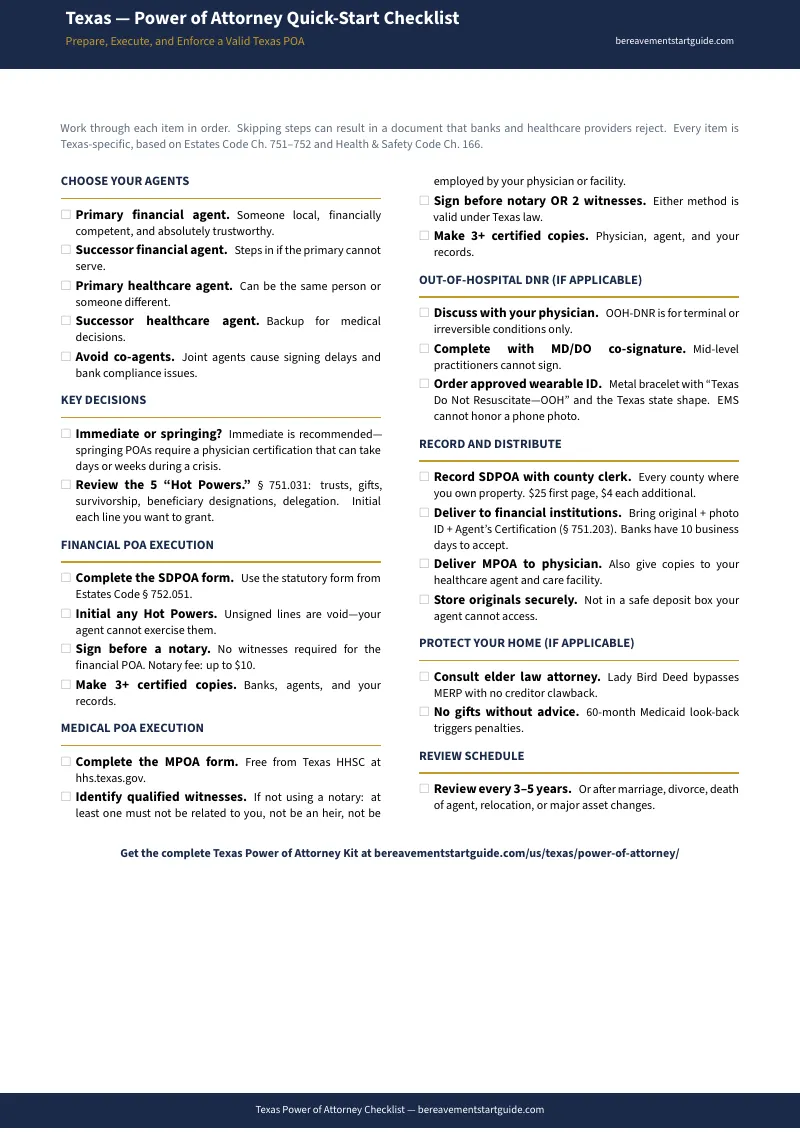
Not ready for the full kit? Download the free Texas POA Quick-Start Checklist — a one-page overview of every document you need, every signing requirement, and every critical step. It's enough to understand the scope. The full kit is there when you're ready to execute.
A power of attorney costs almost nothing to set up and everything to go without. The guardianship courtroom is expensive, public, and slow — and it's where your family ends up if these documents don't exist. Get them done now, while everyone can still sign.