
Your Father Had a Stroke on Tuesday. The ICU Wants to Know Who Decides Whether to Intubate. You Have No Legal Authority, and Three Siblings with Three Different Opinions.
It was supposed to be a routine cardiology follow-up. Instead, he collapsed in the waiting room and now he is on a ventilator in the neuro-ICU at Intermountain Medical Center. The attending physician needs to know whether to escalate to aggressive intervention or transition to comfort care. Your mother is too overwhelmed to speak. Your brother wants everything done. Your sister thinks Dad would not have wanted this. You are standing in a hospital hallway trying to make the most important medical decision of your father's life — and none of you have the legal authority to make it.
Without a valid advance directive on file, Utah hospitals follow a default surrogate hierarchy: spouse first, then adult children. But when adult children disagree — and they almost always disagree in a crisis — the hospital has no tiebreaker. The only resolution is a court-appointed guardian, which means a petition in District Court, attorney fees of $3,000 to $8,000, weeks of waiting, and a judge who has never met your father deciding what happens to him.
The entire crisis could have been prevented with a single document signed on a Tuesday afternoon. Utah law combines the living will and healthcare proxy into one form — the Utah Advance Health Care Directive under Utah Code § 75A-9-110. One document. One signature. One witness. That is all it takes to put one person in charge and spell out exactly what treatments your father would or would not want.
The Utah Advance Directive & Living Will Kit is a Complete Healthcare Autonomy System — a step-by-step planning kit that goes far beyond a blank form downloaded from a government website. It covers Utah's specific statutes, the new 2026 electronic signing laws, POLST coordination, dementia planning, LDS family alignment, hospital submission protocols for Intermountain and University of Utah Health, and every procedural detail that free templates leave out.
What's Inside the Healthcare Autonomy System
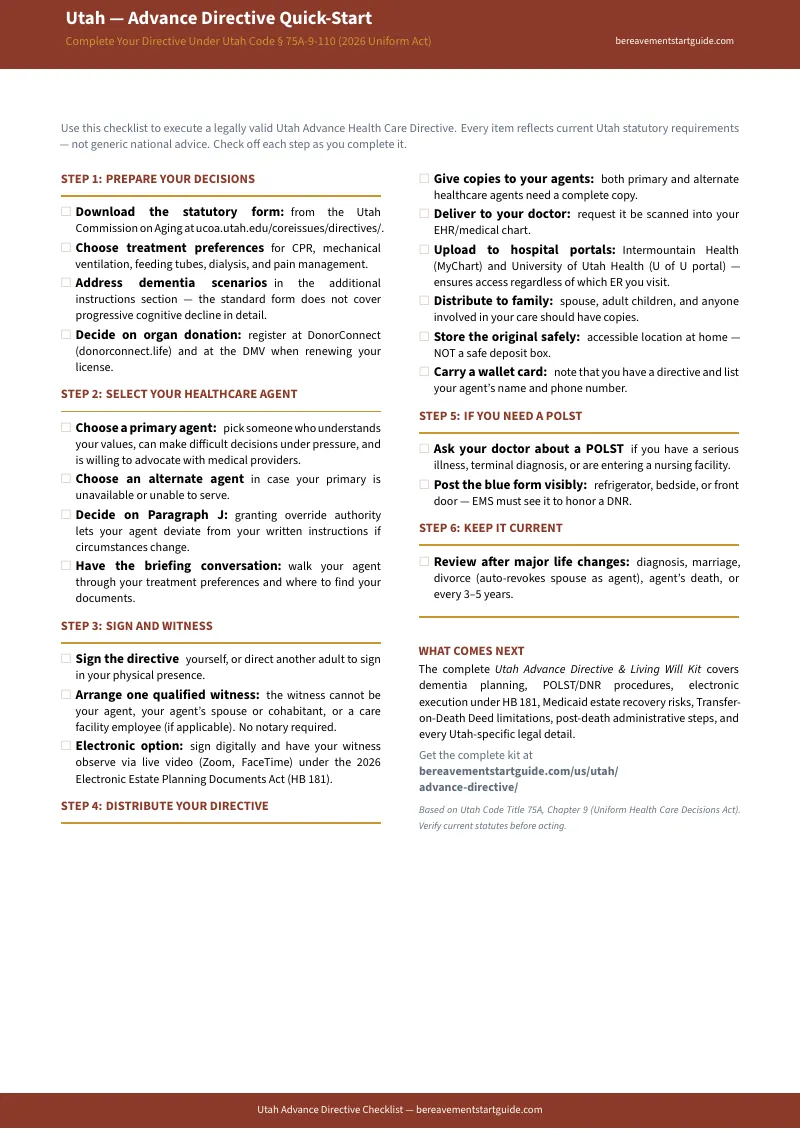
A 12-chapter guide, the Advance Directive Quick-Start Checklist, and 7 standalone printable worksheets — covering every stage from choosing your healthcare agent through hospital submission and family communication, built specifically for Utah law and the unique cultural context that makes planning here different:
Utah's Advance Directive Framework — Why One Document Does Everything
In Utah, there is no separate "living will" and "medical power of attorney." Both functions are integrated into the single statutory Advance Health Care Directive. Part I designates your healthcare agent. Part II contains your living will instructions. Most consumers waste hours searching for multiple documents they do not need. The guide opens by explaining exactly how Utah's framework works and why one form under one statute covers everything.
The 2026 Electronic Signing Revolution
Governor Cox signed House Bill 181 on March 23, 2026, making Utah one of the most digitally progressive states for estate planning. Effective May 6, 2026, you can now sign your advance directive electronically and have it witnessed remotely via video conference — no notary required for the directive itself. The guide includes step-by-step instructions for executing your document digitally under the new Uniform Electronic Estate Planning Documents Act, so you can complete the entire process from your living room.
Choosing Your Healthcare Agent — The Decision That Prevents the Courtroom
Your healthcare agent will decide whether to authorize surgery, withdraw life support, approve hospice care, and donate your organs. The guide includes a structured agent selection process that evaluates trustworthiness, medical literacy, emotional stability under pressure, and geographic proximity — plus instructions for naming successor agents so your plan does not collapse if your primary agent is unavailable during a crisis.
POLST, DNR, and Clinical Orders — What Your Advance Directive Cannot Do
An advance directive tells your family and doctors what you want. A POLST tells paramedics what to do when they arrive at your home and you are unresponsive. These are different documents with different legal authority, signed by different people. The guide explains when you need a POLST, how it coordinates with your advance directive, and why having only one of the two can lead to treatments you explicitly did not want.
Dementia Planning — Documenting Wishes Before Capacity Slips Away
An advance directive must be signed while you have mental capacity. Once a dementia diagnosis progresses past the early stage, the window closes permanently. The guide includes a dedicated dementia planning chapter that walks you through documenting specific wishes about artificial nutrition, hydration, comfort care, and facility placement — decisions that are nearly impossible to make clearly once cognitive decline has started.
LDS Family Alignment — Planning That Honors Both Law and Faith
For Latter-day Saint families, end-of-life planning is stewardship — a moral duty to organize temporal affairs and preserve family harmony. The Church distinguishes between active euthanasia (which it opposes) and declining invasive treatment when death is inevitable (which it permits). The guide helps LDS families navigate these doctrinal boundaries with confidence, covering organ donation, cremation, and the spiritual framework for making difficult medical decisions without guilt or family division.
Hospital Submission Protocol — Guaranteeing Your Document Is Accessible in an Emergency
A directive locked in a home safe or a desk drawer is useless when paramedics arrive. The guide includes a clinical submission protocol with step-by-step instructions for uploading your completed directive to Intermountain Health's MyChart portal, University of Utah Health, and SelectHealth — plus a secure storage plan that ensures your document is immediately accessible to your healthcare agent, your primary care physician, and emergency responders.
Medicaid Estate Recovery — The Threat That Free Forms Never Mention
Utah uses an "expanded estate" definition for Medicaid recovery. That means the state can recover long-term care costs from joint tenancies, living trusts, life estates, and transfer-on-death deeds — not just probate assets. A standalone advance directive does not protect your family home. The guide explains how to coordinate your healthcare directive with broader asset protection strategies, including the five-year lookback period, the limitations of transfer-on-death deeds, and the one-year sale moratorium that catches families off guard.
Revocation, Updates, and Life Changes
Divorce automatically revokes your spouse's appointment as healthcare agent in Utah. Remarriage does not automatically appoint your new spouse. A move to another state may require a new directive. The guide covers every life event that invalidates or weakens your existing document, with specific instructions for updating, revoking, and re-executing your directive so it stays legally current.
Who This Kit Is For
- The adult child whose parent was just hospitalized — who needs to establish medical decision-making authority before the next treatment decision is made, and who cannot afford the weeks and thousands of dollars a court-appointed guardianship requires
- The couple planning ahead after a health scare — who realized during a cancer diagnosis, a cardiac event, or a routine surgery that neither of them had documented what they would want if they could not speak for themselves
- The LDS family preparing for a senior mission or temple service — who view estate and healthcare planning as faithful stewardship and want a directive that aligns with Church teachings on life support, organ donation, and burial preferences
- The caregiver managing a parent with early-stage dementia — who knows the window for signing legal documents is closing and needs to act while their parent still has the mental capacity to execute a valid directive
- The tech-forward planner who wants to do this online — who learned about Utah's 2026 electronic signing laws and wants step-by-step instructions for executing their directive digitally with remote video-conference witnessing
- The family worried about protecting their home from Medicaid — who discovered that Utah's expanded estate recovery program can claim assets from trusts, joint tenancies, and transfer-on-death deeds, and who needs to coordinate their healthcare planning with their asset protection strategy
Why Free Templates Leave Your Family Exposed
The Utah Commission on Aging provides a free statutory form. You can download it today. Here is what you get: a blank PDF with empty fields, clinical language, and zero guidance. Here is what you do not get:
- No explanation of what each section means. Part I and Part II of the directive serve completely different legal functions. The free form does not explain the difference between designating a healthcare agent and documenting treatment preferences — or why completing only one part leaves a critical gap in your plan.
- No electronic signing instructions. Utah's HB 181 allows fully electronic execution, but the free form does not tell you how to do it, what platforms qualify, or how to coordinate a remote video-conference witnessing session.
- No hospital submission protocol. The free form does not explain how to upload your directive to MyChart, how to submit it to University of Utah Health, or how to ensure it appears in your electronic medical record before an emergency occurs.
- No dementia-specific guidance. The free form does not help you document wishes about artificial nutrition, comfort care, or facility placement — the decisions that matter most when cognitive decline makes future communication impossible.
- No Medicaid coordination. The free form does not mention that your family home is vulnerable to state recovery through Utah's expanded estate definition, does not explain the limitations of transfer-on-death deeds, and does not connect your healthcare choices to your asset protection strategy.
Free templates hand you a blank government form. The Healthcare Autonomy System puts every Utah-specific statute, procedure, and deadline into one document, in the order you actually need them — from choosing your agent through hospital submission.
Satisfaction Guarantee
If the kit does not give you the clarity and confidence to create a legally valid Utah advance directive, email us for a full refund. No time limit. No questions.
— Less Than a Single Hour of Attorney Time
An estate planning attorney in Utah charges $250 to $500 per hour. A full advance directive package with attorney guidance runs $500 to $1,500. The Healthcare Autonomy System covers the complete Utah advance directive, POLST coordination, electronic signing, dementia planning, LDS family alignment, hospital submission, and Medicaid coordination — for a fraction of what one attorney consultation would cost.
Download the free Utah Advance Directive Quick-Start Checklist to see how the process works. When you are ready for the complete system, the full kit is waiting.