Vermont Doesn't Have a County Recorder. That's Where Most National Estate Plans Fall Apart.
You buy a will template from a national website. It tells you to "record the deed at your county recorder's office." You search for your county recorder. There isn't one. Vermont is one of the few states where every real property transfer — every deed, every lien release, every title change — must be filed at the individual town clerk's office where the property sits. There are 251 of them. The national template doesn't know which one is yours.
Then there's the advance directive. The template references POLST. Vermont doesn't use POLST. It uses Clinician Orders for Life-Sustaining Treatment (COLST) — a different form, different process, different legal authority. Emergency medical personnel in Vermont won't recognize a POLST form.
And the deed that could keep your family camp out of probate and shield it from Medicaid recovery? The national template doesn't mention it, because most states don't have it. Vermont does — the Enhanced Life Estate Deed, commonly called a Lady Bird Deed. It lets you keep full control of your property during your lifetime while transferring it automatically at death, outside of probate, without triggering a Medicaid lookback penalty.
Each of these has a specific fix. The problem is that they're scattered across different state agencies, court websites, and town offices — and none of them explain how they connect.
The Vermont Estate Protection System
The Vermont Basic Estate Planning Kit is a plain-English walkthrough of every document and decision that determines whether your family handles your estate in a weekend or navigates court supervision for six to eighteen months.
This isn't a stack of blank court forms with instructions to "consult an attorney." It's a structured system: which documents to prepare, in what order, how they interact, and the Vermont-specific execution rules that make or break each one. Your will coordinates with your beneficiary designations. Your power of attorney works alongside your advance directive and COLST. Your Lady Bird Deed gets recorded correctly the first time you walk into the town clerk's office — with the right Property Transfer Tax Return and the right per-page fees.
What You Get — 10 Printable PDFs
- Complete Estate Planning Guide (15 chapters) — covers Vermont will requirements under 14 V.S.A. § 5, powers of attorney, advance directives and COLST, Lady Bird Deeds, intestacy rules, elective share, digital assets, the flat 16% estate tax on estates over $5 million, Medicaid probate-only recovery under Rule 4.108, Act 39 medical aid in dying, the full probate process, property transfer tax, funeral planning, when to hire a professional, and a step-by-step action plan.
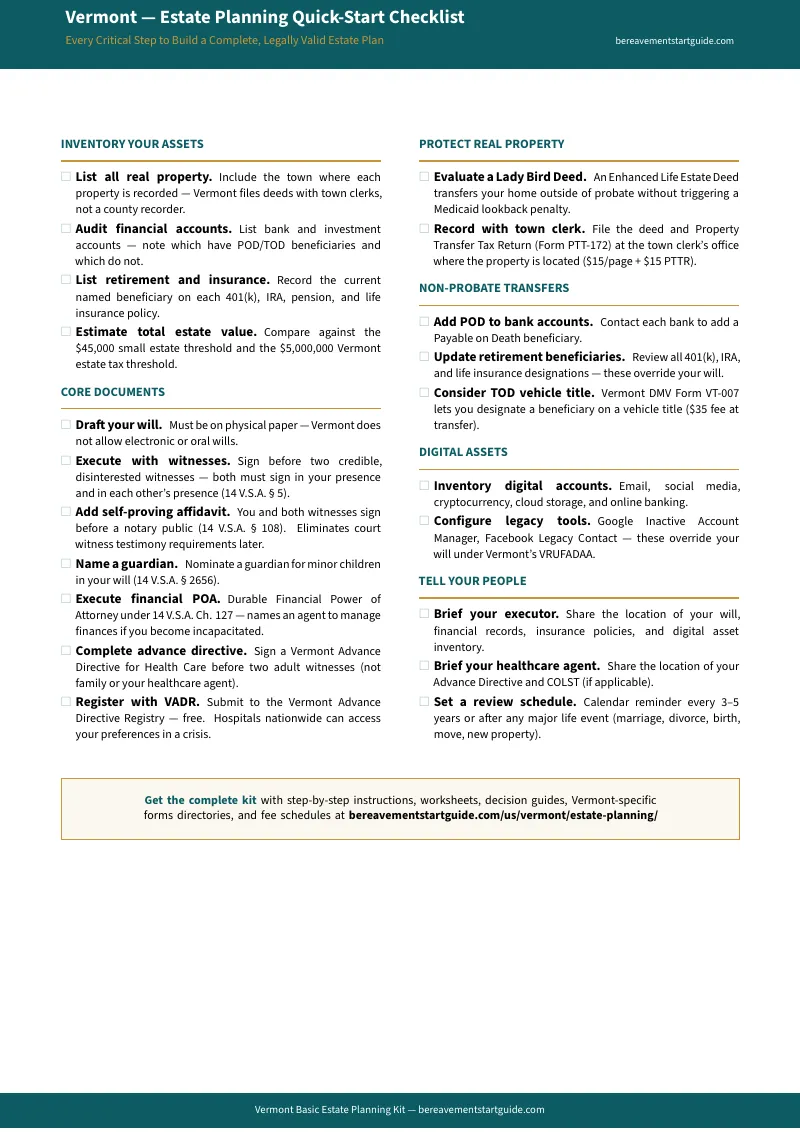
- Quick-Start Checklist — every document and deadline in priority order with Vermont-specific thresholds that determine which steps apply to your situation. Print it, work through it, check things off.
- Asset Inventory Worksheet — fillable worksheet for cataloging real property, accounts, insurance, vehicles, and digital assets before you start planning. Identifies probate exposure and estate tax threshold.
- Will Execution Checklist — signing day requirements under 14 V.S.A. § 5 and § 108, including the three-way simultaneous witness presence rule, disinterested witness requirement, and self-proving affidavit steps.
- Lady Bird Deed Recording Guide — exactly what to bring to the town clerk's office: the executed deed, Form PTT-172, fees ($15/page + $15 PTTR), and the transfer tax exemption citation.
- Probate Pathway Flowchart — decision tree showing which assets bypass probate, the small estate threshold ($45,000), and filing forms and fees for each track.
- Non-Probate Transfer Tracker — fillable tracker for beneficiary designations, POD/TOD registrations, joint titling, and Lady Bird Deeds across all accounts.
- Medicaid Recovery Reference — the six critical Rule 4.108 changes (effective March 2026), hardship forms (DVHA 13/14/15), and protection strategies ranked by simplicity.
- Estate Tax Worksheet — $5 million threshold quick reference with calculation worksheet, two-year gift lookback rule, required tax forms, and lien clearance steps.
- Professional Help Decision Guide — when to hire an attorney, CPA, or Medicaid counselor, with the specific scenarios that make each worth the cost.
Vermont-Specific Coverage You Won't Find Elsewhere
- The Lady Bird Deed advantage — how to use Vermont's Enhanced Life Estate Deed to transfer your home outside of probate and shield it from Medicaid recovery, without triggering a five-year lookback penalty or losing control during your lifetime
- Town clerk filing protocol — exactly which documents to bring, which fees to pay ($15/page recording + $15 PTTR), and how to locate the correct town office among Vermont's 251 municipalities
- COLST vs. POLST — when to complete an Advance Directive on your own and when to transition to a clinician-signed COLST, plus the guardianship approval rule that applies to court-appointed representatives
- Act 39 medical aid in dying — the current multi-step process under the Patient Choice and Control at End of Life Act, including the elimination of in-person consultation mandates and the 48-hour waiting period
- Probate-only Medicaid recovery — why the Department of Vermont Health Access (DVHA) can only recover from assets that pass through probate under Rule 4.108, and how to use that to your advantage
- The blended family trap — 14 V.S.A. § 311/312 intestacy rules that give your surviving spouse only 50% when you have children from a prior relationship, plus the elective share that can override your will
- The witness disqualification rule — 14 V.S.A. § 10 voids gifts to witnesses unless two additional disinterested witnesses sign, and how the self-proving affidavit under § 108 prevents witness-tracking problems
- The Homestead Hardship Exemption — how qualifying heirs can protect up to $250,000 in homestead value from Medicaid recovery using DVHA Forms 13, 14, and 15
Who This Is Built For
- Homeowners and family camp custodians who want to keep their property out of probate and protect it from Medicaid recovery — and need the town clerk filing instructions that actually work on the first visit
- Unmarried partners who share a home and a life but have zero inheritance rights under Vermont law — and need wills and powers of attorney to establish legal priority
- Parents who need to name guardians for minor children and get the basic legal protections in place before the next life milestone
- Blended families navigating intestacy rules and the elective share — trying to protect both a surviving spouse and children from a prior relationship without creating a legal time bomb
- Adults approaching Medicaid eligibility who need to understand exactly what probate-only recovery means and how a Lady Bird Deed shields their home without jeopardizing benefits
- Adult children helping aging parents get powers of attorney signed while they still have mental capacity — because once capacity is lost, the path leads through guardianship court
- Proactive planners who want their advance directive, COLST preferences, and Act 39 wishes documented clearly before a medical crisis forces rushed decisions
Why Not Just Use the Free State Forms?
The Vermont Ethics Network publishes free advance directive templates. Vermont Legal Aid provides some basic forms. The Probate Division offers raw court filing templates.
Here's the problem: the forms come without instructions. When you call the probate court clerk's office and ask how to fill them out, you'll hear the same answer every time: "We are legally prohibited from giving legal advice." You're held to the same filing standards as a licensed attorney, but no one can tell you what those standards are.
The free forms don't explain how a will coordinates with beneficiary designations. They don't warn you about the witness disqualification rule under § 10. They don't cover Lady Bird Deed recording requirements or the Medicaid recovery gap. And they definitely don't tell you when your estate is simple enough to bypass formal probate entirely.
The state provides the pieces. The kit shows you how they fit together — and which ones you can skip.
Why Not Hire a Local Attorney?
For straightforward estates, there's a real question of whether $275 to $900+ in attorney fees is worth it. Vermont estate planning attorneys charge $250 to $350 per hour. A simple will-plus-POA package starts around $300, and a comprehensive couple's package with trust work can exceed $900. That's real money — especially for families where the wealth is in the family camp, not liquid cash.
The kit doesn't replace an attorney for complex situations — and it tells you exactly when you need one (multi-state property, business succession, taxable estates near the $5 million threshold, contested family dynamics, or irrevocable trust planning for Medicaid). But for the vast majority of Vermont families with a home, some retirement accounts, and minor children, the kit covers every document and decision point.
And if you do hire an attorney later, the completed worksheets become your intake package — saving hours of billable time.
— Less Than One Attorney Consultation
Vermont estate planning consultations start at $275. The kit covers what would take multiple meetings to accomplish — document preparation, beneficiary coordination, town clerk filing guidance, and a complete action plan.
One-time purchase. No subscriptions, no annual renewal fees, no paywall between you and your own estate plan.
Money-Back Guarantee, No Time Limit
Download the kit, review the guide and checklist. If the plain-English instructions don't clarify the exact steps needed to protect your family under Vermont law, email us at any time for an immediate, full refund. No questions asked.
Important notice: Bereavement Start Guide is a publisher of educational resources. This kit assists individuals in organizing their estate affairs and completing standard statutory forms. It does not provide personalized legal, financial, or tax advice, does not act as a law firm, and does not establish an attorney-client relationship. For complex assets, multi-state property, or custom trust structures, consultation with a licensed Vermont attorney is recommended.