The Bank Teller Just Said No — Now What?
Your parent had a stroke last Tuesday. You drove to the bank with the power of attorney your family printed from the internet three years ago. The teller looked at it, called the compliance department, and told you to come back with an attorney. Meanwhile, the mortgage payment is due Friday, the property taxes are overdue, and nobody can touch a cent.
This happens in Vermont constantly — because most online POA forms are still based on the old Chapter 123 law that Vermont replaced in July 2023. The execution requirements changed. The witness rules changed. The bank acceptance rules changed. A document that looks valid may be legally unenforceable, and you won't find out until the moment you need it most.
The Vermont Power of Attorney Kit is built entirely around the current law — the 2023 Uniform Power of Attorney Act (14 V.S.A. Chapter 127) and the Title 18 Advance Directive framework — so the documents you execute actually work when you present them at a bank counter, a town clerk's office, or a hospital admission desk.
The Vermont Acceptance System
This isn't a blank form with "sign here" arrows. The kit covers every layer of Vermont's power of attorney framework — financial, medical, and real estate — and shows you exactly how to execute each document so it triggers the statutory protections that force institutions to accept it.
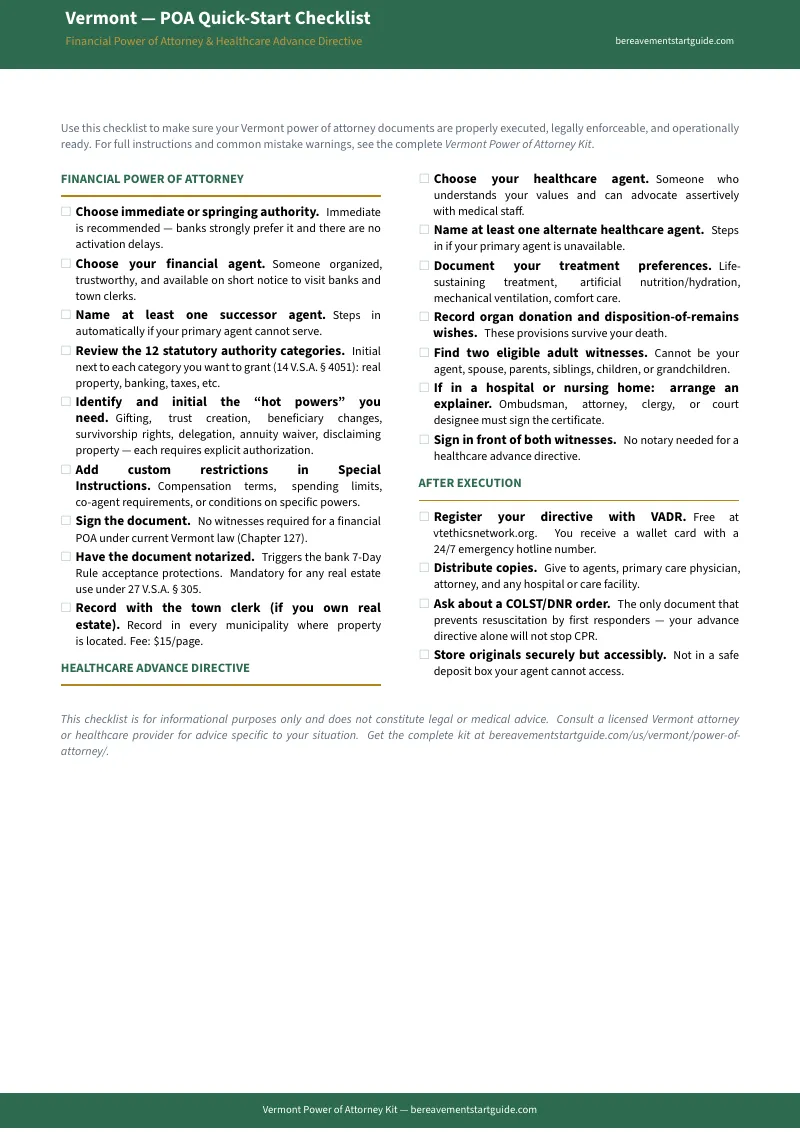
The core mechanism is what Vermont law calls the 7-Day Rule: when you present a properly notarized financial POA to a bank, the bank has 7 business days to accept it or formally request additional documentation. If they request it and you provide it, they get 5 more business days — and then they're legally bound. If they wrongfully refuse, they can be sued for your attorney's fees. This kit shows you exactly how to set up the documents so this protection applies from day one.
What's Inside the Kit
- 2023 Uniform Act Financial POA Guide — The complete framework under 14 V.S.A. Chapter 127. Durability is now the statutory default (no special language needed), and Vermont has eliminated the witness requirement for financial POAs entirely. This chapter walks you through what changed and why older documents may not hold up.
- Hot Powers Walkthrough — Under Section 4031, your agent cannot create trusts, make gifts, alter beneficiary designations, or disclaim property unless you explicitly initial each power in the document. A general grant of authority is not enough — each "hot power" must be individually authorized. This section explains when to grant each one and when withholding is the smarter move.
- 7-Day Bank Acceptance Playbook — What notarization triggers, what banks can legally request, the agent's certification form under Section 4053, and the exact steps to take when a bank refuses. Includes the statutory liability provisions under Section 4020 that most agents never learn about until they've already lost weeks.
- Vermont Advance Directive & Healthcare Proxy — Vermont packages medical decision-making into an Advance Directive under Title 18, not a standalone "medical POA." This chapter covers the two-witness requirement, the strict family member exclusions (no spouse, no parents, no siblings, no children as witnesses), and the facility rule requiring a third independent signature in hospitals and nursing homes.
- No Default Surrogate Warning — Vermont does not have a default surrogate decision-maker law. If you're incapacitated without an advance directive, your spouse cannot legally make healthcare decisions. The hospital must petition for a court-appointed guardian. This section explains the gap and how to close it before it matters.
- COLST & Act 39 Coordination — How Clinician Orders for Life-Sustaining Treatment (Vermont's replacement for DNR/POLST) interact with your advance directive. Plus the strict capacity requirements of Vermont's medical aid in dying law — and why an advance directive can never authorize it.
- Town Clerk Real Estate Recording Guide — Vermont records all land documents at the municipal clerk level, not the county level. A POA for real estate must be notarized and recorded in the specific town where the property sits, or the entire transaction is legally void. Includes recording fees ($15/page), the Property Transfer Tax Return, and the execution requirements that title companies verify before closing.
- Medicaid Estate Recovery Protection — Vermont uses a probate-only estate definition, which means assets that transfer outside probate (joint property, POD accounts, irrevocable trusts) are immune to Medicaid recovery. A financial POA with hot powers lets your agent set up these structures during your lifetime. This section covers the caregiver child exemption, sibling exemption, poverty exemption, and why Lady Bird deeds are legally unsettled in Vermont.
- Agent Duties & Liability Guide — Fiduciary standards under the new statutory framework: loyalty, conflict avoidance, asset segregation, and record-keeping. What an agent can be held personally liable for, and the correct signature format that prevents personal exposure.
- Revocation Protocol — Executing a new POA doesn't automatically cancel the old one. This section covers the correct revocation sequence: written notice, notarization, delivery to the former agent, and certified copies to every bank and town clerk with the original on file.
Who This Is For
Adult children managing aging parents — you discovered during a medical emergency that you have no legal authority to pay bills, access accounts, or make healthcare decisions. Vermont gives you no automatic rights, even as next of kin. Proactive seniors who want documents that prevent a court-appointed guardian from taking control of their finances. Families navigating a terminal diagnosis who need to coordinate advance directives, COLST orders, and financial authority while the patient still has capacity. Anyone selling or refinancing Vermont real estate through an agent — the POA must be recorded with the specific town clerk before closing or the transaction is void.
Why Not Free Forms?
You can download the statutory form from 14 V.S.A. Section 4051. It's the raw legal template — no explanation of what each grant of authority actually allows, no guidance on which hot powers to initial, no warning about the execution sequence that triggers bank acceptance protections.
LegalZoom charges $39–$49 per document with aggressive subscription upsells and no Vermont-specific recording instructions. eForms hides behind a "free trial" that requires your credit card. Neither addresses the 2023 Uniform Act transition, the 7-Day Rule, or the town clerk recording requirements that make Vermont's system different from every other state.
This kit gives you the documents and the system — the execution sequence, the bank acceptance strategy, the town clerk recording checklist, and the Medicaid protection playbook — in one place, for a fraction of a single hour with a Vermont elder law attorney.
Satisfaction Guarantee
If any Vermont bank, town clerk, or healthcare facility rejects a document from this kit due to noncompliance with the 2023 Uniform Power of Attorney Act or Title 18 execution requirements, email us with the rejection details for a full refund.
Get Started Today
Download the free checklist to see the scope of what Vermont requires. Or get the complete kit — the full guide plus 10 printable standalone tools (the Hot Powers Decision Guide, Bank Acceptance Playbook, Town Clerk Recording Checklist, Medicaid Protection Worksheet, and more) — for . Less than the cost of a single hour with an elder law attorney who charges $351 on average.