
Virginia's Probate System Has a Private Auditor. Your Executor Will Meet Them Whether You Plan for It or Not.
Every executor who qualifies before a Virginia Circuit Court clerk is automatically assigned to a Commissioner of Accounts — a court-appointed auditor who examines every dollar your estate spends. Miss the 4-month inventory deadline, and the Commissioner flags your executor as delinquent. File the accounting wrong, and they face personal liability for debts paid out of order.
Most Virginians have no idea this system exists until a family member dies and an executor is suddenly juggling court forms, bond requirements, and an auditing office that charges $275 to $1,030+ just to review the paperwork.
That's one of several Virginia-specific mechanisms that catch families off guard. The "Stone Doctrine" that immediately vests your real estate in your heirs — and immediately exposes them to personal liability for your debts under § 64.2-536. The augmented estate elective share that scales with marriage length and reaches into trusts, joint accounts, and life insurance to prevent spousal disinheritance. The "expanded" Medicaid estate recovery definition that makes the revocable living trust — the instrument national form vendors sell as a Medicaid shield — completely useless in this Commonwealth.
Each of these has a specific fix. The problem is coordinating all of them before the one you missed becomes the one that costs your family.
The Commonwealth Estate Protection System
The Virginia Basic Estate Planning Kit is a plain-English walkthrough of every document, decision, and filing requirement that determines whether your family handles your estate in a weekend or spends eighteen months under the Commissioner of Accounts' supervision.
This isn't a stack of blank court forms with instructions to "consult an attorney." It's a coordinated system: which documents to prepare, in what order, how they interact, and the Virginia-specific execution rules that make or break each one. Your will coordinates with your Transfer on Death Deed. Your power of attorney aligns with your advance medical directive. Your beneficiary designations work alongside — not against — the augmented estate calculations. And every chapter tells you the exact form numbers, filing offices, deadlines, and costs.
What You Get
- Complete Estate Planning Guide (15 chapters) — covers Virginia common-law property rules, the augmented estate elective share, will execution under § 64.2-403 (including Self-Proving Affidavit forms CC-1601/CC-1603), intestacy defaults, Transfer on Death Deeds under the Uniform Real Property Transfer on Death Act (§ 64.2-621), POD/TOD beneficiary designations, the Commissioner of Accounts system, power of attorney and advance medical directives, Medicaid estate recovery under expanded § 32.1-326.1, digital assets under UFAADA, blended family planning, guardianship nominations, step-up in basis tax planning, and a complete Virginia forms and resources directory.
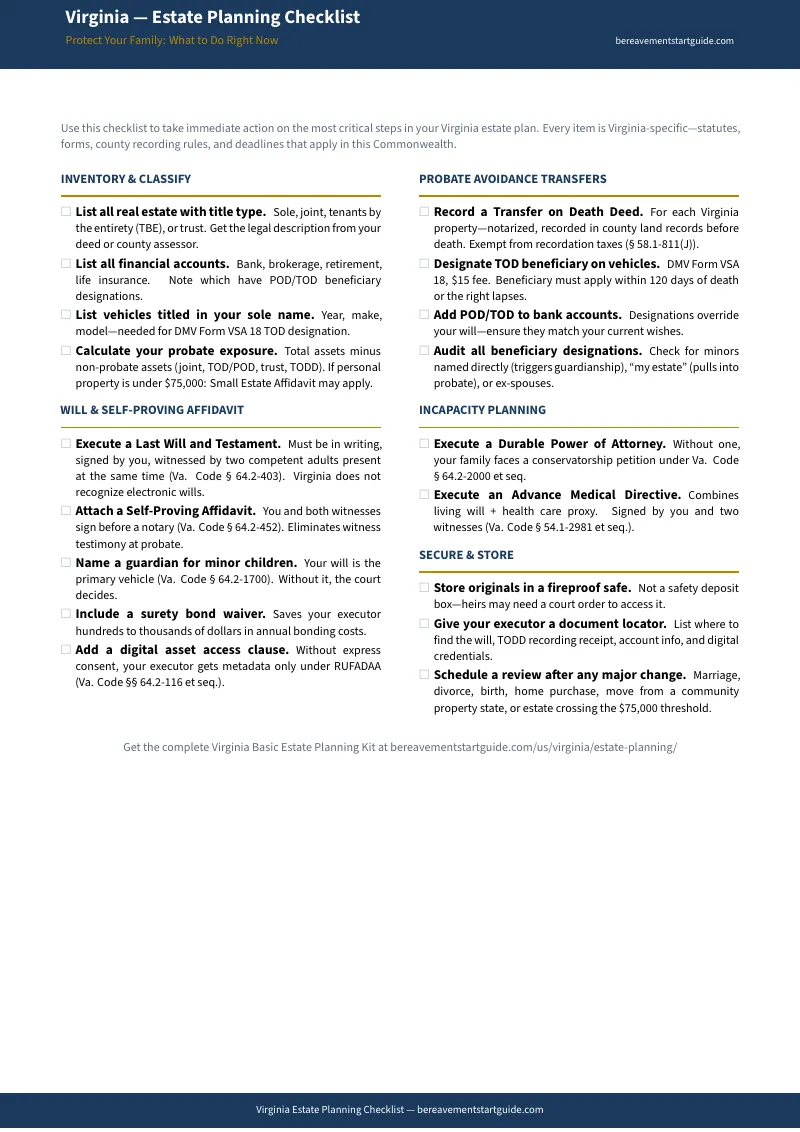
- Quick-Start Checklist — 20 actionable items in priority order with the Virginia-specific thresholds, deadlines, and form numbers that determine which steps apply to your situation. Print it, work through it, check things off.
- 10 standalone worksheets and reference cards — Asset Inventory Worksheet, Probate Exposure Calculator, Beneficiary Audit Worksheet, Document Execution Checklist, Digital Asset Inventory, Virginia Forms Reference, Costs Quick-Reference, Intestacy Quick Reference, Elective Share Reference Card, and Commissioner of Accounts Timeline. Each one is a separate PDF you can print and use on its own — at the kitchen table, in the attorney's office, or at the Circuit Court clerk's window.
Virginia-Specific Coverage You Won't Find Elsewhere
- The Stone Doctrine trap — how Virginia's immediate-vesting rule for real estate sounds like it avoids probate but actually exposes your heirs to personal liability for your debts under § 64.2-536, and what to do about it
- Commissioner of Accounts navigation — the 4-month inventory deadline, 16-month first accounting, fee schedules by estate size ($135 to $1,030+), and how to avoid delinquency proceedings that can strip your executor's commissions
- Augmented estate elective share — the marriage-length-based sliding scale under § 64.2-308.4 (3% at under 1 year to 100% at 15+ years), which non-probate assets get pulled in, and planning strategies for both spouses
- Transfer on Death Deed execution — the Uniform Real Property Transfer on Death Act requirements, recording before death, the tax exemption under § 58.1-811(J), and the formatting rules that cause county recorder rejections
- Expanded Medicaid recovery — why Virginia's definition under § 32.1-326.1 targets revocable trusts, making the instrument national vendors sell as a Medicaid shield completely ineffective in this state, plus the strategies that actually work
- Small Estate Affidavit — the updated $75,000 threshold under § 64.2-601 (effective July 1, 2025) and the $35,000 small asset delivery rule under § 64.2-602 that let many estates bypass probate entirely
- Community property transitions — what happens to assets from California, Texas, or Washington under the Uniform Disposition of Community Property Rights at Death Act (§ 64.2-315), and which documents need to be completely redone
Who This Is Built For
- Homeowners who want to transfer their home outside of probate using a Transfer on Death Deed instead of an expensive living trust — and need the recording instructions that work on the first submission
- Parents who need to name guardians for minor children and understand Virginia's strict will execution requirements before the next life milestone
- Couples relocating from community property states who've been told their existing documents "won't work" in Virginia and need to understand what actually needs to change versus what carries over
- Adult children helping aging parents get powers of attorney signed while they still have mental capacity — because once capacity is lost, the path leads through a court-supervised conservatorship under the Commissioner of Accounts
- Blended families navigating the intestacy one-third/two-thirds split and the augmented estate elective share to protect both biological children and a surviving spouse
- Unmarried partners who currently have zero legal standing under Virginia intestacy if their partner becomes incapacitated or dies
Why Not Just Use the Free Court Forms?
Virginia's Judicial System provides standard fiduciary forms — CC-1650, CC-1611, CC-1612, and dozens more. They're legitimate court documents, the same ones attorneys file.
Here's the problem: the forms come without instructions. Circuit court clerks are legally prohibited from telling you how to fill them out, what language to use, or how to coordinate them. You're held to the same filing standards as a licensed attorney, but no one in the courthouse can explain what those standards are.
The free forms don't explain how a will coordinates with beneficiary designations. They don't warn you about the Stone Doctrine liability trap. They don't cover Transfer on Death Deed recording requirements or the expanded Medicaid recovery definition. And they don't tell you when your estate is simple enough to skip the Commissioner of Accounts entirely using the Small Estate Affidavit.
The Commonwealth provides the pieces. The kit shows you how they fit together — and which ones you can skip.
Why Not Hire a Virginia Estate Planning Attorney?
For straightforward estates, there's a real question of whether $2,500 to $5,000 in attorney fees is the right investment. Virginia estate planning attorneys charge $300 to $450 per hour. A standard will, trust, and powers of attorney package runs $2,500 to $5,000+. That's real money for documents that many families can prepare correctly with proper guidance.
The kit doesn't replace an attorney for complex situations — and it tells you exactly when you need one (multi-state real estate, business succession, taxable estates above the federal exemption, contested family dynamics, or Medicaid planning with significant assets). But for the vast majority of Virginia families with a home, some retirement accounts, and minor children, the kit covers every document and decision point.
And if you do hire an attorney later, the completed worksheets become your intake package — saving hours of billable time at $300 to $450 per hour.
— Less Than One Hour of Attorney Time
Virginia estate planning attorneys bill $300 to $450 per hour. The kit covers what would take multiple consultations to accomplish — document preparation, beneficiary coordination, Commissioner of Accounts guidance, and a step-by-step action plan.
One-time purchase. No subscriptions, no annual renewal fees, no paywall between you and your own estate plan.
Money-Back Guarantee, No Time Limit
Download the kit, review the guide and checklists. If the plain-English instructions don't clarify the exact steps needed to protect your family under Virginia law, email us at any time for an immediate, full refund. No questions asked.
Important notice: Bereavement Start Guide is a publisher of educational resources. This kit assists individuals in organizing their estate affairs and completing standard statutory forms. It does not provide personalized legal, financial, or tax advice, does not act as a law firm, and does not establish an attorney-client relationship. For complex assets, multi-state property, or custom trust structures, consultation with a licensed Virginia attorney is recommended.