
Your Parent Is in the ICU. The Bank Says You Cannot Access Their Accounts Without a Court Order.
You assumed someone in the family had the authority to handle this. Nobody does. Your parent's checking account is frozen. The assisted living facility wants a deposit before they'll hold a bed. The mortgage payment is past due. And the bank teller — who isn't being difficult, who is following the law — says the only thing they can accept is a valid Power of Attorney or a court-issued guardianship order.
You don't have a Power of Attorney. So now you're looking at a Washington guardianship proceeding under the Uniform Guardianship, Conservatorship, and Other Protective Arrangements Act (RCW 11.130): attorney fees, court visitor investigations, a public hearing where a judge decides who controls your parent's finances, ongoing court-supervised reporting of every financial decision, and annual accountings to the court for as long as the guardianship lasts. All while the bills pile up and your parent lies in a hospital bed unable to sign anything.
A Durable Power of Attorney executed last month — last year — last decade — would have prevented every bit of this. One document. One notarized signature. Complete private authority to manage finances, handle real estate, and coordinate healthcare decisions — without ever setting foot in a courtroom.
The Washington Incapacity Protection System
This is not a blank form with "Washington" in the header. At its core is what we call the Washington Incapacity Protection System — a complete, statute-verified execution package that covers every document, every signing requirement, and every institutional enforcement tool you need to protect your family from the guardianship court system.
Free forms from Washington LawHelp give you the raw templates — the same ones legal aid clinics hand out with no instructions. National template sites give you a questionnaire that has never heard of Washington's "hot powers" under RCW 11.125.240, doesn't know that durability is not the default in Washington, and can't help when BECU or Washington Federal refuses to honor the document. The Incapacity Protection System gives you the forms and the execution blueprint — which powers to grant, how to sign and notarize, how to record for real estate, how to get bank acceptance using the Agent's Certification that most Washingtonians don't know exists, and how to coordinate Medicaid planning in a state with one of the most aggressive estate recovery programs in the country.
What's Inside — and the Exact Problem Each Part Solves
10 printable PDFs — the complete guide plus 8 standalone worksheets and reference cards you can print individually and bring to the bank, the notary, the elder law attorney, or the kitchen table signing.
The Durable Financial Power of Attorney
Here is the single most important rule in Washington POA law: durability is not the default. Under RCW 11.125.040, if your document does not contain explicit durability language, your agent's authority terminates the moment you become incapacitated — which is exactly when you need it most. The kit includes the financial POA with the mandatory durability clause pre-formatted, plus customizable "Hot Power" provisions under RCW 11.125.240 for the high-risk categories that require express grant: making gifts, creating or revoking trusts, changing beneficiary designations, modifying community property agreements, and delegating authority. Each hot power is explained in plain English, with guidance on which ones most families need (Medicaid planning requires gifting and trust powers) and which ones to leave out. Includes standalone: Hot Powers Decision Worksheet — check off which powers to grant before signing. Solves: the family whose "general" POA was rejected because it lacked express gift-making authority, disqualifying them from executing the Medicaid planning their elder law attorney recommended.
The Healthcare Power of Attorney
Washington's Durable Power of Attorney for Health Care (DPAHC) has specific witness restrictions that most families violate without knowing it. Under RCW 11.125.050, your witnesses cannot be a home care provider, an employee of the adult family home or long-term care facility where the principal resides, or anyone related to the principal or agent by blood, marriage, or state-registered domestic partnership. Get the witnesses wrong and the document is defective — and you won't find out until the hospital social worker rejects it during a crisis. Includes standalone: Witness Eligibility Worksheet — verify every statutory disqualification before anyone signs, with fill-in fields for witness names and dates. Solves: the daughter who had her brother and her mother's home aide witness the healthcare POA, not realizing both were disqualified — one as a relative, one as a care provider.
The End-of-Life and Remains Disposition Package
Washington has the most progressive end-of-life legal framework in the country. The Death with Dignity Act (RCW 70.245) allows competent, terminally ill adults to request life-ending medication. Natural organic reduction — human composting — has been legal since 2019, making Washington the first state to offer this option. But none of these choices are self-executing. Without a designated healthcare agent with explicit authority under RCW 68.50.160, a funeral home or hospital can default to conventional disposition regardless of what you wanted. The kit includes the designated agent form for remains disposition — the document that ensures your agent has the legal authority to direct your remains to a licensed natural organic reduction facility, arrange a green burial, or carry out any other disposition preference you've documented. Solves: the family that discovered their parent's wishes for human composting were documented in a personal letter that had no legal force, leaving the funeral home to default to cremation.
The Agent's Certification for Bank Acceptance
Your POA is valid. You signed it. You notarized it. And the branch manager at BECU says they need to "send it to legal for review" and wants you to fill out the bank's own proprietary form. This is the most common roadblock families face, and it happens at the worst possible time. The kit includes a pre-formatted Agent's Certification of Validity under RCW 11.125.430 — a sworn document your agent signs and presents to the financial institution, providing the exact statutory assurances the institution requires to verify the agent's authority. Includes two standalones: Agent's Certification Reference (what to certify and how) plus Bank Acceptance Strategy Sheet (rejection responses, pre-registration protocol, and a bank tracker you fill in as you register). Solves: the spouse who spent two weeks arguing with the credit union about a $300 utility payment while the household was about to lose electricity — because nobody knew the certification existed.
The Community Property Protection Guide
You're married. You own everything together. So you assume you can manage your spouse's finances if something happens. You cannot. Washington is one of nine community property states, and under Chapter 26.16 RCW, community ownership does not grant management authority during incapacity. Neither spouse can unilaterally sell community real estate, manage the other's individual retirement account, or alter an existing Community Property Agreement without written legal authorization. The guide explains the "spousal lock-out" problem in plain language and walks you through how a Durable POA with properly granted hot powers eliminates it — covering both community assets and separate property (inherited assets, pre-marriage holdings) without court involvement. Includes standalone: Community Property Worksheet — inventory community vs. separate property with fill-in tables for real estate, bank accounts, retirement accounts, and inherited assets. Solves: the husband who discovered he couldn't refinance the family home — titled as community property — because the lender required his incapacitated wife's signature and he had no POA.
The Medicaid Estate Recovery Planning Guide
Washington operates one of the most aggressive Medicaid estate recovery programs in the country. Under RCW 43.20B.080, the state's expanded recovery program can file claims against both probate and non-probate assets — including joint tenancies, living trusts, life estates, and assets transferred under community property agreements. Most families don't discover this until after the Medicaid recipient has died and a DSHS lien appears on the family home. The guide covers the five-year look-back period, the home equity exemption, spousal protection strategies, estate recovery deferrals and waivers, and the specific hot powers (gifting, trust creation, community property modification) your agent needs to be expressly granted in the POA before any asset protection strategy can begin. Includes standalone: Medicaid Planning Reference — 2026 numbers, required hot powers checklist, strategies, deferral rules, and critical timing on one printable sheet. Solves: the family that assumed putting the house in a living trust protected it from Medicaid recovery, not knowing that Washington's expanded MERP reaches non-probate assets including revocable trust property.
The Real Estate Execution Guide
Using a POA for a real estate transaction in Washington has specific procedural requirements. The POA must be recorded with the county auditor under RCW 11.125.270, and the agent must have express authority over real property transactions — this is not implied by a general grant. Miss either requirement and the title company rejects the closing. The guide walks through real estate POA execution step by step — from verifying the correct authority grant to recording the document with the county auditor before the deed filing. Solves: the family that lost a real estate closing because the POA had been signed but never recorded, and the title company refused to insure the chain of title.
The Complete Execution Blueprint
A POA that sits in a drawer protects nobody. The blueprint is the chronological "do this first, do this second" sequence that takes you from agent selection through document signing, notarization, county recording (for real estate), and institutional delivery. It covers Washington's two execution options — notarization (strongly recommended for institutional acceptance) and the two-witness alternative — with the Witness Eligibility Worksheet, notary block formatting, the Agent's Certification preparation, and a distribution checklist so every bank, brokerage, insurance company, and healthcare provider that needs a copy receives one before a crisis forces them to evaluate an unfamiliar document under time pressure. Includes two standalones: Full Execution Checklist (every step from agent selection through post-death transition) plus Official Forms and Key Contacts Reference (every form source and agency contact on one sheet). Solves: the family that executed a perfect POA and then left it in a safe deposit box that the agent couldn't access without — a power of attorney.
Who This Is For
- The adult child whose parent is declining — you can see the trajectory, and the window for legal documents is closing. Your parent can still sign. Next month, next year, that may not be true. And without a POA, you're looking at a guardianship proceeding under RCW 11.130 that costs more than the bank accounts you're trying to protect.
- The married couple who assumed they were covered — community property does not mean community management authority. If one spouse is incapacitated, the other cannot sell community real estate, manage individual retirement accounts, or alter a Community Property Agreement without a POA. The kit gives both spouses reciprocal protection.
- The family protecting the home from Medicaid recovery — Washington's expanded MERP reaches non-probate assets. Without a POA that expressly grants the hot powers for gifting, trust creation, and community property modification, your agent cannot execute the asset protection strategies that keep the family home out of the state's reach.
- The Washingtonian who wants end-of-life choices honored — from the Death with Dignity Act to being the first state to legalize human composting, Washington offers more end-of-life options than almost any other state. But those choices require a designated agent with documented legal authority. The kit ensures your wishes are binding, not aspirational.
- The real estate buyer or seller who cannot attend the closing — you need a recorded POA with express real property authority, and you need it before the closing date. The kit walks through the exact steps that prevent title company rejections.
Why Free Tools Fall Short
- Washington LawHelp and court self-help centers — free PDFs from legal aid nonprofits. No guidance on which hot powers to grant. No explanation of the witness disqualifications that can invalidate a healthcare directive. No instructions for what to do when the bank refuses your perfectly valid document. No Medicaid planning context. The form is a blank canvas — the kit is the execution manual.
- LegalZoom, Nolo, and national platforms — online questionnaires generating generic templates for $39 to $249, often with monthly subscription upsells. Most use standardized forms that miss Washington's specific legal landscape: the non-default durability rule, the expanded Medicaid estate recovery program, the hot power categories under RCW 11.125.240, natural organic reduction designation, and the Death with Dignity Act coordination. None include the Agent's Certification for bank acceptance.
- Elder law attorneys — the most legally secure option at $300 to $600 for a single POA, or $3,000+ for a full estate plan. Essential for complex situations: contested capacity, business succession, large estates approaching the state estate tax threshold (currently $3 million), or Medicaid planning involving six-figure asset transfers. Disproportionate for the straightforward married couple or the adult child who needs a valid POA executed this week.
- Hospital or hospice social workers — basic medical directive forms distributed during admission. These cover end-of-life treatment preferences but provide zero authority over bank accounts, real estate transactions, community property management, or Medicaid planning during a lifetime incapacity.
Free resources give you raw forms and attorney marketing. The kit gives you the complete Washington incapacity protection system — execution instructions, bank acceptance tools, Medicaid planning guidance, community property protections, end-of-life designations, and every signing requirement — assembled, statute-verified, and ready to use tonight.
Less Than One Hour of Attorney Time
Elder law attorneys in Washington charge $200 to $500 per hour. LegalZoom charges $39 to $249 for basic POA packages. Guardianship proceedings cost thousands — and that's the uncontested price.
The kit costs — once, no subscription, no hourly rate. Durable Financial POA, Healthcare POA, Agent's Certification, community property guide, Medicaid recovery planning, end-of-life designation, real estate execution guide, and the complete step-by-step blueprint. Every instruction, every Washington-specific requirement in one download.
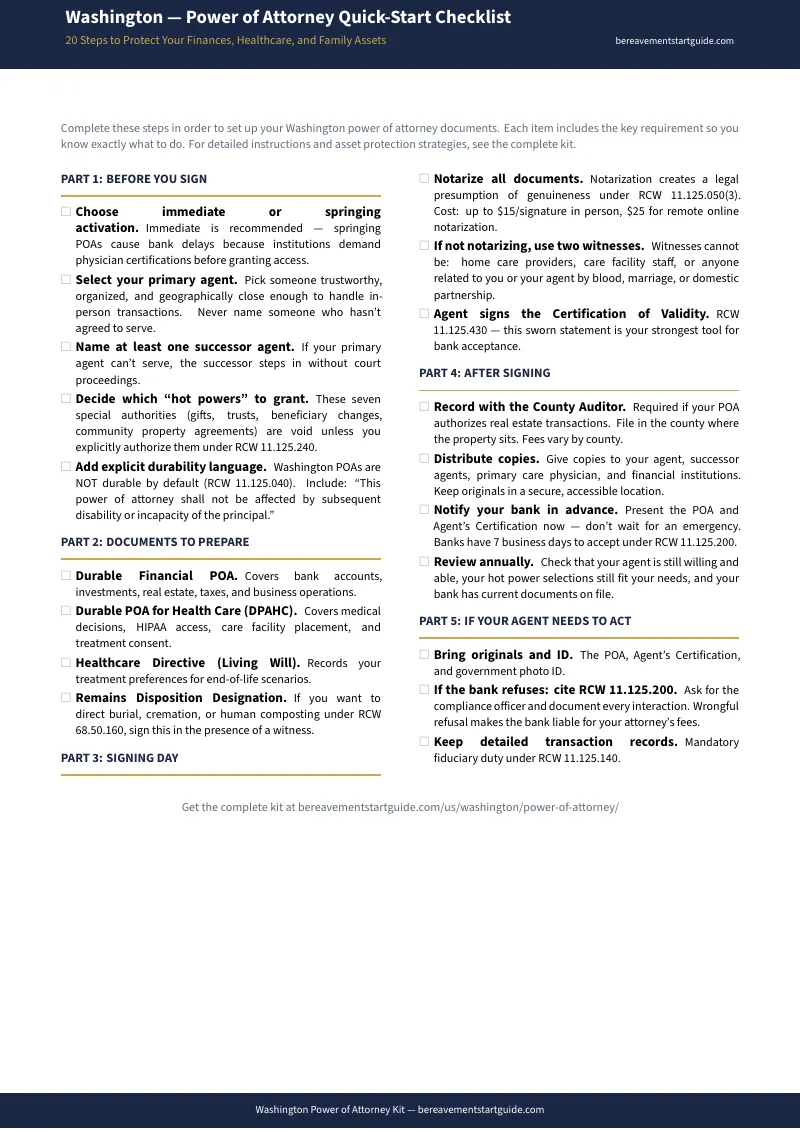
Not ready for the full kit? Download the free Washington POA Quick-Start Checklist — a one-page overview of every document you need, every signing requirement, and every critical deadline. It's enough to understand the scope. The full kit is there when you're ready to execute.
You don't need a crisis to justify a power of attorney. But if the crisis comes without one, your family's next step is a courtroom — not a kitchen table conversation. Get the documents in place now, while everyone can still sign.