Alberta Has No "Power of Attorney" Form. The Authority Your Family Needs Is Two Documents — and the Wrong Witness Silently Voids Both.
You decided to get your affairs in order. Maybe a parent's stroke made it urgent. Maybe retirement made it practical. So you searched for an Alberta power of attorney form — and landed in a swamp of American templates, Ontario advice, and government pages that assume you already know the law. Here is the first thing nobody tells you: Alberta has no single "power of attorney," and no government form for the financial one at all. Money and property are delegated through an Enduring Power of Attorney (EPA) under the Powers of Attorney Act — a private legal document you must have drafted yourself. Healthcare and personal care need a completely separate document, a Personal Directive, under a different statute entirely.
Get this wrong and the consequences arrive at the worst possible moment. If a stroke, a fall, or cognitive collapse leaves you or your parent without capacity — and no EPA exists — banks freeze sole accounts. Mortgage payments stop. Utility bills pile up. The care facility deposit goes unpaid. Your family cannot simply step in and sign: they apply to court for guardianship and trusteeship orders under the Adult Guardianship and Trusteeship Act — thousands of dollars in legal fees, months of delay, and private family finances entered into the public record. All while a loved one is in a hospital bed.
And even a signed document has traps no free template warns you about. Electronic signatures are legally invalid for both Alberta documents — full stop. The witness exclusion list — your spouse, your Attorney, your Attorney's spouse — is exactly who most people ask to witness, which is why DIY documents fail quietly and are discovered at the bank counter. Speaking of banks: they routinely refuse un-notarized EPAs the statute never required to be notarized, and the Land Titles Office applies its own execution standards to any EPA that touches real estate. "Technically valid" does not help when a teller says no.
The Alberta Power of Attorney Kit is built as an Authority Handoff System — the only Alberta planning kit that follows legal authority across its entire lifecycle: drafting both documents correctly, executing them so they're binding, activating them when capacity is lost, getting banks and Land Titles to accept them, and managing the moment every POA ends — the donor's death, when authority passes to the executor and the estate work begins. Fourteen chapters plus three appendices, written in plain language, built for the Alberta system as it exists right now.
What's Inside the Authority Handoff System
A 14-chapter guide, three appendices, a 20-item Quick-Start Checklist, and three standalone fillable worksheets — covering the Enduring Power of Attorney, the Personal Directive, and the estate transition no other resource connects to them:
Chapter 1: Alberta's Two-Document System — What You Actually Need
The strict legislative split between money and care — because assuming one document covers both is how families end up locked out of accounts while holding a valid Personal Directive. What happens when the donor dies, and where the Office of the Public Guardian and Trustee fits in. You need the map before you can walk it.
Chapter 2: Choosing Your Attorney and Agent
Who can legally serve in each role, what to discuss before anyone signs, and why naming alternates is not optional — because the best-drafted EPA in Alberta is leaderless if your Attorney is unreachable, unwilling, or dies first. Includes the calm-under-pressure and trust criteria that matter more than "who is oldest."
Chapter 3: Drafting the Enduring Power of Attorney
Immediate vs. springing activation — the decision that shapes everything else — because a springing EPA that can't prove incapacity quickly is a locked door during a crisis. The clauses your EPA must contain, including the "endures past incapacity" language that gives it its name, and your drafting options from lawyer-drafted to self-directed.
Chapter 4: Drafting the Personal Directive
Appointing an Agent and writing personal-care instructions — coordinated with your EPA so the two documents never conflict, because your Attorney paying for care your Agent refused is a fight your family should never have.
Chapter 5: Signing and Witnessing — Where Most Documents Die
The execution rules that invalidate more DIY documents than everything else combined: in-person wet-ink signing, the full witness exclusion list, why electronic signatures are illegal for both documents, the narrow remote-witnessing rules, and the notarization question — banks demand it, the statute doesn't, and Chapter 5 tells you exactly what to do about that gap. Plus how to revoke a document correctly so an old version cannot resurface.
Chapter 6: Registration and Storage
The free OPGT Personal Directives Registry — what it actually stores (contact information only, never the document) and why registrations sit pending. And the EPA's blind spot: no registry exists at all, so storage and distribution do all the work — including why the original must never sit in a bank safe deposit box, which can be frozen exactly when your family needs what's inside.
Chapter 7: Capacity Assessment and Activation
How a Personal Directive "turns on" — the faster Schedule 2 route when you name a capacity assessor versus the two-provider Schedule 3 process if you don't. Activating a springing EPA in parallel, and the difference between capacity to make documents and capacity to activate them — a distinction that decides whether your plan works on the day it's needed.
Chapter 8: Acting as Attorney or Agent — Fiduciary Duties
What the law demands of the person you appoint: record-keeping, the no-self-dealing rules, what an Attorney can and cannot do with the donor's money, and the personal liability that comes with the role — because well-meaning adult children have been sued by their own siblings over mismanaged EPA accounts.
Chapter 9: Getting Institutions to Accept Your Documents
The chapter free resources skip entirely. Why banks reject valid EPAs and how to pre-clear yours with the branch before a crisis, and the Land Titles Office's own execution standards for any EPA that will touch real estate. A document nobody accepts is a document you don't have.
Chapter 10: If Capacity Is Already Lost — The AGTA Pathway
When no documents exist and capacity is already gone: the Specific Decision-Maker route for a one-time medical decision, informal trusteeship for government benefits, and full court-ordered guardianship and trusteeship — the process, the cost, and the timeline, so you know exactly what you're trying to avoid and what to do if you can't.
Chapter 11: When the Donor Dies — The Estate Transition
Both documents die with the donor — instantly. This chapter maps the handoff no POA guide covers: the immediate steps for the former Attorney, the death-certificate roadblock, Alberta's low-cost digital probate, the CRA deadlines that cost real money if missed, and what changes on an intestacy.
Chapter 12: Low-Income Funeral and Bereavement Benefits
The provincial supports most guides ignore: Income Support and AISH funeral benefits, the statutory 50% cemetery-plot discount under the Cemeteries Act, and how to close a small estate without spending money it doesn't have — because standard estate advice is written for families with assets.
Chapter 13: When to Hire a Professional
An honest assessment — blended families, business ownership, contested capacity, existing guardianship proceedings. Some situations genuinely need a lawyer, and this chapter tells you which ones — plus how to arrive at that lawyer's office organized enough to cut the billable hours significantly.
Chapter 14, Appendices, and the Standalone Printables
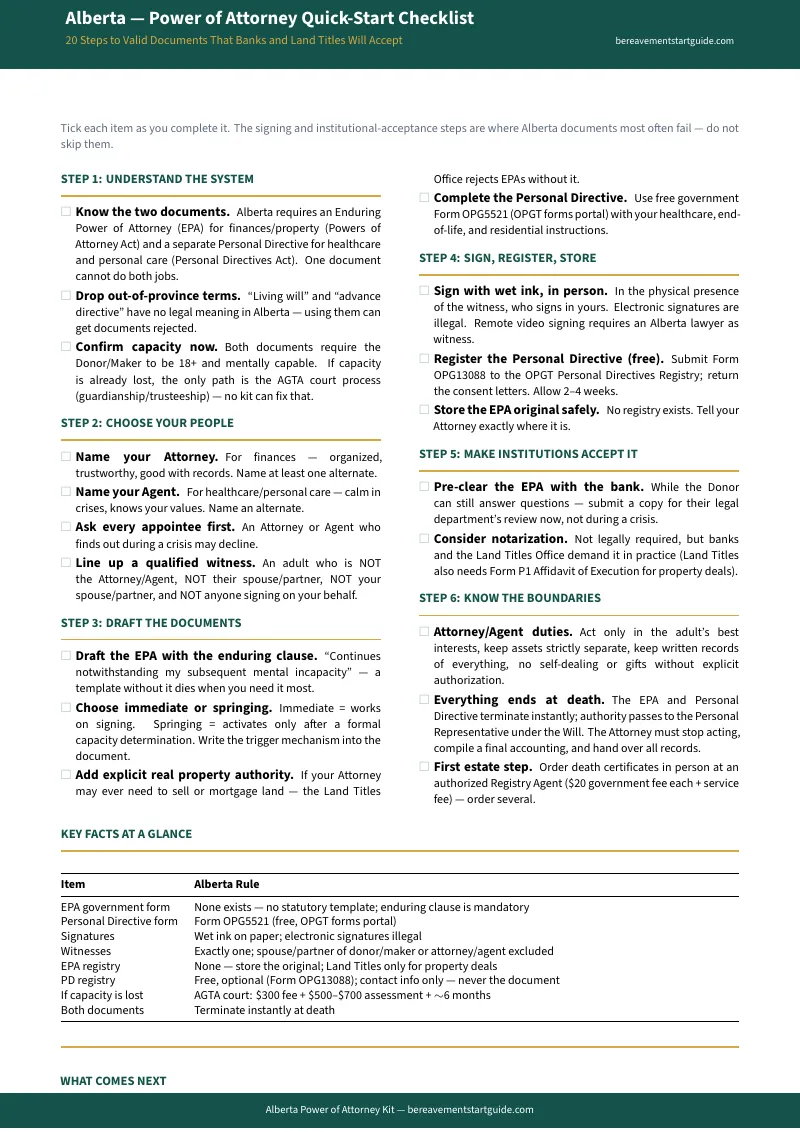
Chapter 14: the master contact directory — every registry, office, form, and phone number in one place. Appendices A–C are also delivered as standalone fillable PDFs you can print and work on directly: the Signing-Day Execution & Witnessing Checklist (bring it to the signing table), the Attorney/Agent Fiduciary Duty Checklist (with a transaction and decision log), and the Instrument Comparison Worksheet (EPA vs. Personal Directive vs. Will, plus space to record your own documents). Plus the standalone Alberta POA Quick-Start Checklist: 20 items across six phases, from understanding the system through institutional acceptance.
Who This Kit Is For
- The adult child who just became a caregiver — a stroke, a fall, a dementia diagnosis, and you suddenly have no legal authority over your parent's accounts or care. The kit gives you the correct documents, the signing rules, and the capacity-assessment pathway in the order you need them, before the family lands in a public guardianship application
- The proactive planner over 60 — you want your finances and your care covered properly on a fixed-income budget — two documents, signed correctly, with alternates named and the conversations had
- The couple doing this together — you each need your own EPA and Personal Directive, and each of you is disqualified from witnessing the other's. The kit's signing-day checklist prevents the single most common error that invalidates Alberta documents
- The new Albertan or returning resident — your out-of-province or US power of attorney was written for a different system. The kit explains exactly which Alberta documents replace it and which execution rules are different here
- The executor-in-waiting — you hold your parent's EPA and know it dies with them. Chapter 11 maps the handoff so the transition is a checklist, not a scramble
- The family navigating a death with no money — Chapter 12 covers the Alberta funeral benefits, AISH routes, and the 50% cemetery discount: the part of the system built for exactly this situation
Why Free Resources Will Not Build This Plan
The information is free. Knowing what to do with it — and getting institutions to accept the result — is not. Here is what you actually get from the free options:
- Alberta.ca and the Office of the Public Guardian and Trustee provide the statutory Personal Directive form and the free registry. They offer no Enduring Power of Attorney form at all — none exists — and no EPA registry. They tell you what the law is; they do not walk you through drafting, signing, or getting a bank to accept anything.
- Online will platforms generate polished documents through friendly questionnaires — then stop. No notarization guidance for bank acceptance, no Land Titles execution standards, no capacity-activation pathway, no estate-transition chapter. The document is the beginning of the job, not the end.
- US and Ontario templates are written for jurisdictions with combined POA documents and different execution law. Alberta's two-document split, its witness exclusions, and its ban on electronic signatures are exactly what these templates get wrong.
- Alberta law firms are thorough and customized at $750 to $1,500+ for a planning package, with weeks of lead time. The right call for complex estates — and unreachable at 9 p.m. on a Sunday when a parent is admitted to hospital.
Free resources hand you a statute and, at best, one blank form. The Authority Handoff System gives you the complete Alberta plan — both documents, correct execution, activation, institutional acceptance, and the estate handoff — assembled in the order you do the work, written for the person doing it.
— A Fraction of One Hour of a Lawyer's Time
An Alberta estate lawyer charges $300 to $500 per hour; a planning package runs $750 to $1,500 or more. A guardianship application for a parent who never signed documents costs several thousand — plus months of delay and your family's finances in the public record. This kit costs less than a single hour of professional time and gives you the complete system: fourteen chapters and three appendices covering the Enduring Power of Attorney, the Personal Directive, execution and witnessing rules, capacity assessment and activation, bank and Land Titles acceptance, the AGTA pathway, the estate transition, and low-income bereavement benefits. Plus the standalone Quick-Start Checklist and three fillable worksheets — signing-day execution, fiduciary duty log, and instrument comparison — you can print and start working through tonight. And a money-back guarantee, no time limit — if the kit does not give you clarity and a completed plan, email us for a full refund. No questions asked.
Not ready for the full kit? Download the free Alberta — POA Quick-Start Checklist — 20 steps covering the two-document system, the witness rules that invalidate most DIY documents, and how to get institutions to accept your paperwork. It is enough to get the critical moves right. The full kit is there when you want the complete roadmap.
A capacity crisis does not wait for you to finish researching. This kit turns an afternoon into legally binding documents your bank will accept — and a handoff plan your family will need one day.