"Living Will" and "Healthcare Power of Attorney" Are Not Legal Documents in British Columbia. The Documents That Protect You Have Different Names — and One Wrong Witness Silently Cancels Them.
You decided to get your affairs in order. Maybe a parent's dementia diagnosis made it urgent. Maybe retirement made it practical. So you searched for a "BC living will" or "advance directive" — and landed in a swamp of American templates, Ontario advice, and government pages that assume you already know the law. Here is the first thing nobody tells you: the terms "living will" and "healthcare power of attorney" appear nowhere in BC legislation. British Columbia splits the job across four instruments: a Section 9 Representation Agreement (your healthcare proxy), a Section 7 Representation Agreement (built for adults whose capacity is already in question), an Advance Directive (written instructions directly to doctors), and an Enduring Power of Attorney (finances only — never healthcare). Download a US-style template tonight and a BC hospital can disregard it tomorrow.
Get this wrong and the consequences arrive at the worst possible moment. If you lose capacity without the right documents, the hospital appoints a Temporary Substitute Decision Maker from a statutory list of relatives — someone who cannot make personal care decisions and cannot refuse life-sustaining treatment on your behalf, no matter how well they know you. For your money, there is no family default at all: your family applies to the Supreme Court of BC for a Committeeship order — roughly $7,500 in legal fees, two physician affidavits at $300–$2,000 each, a $525 Public Guardian and Trustee review fee, months of frozen accounts, and your private medical details on the public record. All while a loved one is in a hospital bed.
And even people who do sign documents fall into two traps no free resource warns them about. First: the vagueness trap. "No heroic measures" is not an instruction a physician can legally act on — it requires interpretation, and interpretation requires someone's consent, which defeats the entire point of the document. Second: the execution trap. Have your daughter witness the document that names your son as representative, sign electronically, or miss a statutory certificate on a Section 7 agreement, and the document is invalid — a fact nobody discovers until a hospital refuses to follow it. Meanwhile the MOST form your doctor signed, which the family assumes is the legal directive, is only a medical order. It never replaces legal consent.
The British Columbia Advance Directive & Living Will Kit is a Four-Document Bridge System — the only BC planning kit that connects what free resources leave scattered: the Section 7 vs. Section 9 decision, clinical-grade drafting templates doctors can actually follow, the witnessing rules that make documents binding, and the MOST/Nidus clinical layer that makes them findable at 2 a.m. Twelve chapters plus a standalone 18-item Quick-Start Checklist, written in plain language, built for British Columbia law as it exists right now.
What's Inside the Four-Document Bridge System
A 12-chapter guide and an 18-item Quick-Start Checklist — covering the RA9, the RA7, the Advance Directive, the Enduring Power of Attorney, and the clinical integration that turns paperwork into protection:
Chapter 1: How British Columbia Is Different — The Four Planning Documents
Why "living will," "healthcare proxy," and "personal directive" have no standing in BC — and what the Representation Agreement Act and the Health Care (Consent) Act actually create. Includes what happens if you do nothing: the TSDM hierarchy, its hard legal limits, and the Committeeship path your family faces without a plan. You need to know what you're avoiding before you can avoid it.
Chapter 2: Choosing Your Documents — The Capacity Decision
The single most damaging error BC families make is drafting a Section 9 agreement for a parent who already shows cognitive decline — a document that can be ruled invalid exactly when you need it, because Section 9 requires full traditional capacity. This chapter is the decision matrix: capacity indicators mapped to the right instrument, and every job (surgery consent, bill paying, real estate, treatment refusals) matched to the document that does it.
Chapter 3: The Section 9 Representation Agreement — Your Healthcare Proxy
What your representative can and can never do, the Section 16 duties they legally owe you, and the representative selection worksheet — because calm under pressure and geographic availability matter more than "who is oldest." Why at least one alternate is not optional, and the drafting tips that prevent hospital rejections — including explicitly granting end-of-life powers, because silence on that point makes clinicians hesitate.
Chapter 4: The Section 7 Representation Agreement — When Capacity Is Already in Question
The chapter that answers "is it too late for my parent?" — usually, no. Under Section 8, an adult can sign an RA7 even if they can't manage their affairs or make a contract, as long as they can express a desire for help and show trust in their chosen person. Scope of authority, the monitor requirement, and the mandatory statutory certificates (Forms 1–4) where most self-drafted RA7s fail — plus the math on why an RA7 executed in an afternoon beats a $7,500+ Committeeship application every time.
Chapter 5: The Advance Directive — Direct Instructions to Your Doctors
The closest thing BC has to a living will — and more powerful. A clear, applicable Advance Directive binds clinicians directly, without anyone else's consent; under the Emergency Health Services Act, even first responders cannot override it; and where it conflicts with a MOST form or an undated DNR order, the dated directive legally prevails. The fix for the vagueness trap: clinical-grade model phrasing for CPR, ventilation, tube feeding, antibiotics, and the situations clause — the exact wording structure that turns a wish into an enforceable instruction.
Chapter 6: The Enduring Power of Attorney — The Financial Half
Why an EPOA grants zero healthcare authority (and why assuming otherwise is one of the costliest mistakes in BC), immediate vs. springing activation, choosing your attorney, the LTSA filing requirement if real estate is involved, and the execution rules — wet ink, two witnesses or one lawyer/notary, and the attorney signs too.
Chapter 7: MOST Forms — Where Clinical Orders Meet Legal Documents
The chapter free resources skip. What a Medical Orders for Scope of Treatment form actually is — a doctor's medical order, not your legal document — the M1-to-C2 designations decoded, the four-step conversation guide for your physician visit, the emergency hierarchy that shows exactly where the MOST form fits (and where it doesn't), and the Greensleeve-on-the-fridge protocol paramedics are trained to look for. This is how a legal plan becomes a treatment decision.
Chapter 8: Signing and Witnessing — Where Most Self-Drafted Documents Die
Wet ink on paper only — electronic signatures on Representation Agreements and EPOAs are legally invalid in BC. Two witnesses or one BC lawyer/notary. The full disqualification list — anyone named in the document, their spouse, child, or parent, paid caregivers, anyone under 19. The remote witnessing conditions, and a pre-signing checklist so you get it right the first time, not after a hospital says no.
Chapter 9: Storage, Registration, and Keeping the Plan Alive
The two registries people constantly confuse: the Nidus Personal Planning Registry — which stores actual PDF copies an ER team can pull at 2 a.m. — versus the BC Wills Registry, which files a notice about your will only. Step-by-step Nidus registration, the Document Storage and Access Log, distribution lists, review triggers, and the full revocation sequence — because a revocation is legally ineffective until it's delivered to every named person.
Chapter 10: If There Is No Plan — The TSDM List and Committeeship
The statutory substitute decision-maker hierarchy, the equal-rank dispute rules that produce bedside gridlock between siblings, the TSDM's hard limits, and the full Committeeship cost picture — legal fees, physician affidavits, the PGT review fee, and the Public Guardian and Trustee's statutory commissions if no family member can serve. Every dollar and month of it is avoidable.
Chapter 11: Special Situations
Common-law partners (the two-year cohabitation rule — and why even a qualifying spouse should be named in an RA9), out-of-province documents and the Form 5 Certificate of Extrajurisdictional Solicitor, updating after a new diagnosis, First Nations Health Authority planning resources, and why MAID can never be requested through these documents.
Chapter 12: When You Need a Professional — and the BC Resource Directory
An honest assessment — family conflict, business assets, borderline capacity, out-of-province certificates — plus every official resource in one place: Nidus, the Public Guardian and Trustee, People's Law School, HealthLink BC, FNHA, LTSA, and Vital Statistics. Some situations genuinely need a lawyer; this chapter tells you which, and how to arrive organized enough to cut the billable hours.
Plus: The Quick-Start Checklist
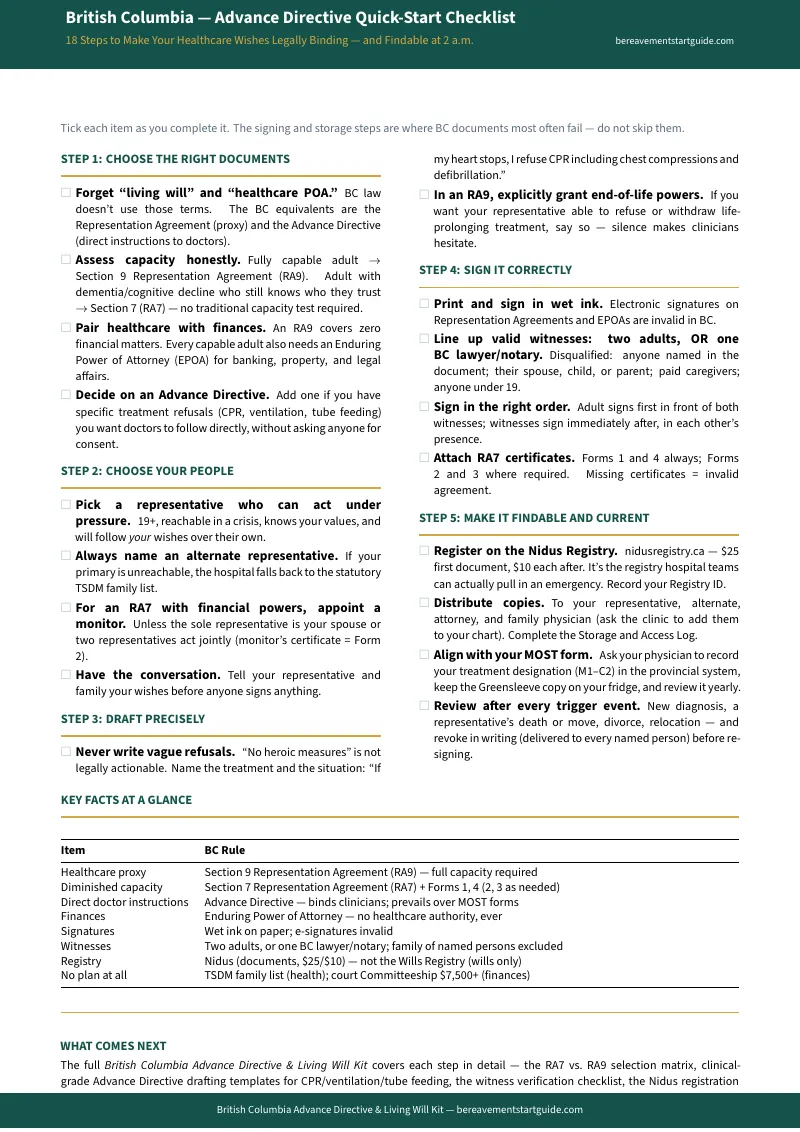
The standalone British Columbia Advance Directive Quick-Start Checklist — 18 items across six steps, from choosing the right documents through signing, registration, distribution, and review. Every witness exclusion, certificate requirement, and Nidus step at a glance. Print it and start tonight.
Plus: Five Standalone Worksheets
Fillable printables extracted from the guide, built for the moment you actually use them:
- Representative Selection Worksheet — compare up to three candidates against the seven questions that matter, then record your briefing notes so your representative actually knows your wishes
- Advance Directive Drafting Worksheet — the clinical-grade model phrasing for CPR, ventilation, tube feeding, antibiotics, and the situations clause, with space to write your own version line by line
- Signing-Day Execution & Witnessing Checklist — one sheet per document: witness verification against the disqualification list, the signing sequence, the RA7 statutory certificates, and the remote witnessing conditions
- MOST Conversation Card — fill it in before your physician visit and bring it to the appointment: your priority, the designation that fits you, your comfort preferences, and the Greensleeve-on-the-fridge protocol
- Document Storage & Access Log — where every original lives, your Nidus Registry ID, institutional filings, emergency contacts, and the distribution and review triggers that keep the plan alive
Who This Kit Is For
- The adult child who just became a caregiver — a dementia diagnosis, a stroke, a fall, and you suddenly have no legal authority to speak to your parent's doctors or touch their bank account. The kit gives you the Section 7 pathway most families never hear about — designed for exactly this situation — before the family lands in a Committeeship application
- The proactive planner over 60 — you want your treatment wishes and your decision-maker documented properly, not left to a statutory list of relatives who may not agree with each other
- The couple doing this together — you each need your own documents, and each of you — plus your children — is disqualified from witnessing if named in them. The witness verification checklist prevents the most common execution error
- The unmarried or common-law partner — BC recognizes common-law spouses only after two years of marriage-like cohabitation, and even then, proving it to a clinician mid-crisis is a gamble. An RA9 makes your partner's authority immediate and unquestionable
- The new British Columbian — your out-of-province personal directive or healthcare proxy means nothing here without a Form 5 certificate from a lawyer in that jurisdiction. The kit explains the validity conditions — and why most newcomers simply redo their documents under BC law
- The recently diagnosed — a serious diagnosis makes the MOST conversation immediate, not theoretical. The kit shows you how to align your Advance Directive and your MOST designations, and how to brief your representative to advocate for the right one
Why Free Resources Will Not Build This Plan
The forms are free. Knowing which one you need, drafting it so a clinician can act on it, and executing it so it's legally valid — is not. Here is what you actually get from the free options:
- The BC Ministry of Health "My Voice" booklet is legally authoritative and free — but it's 56 dense pages written from the healthcare system's perspective, and it leaves you to write your own medical instructions in blank spaces. That is exactly how vague, unenforceable refusals happen. No financial planning, no EPOA guidance, no registration walkthrough.
- Nidus and People's Law School offer excellent free forms and plain-language explainers — but the forms are structurally rigid, the websites are dense, and nothing walks you through the Section 7 vs. Section 9 decision, clinical-grade drafting, or the certificate requirements in sequence.
- Regional health authorities (Vancouver Coastal, Fraser, Island) publish good clinical MOST materials — but they explicitly do not provide legal documents and do not explain Representation Agreements. Their scope is consent in hospital, not your plan.
- Dying With Dignity Canada's free BC kit is compassionate and clearly written — but it combines the Advance Directive and Section 9 Representation Agreement into one document, so a single execution error can invalidate both. No financial or estate planning tools.
- Online document builders (Willful, LawDepot) generate polished documents from $129 — using generic multi-jurisdictional terms like "Living Will" that cause confusion in BC, with nothing on how MOST forms interact with legal documents and nothing on Section 7 supported decision-making.
- BC notaries and estate lawyers are thorough and customized at $400 to $1,500+ for a planning package, with formal appointments and lead time. The right call for complex estates — and unreachable at 9 p.m. on a Sunday when a parent is admitted to hospital.
Free resources hand you a blank form and a statute. The Four-Document Bridge System gives you the complete BC plan — the document decision, the drafting templates, the execution rules, the clinical integration, the registry walkthrough — assembled in the order you do the work, written for the person doing it.
— Less Than One Hour of a Notary's Time
A BC notary or estate lawyer charges $400 to $1,500 or more for a planning package; online builders start at $129 and stop at the document itself. A Committeeship application for a parent who never signed anything starts around $7,500 — plus months of delay and your family's private details in the public record. This kit costs less than a single hour of professional time and gives you the complete system: twelve chapters covering the Section 7 vs. Section 9 decision, the RA9 and RA7, the Advance Directive with clinical-grade drafting templates, the Enduring Power of Attorney, MOST forms, signing and witnessing rules, Nidus registration, revocation, and the TSDM/committeeship defense. Plus the standalone Quick-Start Checklist and five fillable worksheets — representative selection, directive drafting, signing-day witnessing, the MOST conversation, and the storage and access log — you can print and start working through tonight. And a money-back guarantee, no time limit — if the kit doesn't give you clarity and a completed plan, email us for a full refund. No questions asked.
Not ready for the full kit? Download the free British Columbia — Advance Directive Quick-Start checklist — 18 steps covering the document decision, the witnessing rules that invalidate most DIY documents, and the Nidus registration setup. It's enough to get the critical moves right. The full kit is there when you want the complete roadmap.
A medical crisis does not wait for you to finish researching. This kit turns an afternoon into a legally binding, clinically actionable plan — the documents your family needs, drafted the way BC doctors can actually follow.