Two Legal Systems. No Single Point of Contact. One Family Holding Everything Together.
Your loved one has died in India. The hospital or police have the body. The British High Commission has told you they cannot register the death, arrange transport, or pay for anything. And you are trying to coordinate a process that crosses two entirely separate legal jurisdictions — Indian municipal and criminal law on one side, UK probate and administrative law on the other — from thousands of miles away, on a smartphone, while grieving.
The free government guidance gives you a list of things that exist. The British Person Dies in India — Family Emergency Guide gives you the Dual-Jurisdiction Command Sequence — the specific order of authorities, documents, and decisions mapped across both countries, timed against the deadlines that actually matter, starting from the first phone call.
What Free Guidance Gets Wrong
The FCDO bereavement pack tells you to "contact the local registrar." It does not tell you that India has no central registrar — death registration is handled by whichever municipal corporation, municipal council, or gram panchayat has jurisdiction over the specific location of death, and that each operates under different procedural norms. It does not tell you that the 21-day registration window is now enforced with escalating judicial requirements under the 2026 amendment, or that a filing delayed past two years requires a First-Class Judicial Magistrate petition with court hearings and witness testimony.
Forum advice tells you to "get the death certificate apostilled." It does not tell you that the Ministry of External Affairs will not accept documents directly — you must route through one of five authorised outsource agencies — or that the certificate must first be notarised by a Notary Public and then attested by the State Home Department before the MEA will touch it. Skip one step and the entire chain restarts.
Repatriation companies tell you their costs. They do not tell you that if the death is classified as a Medico-Legal Case, the police hold the body until they issue a No Objection Certificate, that the forensic medical officer can remove and retain organs without your consent, or that state forensic laboratory backlogs can delay the official cause of death for six months to five years.
This guide covers what they leave out.
What's Inside the Guide
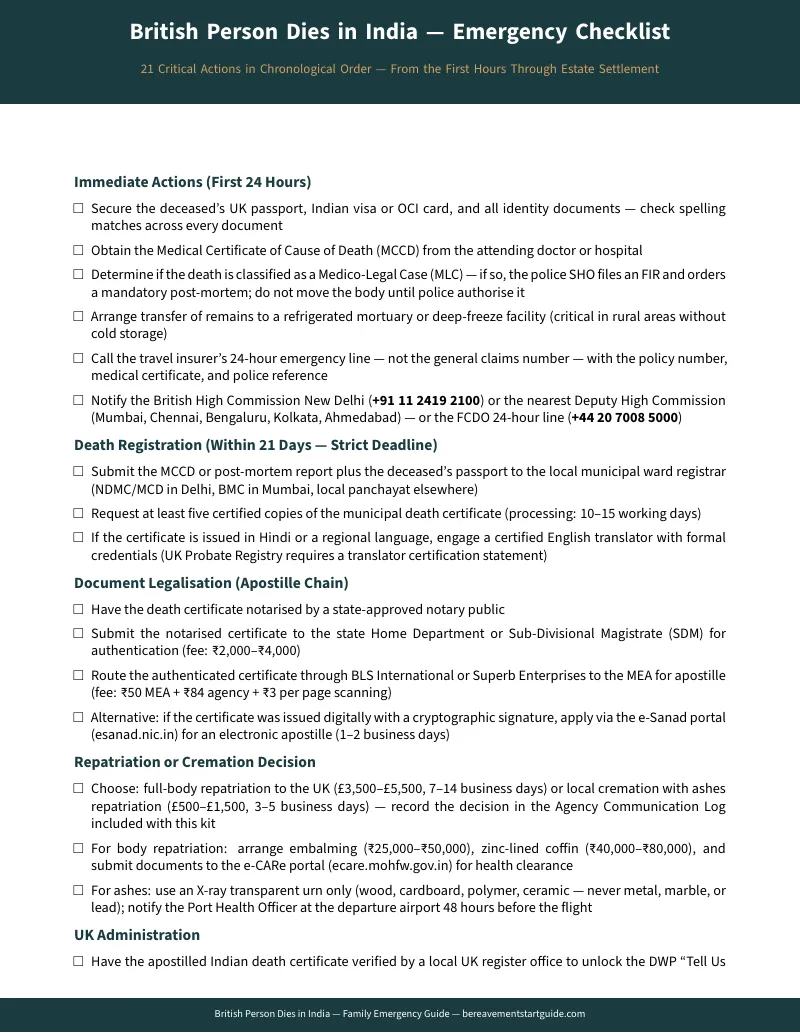
The 72-Hour Emergency Sequence — because rural India often lacks refrigerated mortuaries, and decomposition in tropical heat can prevent full-body repatriation within days. The guide maps the exact order: secure remains, verify cause-of-death pathway, activate insurance, contact the British High Commission — with the specific phone numbers, the specific forms, and the specific words to use at each step.
The Medico-Legal Case Response Protocol — because any sudden, accidental, or suspicious death triggers a mandatory police investigation, a government-ordered forensic post-mortem, and a hold on the body that the family cannot override. The guide explains what triggers an MLC, what the police require, how to obtain interim documentation for UK insurers and coroners, and the realistic timeline for body release in both urban and rural jurisdictions.
The MEA Apostille Chain — Step by Step — because an Indian death certificate has no legal force in a UK court until it passes through four sequential stages of legalisation, and a single break in the chain or a name discrepancy between the Indian certificate and the UK passport restarts the entire process. The guide maps each stage, names the outsource agencies, and flags the spelling traps that delay families for months.
Repatriation vs. Local Cremation Decision Framework — because the choice between full-body repatriation (£3,500–£5,500) and local cremation with ash transport (£500–£1,000) depends on factors most families do not discover until they are mid-process: religious requirements, police clearance status, cold-storage availability, airline cargo restrictions, and the 48-hour Port Health Officer notification rule.
Same-Sex Partner and Unmarried Next-of-Kin Authorisation — because Indian law does not recognise same-sex marriages, civil partnerships, or cohabiting relationships. A surviving same-sex spouse is a legal stranger to every Indian authority. The guide covers the Special Power of Attorney route, the biological-family authorisation process, and the High Court petition option.
Indian Estate Settlement and FEMA Compliance — because NRO account repatriation is capped at USD 1 million per financial year and requires Form 15CA (online tax declaration) and Form 15CB (Indian Chartered Accountant certificate), while the deceased's worldwide estate must be disclosed on HMRC Form IHT400 under the India-UK Double Taxation Avoidance Agreement.
UK Probate with a Foreign Death Certificate — because the Probate Registry requires either a licensed translation company's certificate or a completed Form PA19 with the translator's credentials declared under oath, and banks apply their own additional standards on top of the probate requirements.
Nine Printable Standalone Planning Tools — the emergency contacts card, the 72-hour emergency action plan, the master document tracker, the MEA apostille tracker, the repatriation decision worksheet, the insurance claim sequence, the financial tracker, the NRO remittance checklist, and the agency communication log — each designed to work independently from the main guide so different family members can handle parallel tracks.
Who This Guide Is For
- Adult children and siblings in the UK coordinating remotely with Indian hospitals, police, and municipal registrars across a five-and-a-half-hour time zone gap — managing contradictory advice from forums, family WhatsApp groups, and contacts whose knowledge predates the 2026 registration reforms
- Surviving spouses and partners — especially same-sex spouses, civil partners, and unmarried partners whose relationship is invisible to Indian law and who face immediate exclusion from remains access, medical records, and registration rights
- British-Indian families with dual roots where the deceased was a retired NRI or OCI cardholder, the estate includes Indian property and bank accounts, and local relatives' understanding of the system may be years out of date
- Executors and probate solicitors who need the Indian-to-UK certified document chain correct on the first attempt — particularly where the deceased held assets in both countries or died without an Indian will
- Corporate HR directors and travel-insurance case managers managing duty-of-care obligations for British employees and contractors deployed to India
Why Not Piece It Together Yourself?
You can. The information exists — scattered across FCDO guidance pages, Indian municipal websites in Hindi, MEA circulars, airline cargo policies, probate court practice directions, and Reddit threads from 2019 that predate the 2026 registration reforms. Assembling it into a coherent sequence while managing grief, time zones, and a deteriorating body is the problem this guide solves.
A single procedural error — an un-apostilled death certificate, a misspelled name, a lapsed registration deadline — can delay UK probate for months, freeze bank accounts, and cost thousands in solicitor fees or unnecessary repatriation expenses. The guide costs less than one hour of a cross-border probate solicitor's time.
Full Refund, No Time Limit
If the guide does not help — for any reason — email hello@bereavementstartguide.com for a full refund. No time limit, no questions.
Get Started Now
Download the free emergency checklist to get the first-72-hours action sequence immediately. Or get the full British Person Dies in India — Family Emergency Guide for the complete Dual-Jurisdiction Command Sequence, the MEA apostille chain, the estate repatriation process, and every standalone planning tool — for .