Two Countries, Zero Coordination — and the Clock Is Running
Your family member has died in the United Kingdom. You are in India, possibly thousands of miles from the body, the hospital, the register office, and the coroner — and every institution you need to contact operates on UK business hours, in a legal system you have never encountered.
Here is what no one tells you upfront: the UK has four separate death registration systems (England, Wales, Scotland, Northern Ireland), each with different deadlines and documents. The coroner can hold the body for weeks without giving you a timeline. An apostille you thought was valid gets rejected at an Indian bank. And the government health portal that controls whether your loved one's remains can even enter India has a registration trap that locks you out if you use the wrong passport number.
These are not rare complications. They are the standard experience for Indian families navigating this corridor — and each one costs time, money, and emotional capacity you cannot afford to waste.
The Dual-Jurisdiction Roadmap
This guide is the independent, step-by-step playbook for families coordinating a UK-to-India bereavement from a distance. It maps every decision, document, and deadline across both jurisdictions in the order you will actually face them — not as a list of government links, but as a chronological workflow built around the three critical windows: the first 72 hours, the document-and-transit phase, and long-term estate resolution.
It is fully updated for the 2025 RBI Directions on deceased bank claims and the 2025 repeal of Section 213 of the Indian Succession Act — two recent changes that can save your family months of unnecessary court proceedings and tens of thousands of rupees in legal fees.
What You Get
- The coroner-versus-Medical Examiner decision tree — England's coroner and Scotland's Procurator Fiscal operate under different legislation, with different timelines and different release procedures. The guide maps both pathways so you know within hours whether you are looking at a 2-day or a 21-day hold.
- The repatriation cost comparison — body repatriation (£3,000–£6,000) versus direct cremation and hand-luggage ashes (under £2,000), with the exact documents required for each option. A family that discovers the ashes route at the right moment saves over £3,000.
- The apostille-trap explainer — Indian banks reject digital e-Apostilles on registry death certificates. The guide walks you through the FCDO paper-based route and the next-day express agent option so your documents are not sent back at the counter.
- eCARe portal step-by-step — India's mandatory health clearance system for importing human remains, with the 48-hour filing rule and the critical warning about account registration that catches most first-time users.
- Indian bank claims under the 2025 RBI Directions — accounts under ₹15 lakh with no nominee can now be settled in 15 calendar days using a Legal Heir Certificate instead of a court Succession Certificate. The guide details the exact paperwork Indian banks require from overseas heirs.
- EPFO, EDLI, and life insurance claims — Aadhaar-based e-KYC for provident fund death benefits, the EDLI insurance calculation, and the IRDAI 15-day settlement timeline for straightforward life insurance claims.
- Identity cleanup sequence — Aadhaar deactivation, PAN surrender, and the Section 159 final income tax return, in the order that avoids triggering compliance flags at other institutions.
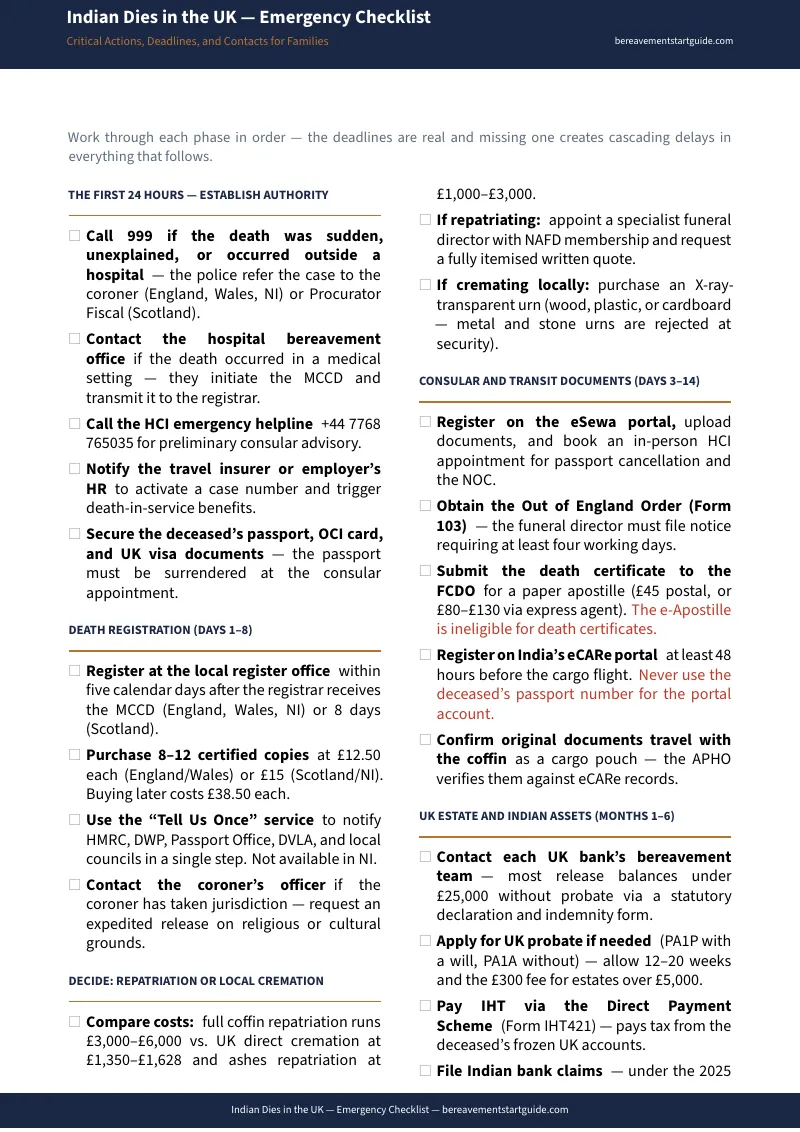
- 24-item emergency checklist (included free) — a printable, phased checklist covering every action from the first phone call through the final estate settlement, designed to be worked through by a family member who has never dealt with UK or Indian bureaucracy before.
- 5 printable worksheets — Emergency Contact Sheet, Repatriation Decision Worksheet with fill-in cost fields, Document Tracking Checklist across both jurisdictions, Financial Asset Inventory for UK and Indian accounts, and Agency Communication Log for your paper trail with every institution.
Who This Guide Is For
- Families in India coordinating a loss in the UK across time zones, with no prior experience of the coronial system, devolved registration, or UK funeral logistics
- UK-based relatives or friends acting as the local point of contact for register offices, funeral directors, and the High Commission
- Executors and administrators managing a dual-jurisdiction estate where Indian succession law and UK probate rules each demand different original documents
- Corporate HR, university welfare officers, and community organisations needing a structured workflow to hand to a grieving family
Why This Exists When Free Information Is Available
The High Commission of India publishes a document checklist. The FCDO has a bereavement information page. Citizens Advice covers basic registration. But none of these sources tell you how to sequence decisions across jurisdictions, how to avoid the apostille trap that delays bank claims by weeks, or how to navigate the eCARe portal without locking yourself out.
Commercial repatriation firms charge £3,000–£6,000 and stop at the Indian airport door. Private apostille agents charge £97–£229 per document but do not advise on broader estate administration. Nobody covers the full corridor — from the first 72 hours through Indian bank claims and Aadhaar deactivation — in a single, sequenced resource.
This guide does. It is independent, up to date, and built for families who need to act now — not after a six-month learning curve.
Full Refund, No Time Limit
If the guide does not help, email hello@bereavementstartguide.com for a full refund. No time limit, no conditions. You are navigating one of the most difficult administrative corridors a family can face — the last thing you need is risk on a resource that promises to help.
Download the free emergency checklist to see the structure and detail. When you are ready for the full 13-chapter guide with worked cost comparisons, template letters, and the complete estate resolution sequence, the paid version covers everything.