Wisconsin's Default Rules Are Already Making Decisions for Your Family
Most Wisconsin families assume that if something happens, everything goes to the spouse. It doesn't.
Die without a will and Wisconsin's intestacy statutes take over: if you have children from another relationship, your surviving spouse keeps only half the marital property — the rest goes to your children, including minors, through court-supervised guardianship. And because Wisconsin is a marital property state, default titling rules and the 120-hour survivorship rule can quietly hand partial ownership of your home to people you never intended — including, in blended families, stepchildren or an ex-spouse's relatives.
Meanwhile, the probate process your family lands in typically runs 12 to 18 months and costs 4% to 7% of the estate's value. A simple family home can be the only reason an estate gets dragged through court at all.
The problem was never motivation. It's knowing exactly which documents Wisconsin law requires, how they interact under the Marital Property Act, and which signing mistakes silently void them.
The Wisconsin Probate-Bypass Planning System
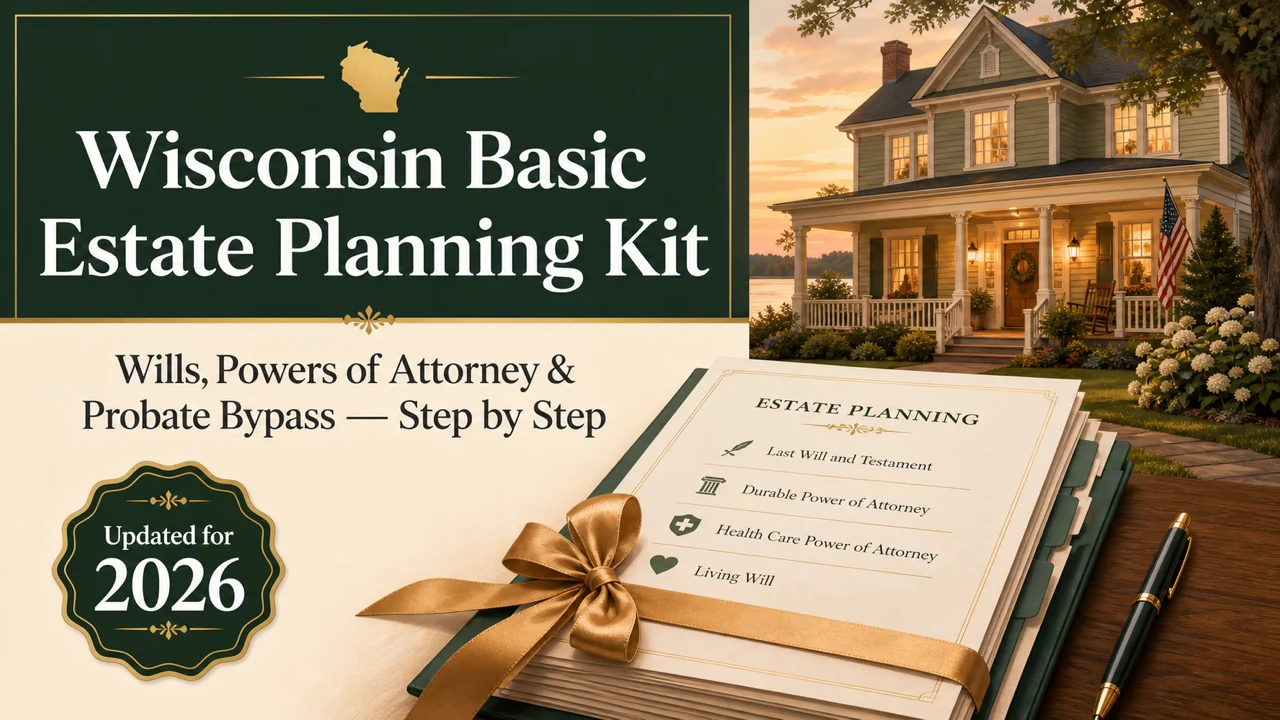
The Wisconsin Basic Estate Planning Kit is a complete, plain-English walkthrough of every document and decision that stands between your family and Wisconsin's probate courts.
This isn't a stack of blank forms with a "good luck" sticker. It's a step-by-step system built on one core strategy: keep your probate-subject estate under $50,000 using Transfer on Death deeds and beneficiary designations, so your heirs can settle everything with a simple Transfer by Affidavit under Wis. Stat. § 867.03 — no court case, no 18-month wait, no statutory fees. The kit shows you which documents to complete, in what order, and exactly how to sign each one so it holds up.
What You Get
- Complete Wisconsin Estate Planning Guide — 8 chapters covering how Wisconsin estate law works, the four core documents every adult needs (will, financial POA, health care POA, TOD deed), the step-by-step build plan, intestacy rules, the executor's roadmap after a death, Medicaid estate recovery, and special situations. Every rule cited to the Wisconsin statute that governs it.
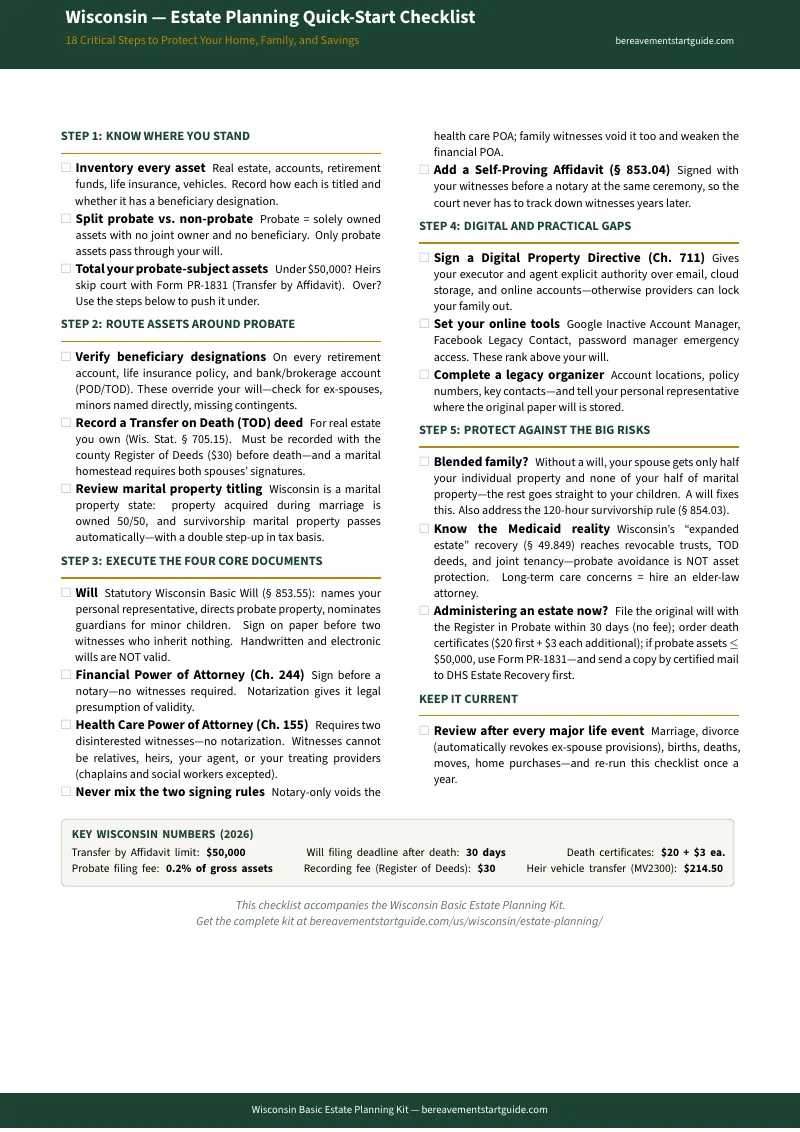
- Quick-Start Checklist — 18 action items in priority order, from auditing your probate exposure to executing and storing each document, so you can work through the whole plan in a handful of evenings.
- Asset Inventory Worksheet — a fill-in worksheet that lists everything you own, splits it into probate vs. non-probate, and totals your exposure against the $50,000 affidavit line.
- Probate Bypass Audit — the worksheet that walks the three levers (beneficiary designations, TOD deed, survivorship titling) and recalculates until your probate-subject total is under the threshold.
- Beneficiary Designation Audit — beneficiary forms override your will. This worksheet audits every account against the five catastrophic mistakes, including stale post-divorce designations and missing contingents.
- Execution Blueprint — the signing-day checklist covering the Wisconsin Basic Will (§ 853.55), the self-proving affidavit, the health care POA's strict dual-witness rules (no relatives, no heirs, no treating providers), and the financial POA's notarization step — the ceremony that keeps every document valid.
- TOD Deed Planning & Recording Log — move your home past probate entirely under § 705.15, with the spousal signature requirement for marital property homesteads and the county Register of Deeds recording log that must be completed before death.
- Family Legacy Organizer — document locations, key people, account and policy numbers, digital access settings, and funeral notes in one fill-in packet your personal representative can actually use.
- Digital Property Directive — a ready-to-sign authorization under Wisconsin's Chapter 711 Digital Property Act, granting your executor legal access to email, online banking, and cloud accounts and overriding restrictive provider terms of service.
- Marital Property Act guidance — what Wisconsin's 1986 marital property law means for your estate, including the double step-up in tax basis on survivorship marital property and the titling mistakes that quietly cost families six figures.
- Blended family & 120-hour rule planning — how to override the survivorship defaults so a common accident doesn't split your home between estates and accidentally disinherit the people you meant to protect.
- Medicaid estate recovery reality check — Wisconsin's "expanded estate" recovery reaches probate and non-probate assets, including TOD deeds and revocable trusts. The guide tells you plainly what DIY planning can and cannot protect — and the exact situations where you must hire an elder-law attorney.
Who This Is Built For
- Parents who need to legally name guardians for minor children — without a $1,000 attorney consultation
- Modest-asset homeowners who want to route the house and accounts around probate so heirs settle everything with a simple affidavit
- Retirees who want powers of attorney and non-probate transfers set up correctly while capacity is unquestionable
- Remarried couples and blended families protecting both a current spouse and biological children from Wisconsin's default survivorship rules
- Adult children organizing an aging parent's affairs before a crisis forces guardianship court
- Anyone who's been meaning to "get around to it" and needs a Wisconsin-specific plan sized for evenings, not billable hours
Why Not Just Use the Free State Forms?
Wisconsin's courts and State Bar publish real, free forms — the Basic Will, the Transfer by Affidavit, the health care POA. They're legally valid documents.
What they don't include is any guidance. Form PR-1831 arrives as a blank PDF with zero instructions — and the courts explicitly state they cannot tell you how to fill it out. Nothing explains which assets count toward the $50,000 threshold, that a personal representative named in a will cannot sign the affidavit for real property, that the DHS Estate Recovery Program must get a certified-mail copy, or that a health care POA signed by a relative as witness is void. The state gives you the pieces. The kit shows you how they fit together — and which mistakes can't be undone.
Why Not LegalZoom or Trust & Will?
Those platforms charge $149 to $499+ upfront, then quietly bill $49 to $299 per year just to keep editing or re-downloading your own documents. Cancel, and you lose access. And their questionnaires don't account for Wisconsin's wrinkles: the Marital Property Act, deferred marital property and the elective share, dual-witness health care POA rules, or the expanded reach of Medicaid estate recovery.
The Wisconsin Basic Estate Planning Kit is a one-time purchase — no subscription, no renewal, no paywall between you and your own estate plan.
— Less Than One Hour of Attorney Time
Wisconsin estate planning attorneys charge $200 to $350 per hour. A simple will package runs $300 to $1,500; a trust package, $1,500 to $5,000+. The kit doesn't replace an attorney for complex situations — and it tells you exactly when you need one — but for the majority of Wisconsin families who need compliant documents and a clear sequence of steps, it delivers immediate protection at a fraction of professional fees.
And if you do hire an attorney later, the completed inventories, beneficiary audit, and worksheets become your intake package — saving hours of billable time.
Money-Back Guarantee, No Time Limit
Download the kit and work through the checklists. If the plain-English instructions don't clarify exactly what your family needs — or if you decide to hire a local attorney for a custom plan instead — email us at any time for an immediate, full refund. No questions asked.
Important notice: Bereavement Start Guide is a publisher of educational resources and legal templates. This kit assists individuals in organizing their estate affairs and completing standard statutory forms. It does not provide personalized legal, financial, or tax advice, does not act as a law firm, and does not establish an attorney-client relationship. For anticipated long-term care needs, significant assets, or complex family structures, consultation with a licensed Wisconsin attorney is strongly recommended.