The hospital is billing daily storage. The embassy cannot move the body. And you are twelve time zones away trying to figure out who to call first.
An American family member just died in Thailand. You are sitting in the United States, trying to piece together a process you have never seen before. The embassy website lists phone numbers and general services. A funeral home in Bangkok is quoting a price in baht. Reddit has three-year-old threads from people who handled a different situation in a different province. Meanwhile, Thai hospital morgues are charging daily cold-storage fees and the 12-to-15-hour time zone gap means every day you spend researching is a day the costs accumulate and the procedural window narrows.
The Cross-Border Authority Sequencer exists because Thailand's death administration system has a specific order of operations — and contacting the wrong authority at the wrong time creates bottlenecks that compound costs, delay the release of remains, and stall every downstream document.
What makes this different from free embassy resources
The U.S. Embassy publishes policy statements and phone numbers. It does not tell you the order in which to contact Thai police, the hospital, the forensic institute, the Amphur district office, the Ministry of Foreign Affairs, and the embassy itself. It does not explain that the official Thai death certificate is not issued by the hospital or the police — it is issued by the Amphur, and getting it requires presenting documents from the other authorities in a specific sequence. It does not map the document legalization chain that turns a Thai death certificate into a Consular Report of Death Abroad. And it does not cover what happens on the U.S. side — probate, insurance claims, frozen bank accounts, Social Security survivor benefits.
The Cross-Border Authority Sequencer is a procedural system — it puts every Thai and U.S. authority in order, with timelines, cost ranges, and the specific sequencing mistakes that other families made so you do not repeat them.
What's inside
The First 72 Hours — Emergency Triage Protocol
Who to contact first depending on whether the death occurred in a hospital, a hotel, a private residence, or on the street. How the hospital-death track differs from the forensic-investigation track — because a death outside direct medical supervision triggers a mandatory police investigation and forensic autopsy that adds days to the timeline. The asset security checklist for locating and safeguarding the deceased's passport, phone, bank tokens, and personal property before they are lost or stolen.
The Thai Authority Sequence — The Order That Unlocks Everything
Thailand's death administration runs through a strictly sequential chain: local police → hospital or forensic facility → embassy Letter of Instruction → Amphur death registration → MFA legalization → U.S. Embassy CRODA. Skip a step or contact them out of order and the system stalls — the Amphur will not register the death without the police report, the embassy cannot issue the CRODA without the legalized Amphur certificate, and U.S. institutions cannot process any claim without the CRODA. The guide maps every node in this chain and tells you exactly what each authority needs from you.
The Document Legalization Chain — Current and Post-Apostille
Thailand acceded to the Hague Apostille Convention on June 30, 2026. Until February 28, 2027, documents must follow the multi-tiered legalization process — certified translation, MFA stamp, embassy authentication. After that date, a single Apostille certificate replaces the chain. The guide maps both paths and the transitional rules for documents filed close to the cutoff. Get the wrong path for your filing date and the package is rejected.
Forensic Investigation and Autopsy Procedures
Most foreign-national deaths outside a hospital trigger a mandatory forensic examination. The police authorize the autopsy, not the family. Remains are typically released in two to five days, but the full written autopsy report takes 45+ business days. The critical distinction the guide makes clear: you do not need the final report to move the remains. Do not wait for it before making your repatriation or cremation decision.
Repatriation Pricing — Four Providers, Line by Line
Full-body repatriation preparation runs 100,000 to 125,000 THB from Bangkok and higher from the provinces — before international air cargo freight and U.S. receiving funeral home fees. The guide includes transparent pricing from four embassy-listed funeral providers, broken down by service category: local cremation, ash repatriation, full-body preparation, provincial surcharges, autopsy handling, and ash scattering. Every line item side-by-side, so you can compare providers on the same service and spot where the markup lives.
Carrying Ashes Home — The Airport Compliance Pack
TSA and Thai airport security cannot open a sealed urn. If the X-ray scanner cannot see through the container, the urn is barred from the cabin. The guide includes the scanner-transparency checklist, the material rules (lightweight wood and plastic pass; bronze, brass, marble, and granite block), and the Thai customs documentation package you must assemble before departure — original death certificate, certified translations, cremation certificate, and embassy letter confirming next-of-kin permission.
Cross-Border Estate Settlement
Thai bank accounts freeze when a death is registered. U.S. financial institutions reject foreign death documents that have not been certified through the proper consular chain. The guide covers the Consular Report of Death Abroad (Form DS-2060), the DS-5511 Affidavit of Next of Kin for small overseas estates, the process for releasing frozen Thai bank funds under Thai probate law, and the documentation sequence that prevents institutional rejections on the first submission.
Post-Repeal Social Security Survivor Benefits
WEP and GPO are permanently repealed. If the deceased was already receiving reduced benefits, SSA has automatically recalculated and paid retroactive amounts back to January 2024. If they never applied because the old formulas would have zeroed out the benefit, a new application is required — it is not automatic. The guide covers both tracks, the phone filing process, the "Fairness Act" voice-routing keyword, and the Form SSA-561 reconsideration for disputing the six-month retroactivity cap.
Who this is for
- The spouse or adult child coordinating from the U.S. — You are managing everything by phone across a 12-to-15-hour time zone gap, you have never dealt with Thai civil authorities, and you need the complete procedural sequence with the authority hierarchy and the steps you can delegate to a local funeral director versus the ones that require your direct involvement through the embassy.
- The family dealing with a non-hospital death — The body is in a forensic facility and the police investigation is underway. You need to know how to get the body released, how long the autopsy will take, what happens if the police retain tissue samples, and what the body release process involves.
- The executor managing a cross-border estate — You need to figure out which documents each institution requires, in what sequence, and how to prevent the rejections that send you back to square one with frozen accounts and stalled insurance claims.
- The family trying to control repatriation costs — A funeral home quoted you a number in baht and you have no way to evaluate it. The line-by-line pricing comparison across four embassy-listed providers lets you identify markup and understand where fees are negotiable versus fixed.
Why free resources fall short in this corridor
- The U.S. Embassy website lists consular services and phone numbers. It does not provide a sequential family workflow, does not explain the Amphur death registration system, does not map the document legalization chain, and does not cover U.S.-side estate settlement, insurance claims, or Social Security filings.
- Thai funeral home websites list services with variable pricing. They will not explain how their Bangkok rates differ from provincial surcharges or show you how their line items compare to competitors on the same service category.
- Expat forums and Reddit threads are anecdotal, province-specific, frequently outdated on the Apostille transition timeline, wrong on forensic autopsy procedures, and dangerously inaccurate on post-repeal Social Security rules.
- Generic "death abroad" checklists cover embassy phone numbers. They do not touch Thai civil registration, the Amphur system, the forensic investigation process, airline cargo specifications for human remains, carry-on ash transport rules, or cross-border estate settlement mechanics.
Satisfaction guarantee
Full refund, no time limit. If the guide does not give you the procedural clarity you need, email hello@bereavementstartguide.com and we will refund the full purchase — no questions, no expiration, no hoops.
Start working the process within minutes
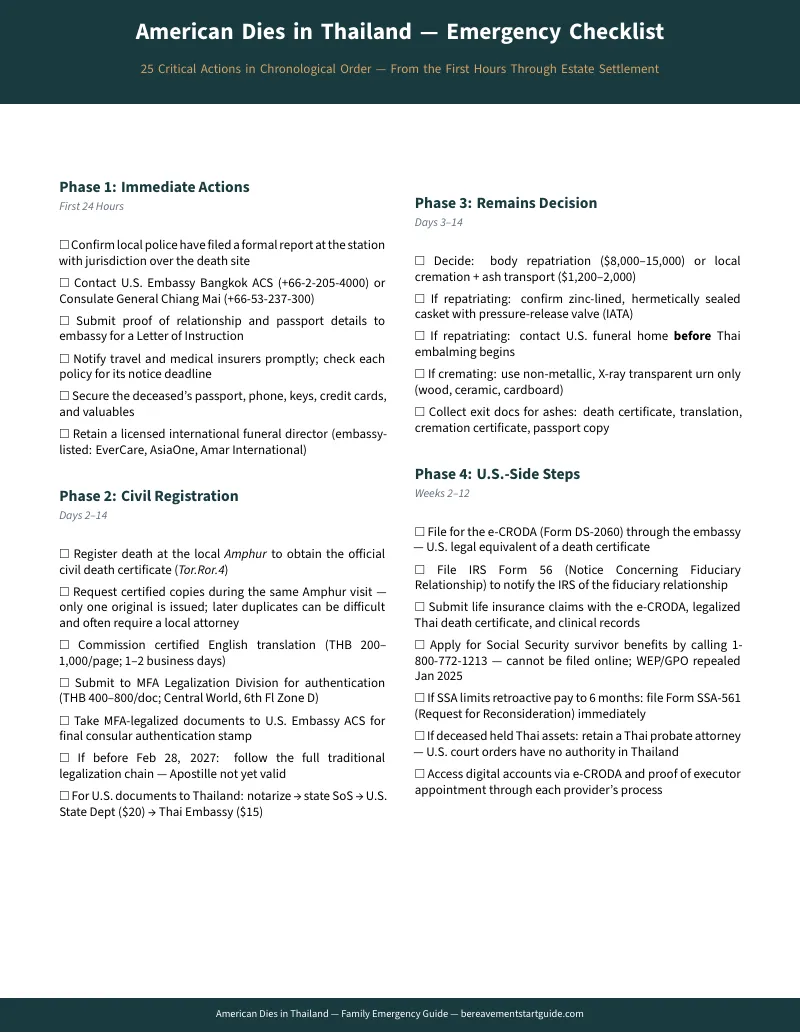
The guide costs — once, no subscription. It covers every procedure, every document, every deadline, every cost range, and the specific corridor mistakes that cost other families time and money — plus printable worksheets and trackers: document tracking, repatriation cost comparison, agency communication log, SSA benefits filing checklist, and a 72-hour emergency triage sheet. The printable emergency checklist lets you start triaging the situation immediately.
Not ready for the full guide? Download the free Emergency Checklist — a printable reference with the critical actions, contacts, and deadlines for the first 72 hours. The full guide is there when you need the complete cross-border procedure.