You're Managing a Death Across Two Countries, Two Legal Systems, and a Nine-Hour Time Gap
Your family member just died in Spain. The funeral home — a tanatorio — is already asking whether to proceed with local burial or cremation. The civil registry has a 24-hour registration deadline. The U.S. Embassy in Madrid can register the death, but it cannot pay for anything, cannot hire a funeral director for you, and cannot navigate the Spanish administrative system on your behalf.
Meanwhile, every hour you spend searching for answers is an hour the default process keeps moving. Spain's death-care timeline operates on a 24-to-72-hour cycle. If the family doesn't intervene — requesting the right type of death certificate, halting a default cremation, securing the passport before it's archived — the results are expensive to reverse and sometimes impossible to undo.
The information exists, but it's scattered across U.S. consular pages, Spanish Ministry of Justice portals, airline cargo regulations, and state probate court requirements. Piecing it together under grief, a language barrier, and time pressure is where families make the mistakes that cost months of delays and thousands of dollars in unnecessary fees.
The Cross-Border Emergency Roadmap — Every Step Mapped in Sequence
This guide replaces the frantic search with a single, sequenced workflow. It walks you through the exact administrative pipeline — from the first call to the embassy through the final probate filing — so you know which Spanish authority handles each step, what documents to request at each office, and what your U.S. institutions will demand when the remains or ashes arrive home.
It's built for the reality that most families are managing this from thousands of miles away, often through a Spanish funeral director who is their only proxy on the ground.
What's Inside the Guide
- The 72-hour protocol by death type — separate action paths for hospital deaths, sudden or unattended deaths, tourist accidents, and deaths where a Spanish judge orders a mandatory autopsy and judicial hold on the remains
- The death certificate trap — why you must request the Certificado Literal de Defunción (the full registry entry) instead of the standard summary extract, and how ordering the wrong version delays U.S. probate by weeks and costs you a second request cycle
- The Hague Apostille and sworn translation sequence — apostille first at the Ministry of Justice, then sworn translation by a MAEC-accredited traductor jurado, because reversing this order invalidates the documents for U.S. courts
- Repatriation cost breakdown — full-body transport in a hermetically sealed zinc-lined casket via IAG Cargo, American Airlines, or United (typically USD 5,000–20,000), cremation with ash transport, and local burial in a Spanish niche or cemetery plot — itemized so you can evaluate provider quotes and identify unnecessary markups
- Cremation authorization from abroad — the notarized power of attorney or consular affidavit process when the next of kin cannot be physically present in Spain to sign the authorization
- The judicial hold — what happens when the juzgado de instrucción orders a mandatory autopsy after a sudden or suspicious death, and what your funeral director can and cannot do until the judge releases the remains
- Travel insurance claims — how to verify repatriation-of-remains coverage before authorizing expenses, what documentation insurers require, and how case managers coordinate with Spanish funeral homes
- Cross-border estate coordination — Spanish inheritance tax declarations (the six-month deadline), U.S. probate with foreign documents, and closing Spanish bank accounts from the United States
- Post-repeal Social Security — the WEP and GPO were repealed in January 2025; how to verify automatic adjustments, claim retroactive payments back to January 2024, or file a new survivor claim that can't be done online
- The Andorran corridor — specific procedures for deaths in Andorra, which falls under the U.S. Consulate General in Barcelona
- Six printable planning worksheets — an emergency contact log, a document tracker for the legalization chain, a cost estimator for comparing vendor quotes and filing insurance claims, a disposition decision matrix, an inheritance tax timeline with fill-in dates, and a Spanish bank account tracker
Who This Guide Serves
- Spouses and adult children managing a death from the United States — you're the primary decision-maker and this is your operational manual
- Estate executors who need Spanish documents that will survive scrutiny in U.S. probate court — the guide covers exactly which documents to request and the legalization sequence that U.S. institutions accept
- Travel insurance case managers verifying coverage and coordinating with Spanish funeral homes — the regulatory framework is mapped against common policy exclusions
- U.S. funeral directors receiving repatriated remains — the guide explains what documentation should accompany the casket and what clearances should already be in place
- Study-abroad coordinators and corporate HR managers handling a student or employee emergency — the guide provides a repeatable institutional checklist
Why Free Information Isn't Enough for This
The U.S. Embassy's consular pages are authoritative — but they describe what the government does, not what you do. They list obligations without sequencing them. They reference Spanish offices by their formal names without explaining which one handles your specific situation.
Commercial repatriation firms like Funecon offer professional transport services — but their pricing is opaque, their process explanations are marketing for their own logistics, and they don't cover the estate settlement, insurance claims, or Social Security actions that families need to handle in parallel.
Expat forums and Reddit threads offer real, emotionally resonant experiences — but the advice is disorganized, frequently outdated (many posts still treat WEP and GPO as active law), and rarely accounts for the specific administrative differences between deaths in Madrid, Barcelona, the Canary Islands, and Andorra.
This guide is none of those things. It's an independent, sequenced reference that tells you what to do, in what order, at which office, with which documents — and what each step typically costs. It's written for a family operating under grief, time pressure, and a language barrier, not for a professional who already knows the system.
The Guarantee
If any administrative checklist, cost range, or regulatory reference in this guide is outdated or inaccurate, you get a full refund — no time limit, no questions. Email hello@bereavementstartguide.com and we'll make it right.
Start With the Free Emergency Checklist
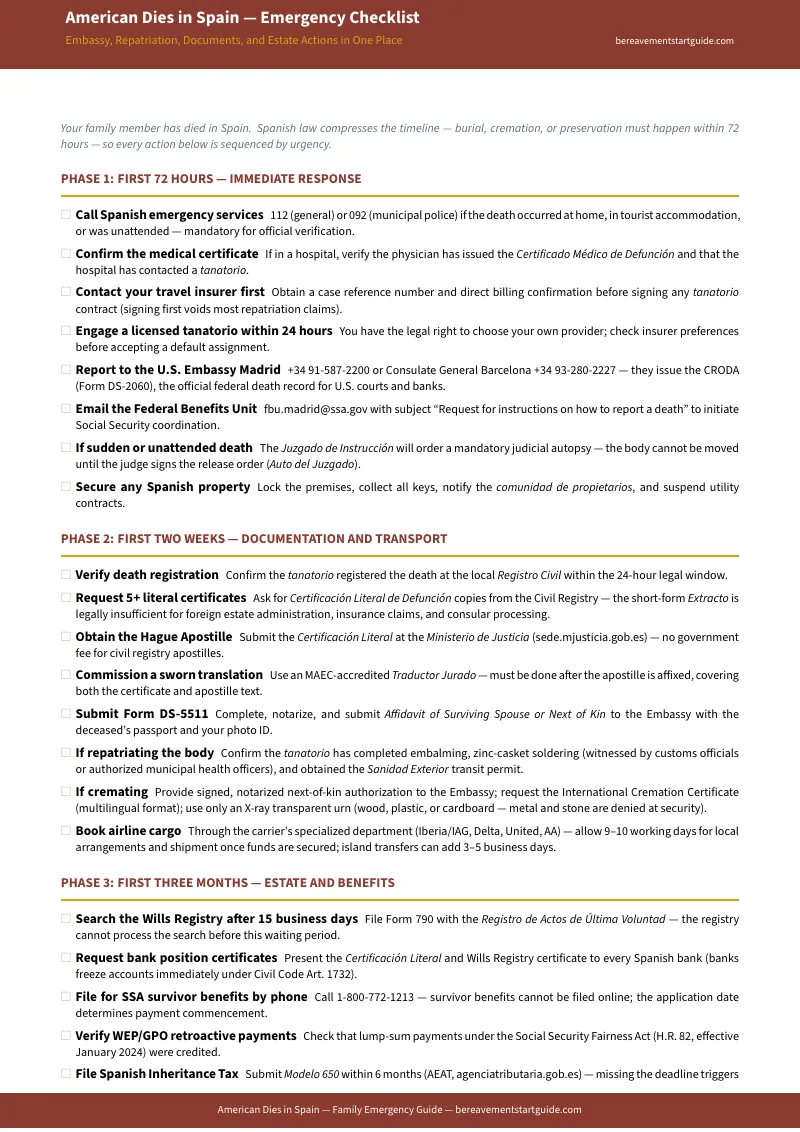
Not ready for the full guide? Download the free checklist — the critical action items across three phases, covering everything from the first embassy call through the final estate filings. It's the sequence you need to avoid the most common and costly mistakes.
When you're ready for the complete workflow — the cost breakdowns, the document legalization pipeline, the repatriation decision framework, and the cross-border estate coordination — the full guide is here for .