
You Have 72 Hours. Indian Law Won't Wait for You to Catch Up.
When an American citizen dies in India, the family back home faces a crisis that operates on two clocks — grief's clock, and India's 48-to-72-hour window before unembalmed remains must be cremated, buried, or embalmed. Most families find out about the second clock after it's already running.
Meanwhile, you're navigating five different U.S. consular districts, municipal registrars who issue certificates in Marathi or Telugu, police stations that won't release a body without a formal No Objection Certificate, and a 21-day death registration deadline that — if missed — escalates from a standard filing into a magistrate's hearing that can freeze everything downstream for months.
Free advice exists. Government websites cover fragments. Expat forums offer unverified speculation. Repatriation firms quote services without disclosing that cremation in India costs a fraction of full-body transport. Nobody gives you the complete, sequential roadmap — from the moment you get the phone call to the day you close the last U.S. bank account.
The Cross-Border Emergency Roadmap
This guide is built around one principle: when a family is in crisis, they need the next step — not background reading. Every chapter follows the actual decision sequence, tells you exactly which authority handles each step, and flags the traps that cost families weeks of delay or thousands in avoidable expenses.
What's Inside
- The 72-Hour Emergency Protocol — what Indian law demands before you can make any disposition decision, when police involvement is mandatory, and how to contact the correct U.S. consular district based on which Indian state the death occurred in
- Municipal Death Registration Walkthrough — the 21-day statutory window, city-by-city portal details for Delhi, Mumbai, Hyderabad, and Kolkata, and the exact escalation path if you miss the deadline (late fees → registrar permission → magistrate order)
- The Apostille Chain — the three-step process for making Indian documents legally valid in American courts, including the approved outsourced agencies the MEA actually accepts submissions from
- eCRODA Application Guide — how to apply for the Consular Report of Death Abroad (Form DS-2060), the six documents you need, and why this federal record matters more than the Indian certificate for most U.S. purposes
- Disposition Decision Matrix — full-body repatriation, cremation with ashes transport, or local disposition compared side by side with real cost breakdowns, document requirements, and timelines
- Airline Cargo and TSA Rules — IATA packaging requirements, the e-CARe health clearance portal (including the passport registration trap that blocks applications), and exactly what kind of urn TSA will and won't allow through screening
- Insurance Claims Strategy — how to file life, travel, and corporate AD&D claims simultaneously using the eCRODA as primary proof of death
- Cross-Border Estate Settlement — why U.S. probate orders don't work in India, what banks actually require to release accounts, ancillary probate mechanics, and the IRS Tax Transfer Certificate process
- Post-Repeal Social Security Benefits — the GPO and WEP are repealed (January 2025). If the surviving spouse never filed because the offset would have zeroed their benefit, the guide covers the exact steps to claim — including why survivor benefits can't be filed online
- Worksheets and Contact Reference — disposition decision worksheet, insurance claims tracker, communication log, document tracking log, funeral home comparison sheet, and a contact reference card with every embassy, consulate, and government agency number
Who This Guide Is For
- Spouses, adult children, and executors coordinating from the United States while a body sits in an Indian hospital mortuary
- Families of retirees and long-term residents who need to navigate FRRO exit permits and visa compliance on top of the standard process
- HR managers and university administrators handling a death under corporate travel, medical tourism, or study-abroad coverage
- U.S. funeral directors receiving remains from India who need to verify that the document package is complete before accepting cargo
Why Free Resources Fall Short
The U.S. Embassy website covers consular services but stops at the embassy door — it doesn't walk you through municipal registration, the MEA apostille chain, or estate settlement. India's municipal portals operate in regional languages and assume local knowledge. Repatriation firms sell logistics without explaining the regulatory framework, and they're incentivized to push the most expensive pathway.
Reddit threads and expat forums contain raw, unverified advice — sometimes dangerously wrong. Families describe being "strung along" for months by the Indian Income Tax Department, accounts flagged as "mule accounts" because of undocumented capital trails, and scams at every administrative checkpoint.
The guide consolidates official statutory requirements, verified consular procedures, and real-world cost benchmarks into one decision-by-decision roadmap. Every recommendation traces back to the specific Indian statute, U.S. federal regulation, or consular procedure that governs it.
Your Purchase Is Protected
Full refund, no time limit. If the guide doesn't help your situation, email hello@bereavementstartguide.com and you'll get your money back. No forms, no waiting period.
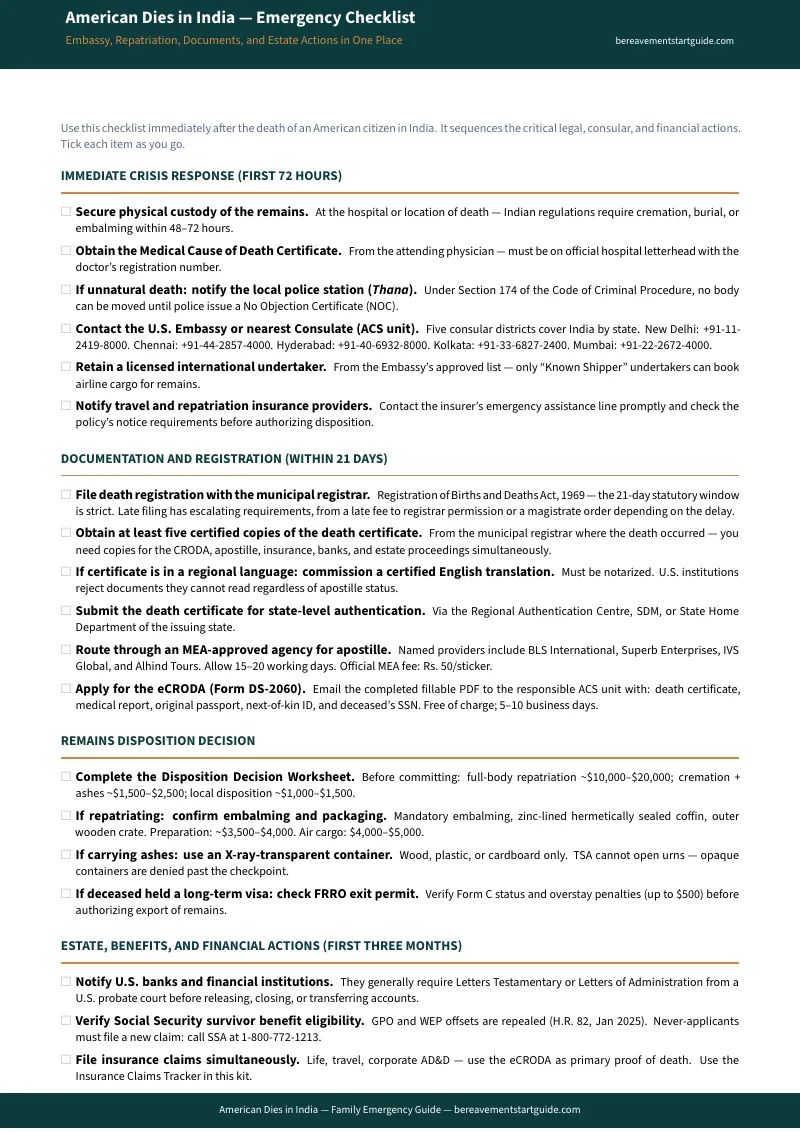
The free checklist gives you the sequence — 23 critical steps in order. The full guide gives you the worked examples, the cost matrices, the portal walkthroughs, and the legal context that keep one missed step from cascading into months of delay. For , it replaces the consultations, the frantic Googling, and the expensive mistakes that families make when they're learning the system in real time.