The clock started when you got the call. The bureaucracy does not care that you are grieving.
An American family member just died in Mexico. You are sitting stateside, trying to figure out what happens next. The embassy website gives you a phone number. The funeral home in Mexico is quoting a price in pesos that you cannot evaluate. Google returns a dozen forum posts from people who navigated a different situation in a different Mexican state five years ago.
Meanwhile, the 48-hour sanitary window is closing. Mexican health regulations require embalming or refrigeration within that window — miss it and repatriation becomes more complex, more expensive, and in some cases impossible. There are two entirely different death certificates in Mexico, and U.S. institutions will reject everything you file until you have the right one, apostilled in the correct sequence, translated after the apostille is attached. Reverse that order and the entire package goes back.
The Cross-Border Emergency Navigator exists because this process has a specific sequence — and every mistake in that sequence costs time, money, or both.
What makes this different from free embassy resources
The U.S. Embassy publishes policy statements and phone numbers by consular district. It does not give you a step-by-step family workflow. It does not explain the two-document death certificate system, or the apostille sequencing rule that catches families who translate before they legalize. It does not map the SEMEFO forensic track that applies to unattended deaths, or the Known Shipper requirement that forces you to hire two funeral homes for full-body repatriation.
The Cross-Border Emergency Navigator is a procedural system — it puts every step in order, with deadlines, cost ranges, and the specific mistakes that other families made so you do not repeat them.
What's inside
The First 48 Hours — Emergency Triage Protocol
Who to call first depending on whether the death occurred in a hospital, a resort, a private home, or under suspicious circumstances. How to prevent an unnecessary SEMEFO forensic autopsy by providing pre-existing medical records to the attending physician — because landing on the forensic track instead of the natural-causes track adds days to the timeline and thousands of dollars to the cost.
The Two-Document Death Certificate System
The medical Certificado de Defunción certifies the cause of death but carries no civil authority. The Acta de Defunción from the Registro Civil is the document U.S. institutions require — and getting it demands proof of next-of-kin authority with apostilled, translated vital records. The guide maps the complete registration process, the next-of-kin hierarchy under Mexican civil law, and how to authorize someone locally when you cannot travel.
The Apostille-First Sequencing Rule
Every year, families pay for a certified English translation, then get the apostille — and the receiving institution rejects the package because the apostille certificate itself remains untranslated. The correct sequence is apostille first, translate second. The guide includes the state-by-state apostille office directory and processing timelines so you get it right the first time.
The e-CRODA Filing and Fallback Process
Since November 2022, U.S. Mission Mexico issues the Consular Report of Death Abroad as a digitally signed PDF. Most institutions accept it. Some conservative probate courts and older insurance companies demand a raised-seal physical copy from Washington, D.C. The guide covers both tracks — the standard e-CRODA filing and the Record Services Division request for institutions that reject the PDF.
Repatriation Cost Breakdown and the Double-Fee Trap
Full-body repatriation runs $4,000 to $14,000. The guide breaks down every cost category — Mexican funeral home fees, embalming, transport casket, air cargo freight, apostille services, consular processing, and the U.S. receiving funeral home — with low-end and high-end ranges. It explains the Known Shipper requirement that forces two funeral homes into the process and shows you how to identify overlapping charges where both providers bill for the same logistics work.
Local Disposition Options
Not every family repatriates. Local burial in Mexico can cost a fraction of cross-border transport, but the cemetery deed structure works differently — including the six-year perpetual deed system. Cremation requires physical next-of-kin presence or a specifically notarized power of attorney. The guide covers the decision framework, the cost comparison, and the legal requirements for each option.
Cross-Border Estate Settlement Mechanics
Mexican bank accounts freeze when a death is registered. U.S. financial institutions reject the first submission of foreign death documents more often than they accept it. The guide covers IRS Transfer Certificates for non-resident estates, frozen Mexican bank access, travel insurance repatriation claims, and the documentation sequence that prevents institutional rejections.
Post-Repeal Social Security Survivor Benefits
WEP and GPO are permanently repealed. If the deceased was receiving reduced benefits, SSA has automatically adjusted. If they never applied because the old formulas would have zeroed out the benefit, a new application is required — it is not automatic. The guide covers both tracks, including the phone routing keyword and in-person filing procedures.
Who this is for
- The spouse or adult child coordinating from the U.S. — You are managing everything by phone across a time zone gap, you do not speak Spanish, and you need the complete procedural sequence with the bilingual terminology and the steps you can delegate versus the ones that require your direct involvement.
- The family dealing with an unattended or suspicious death — The body is in a SEMEFO forensic facility and the Ministerio Público has opened a case. You need to know how to get the body released, how long the autopsy will take, and what the Oficio de Entrega process involves.
- The executor managing a cross-border estate — You need to figure out which documents each institution requires, in what sequence, and how to prevent the rejections that send you back to square one with frozen accounts and stalled insurance claims.
- The family trying to control repatriation costs — A funeral home quoted you thousands and you have no way to evaluate the number. The cost breakdown lets you identify markup, compare providers, and understand where fees are negotiable versus fixed.
Why free resources fall short in this corridor
- The U.S. Embassy website lists consular services by district. It does not provide a sequential family workflow, does not explain the two-document death certificate system, does not warn about the apostille sequencing error, and does not cover what happens when a stateside probate court rejects the e-CRODA.
- Mexican funeral home websites are lead generation tools with opaque pricing. They will not explain the Known Shipper double-provider structure or the overlapping-fee trap that adds thousands to the bill.
- Expat forums and Reddit threads are anecdotal, state-specific, frequently wrong on document sequencing, outdated on the e-CRODA process, and dangerously inaccurate on post-repeal Social Security rules.
- Generic "death abroad" checklists cover embassy phone numbers. They do not touch Mexican civil registry codes, the SEMEFO forensic track, the apostille-first rule, TSA Known Shipper requirements, or cross-border estate settlement mechanics.
Satisfaction guarantee
Full refund, no time limit. If the guide does not give you the procedural clarity you need, email hello@bereavementstartguide.com and we will refund the full purchase — no questions, no expiration, no hoops.
Start working the process within minutes
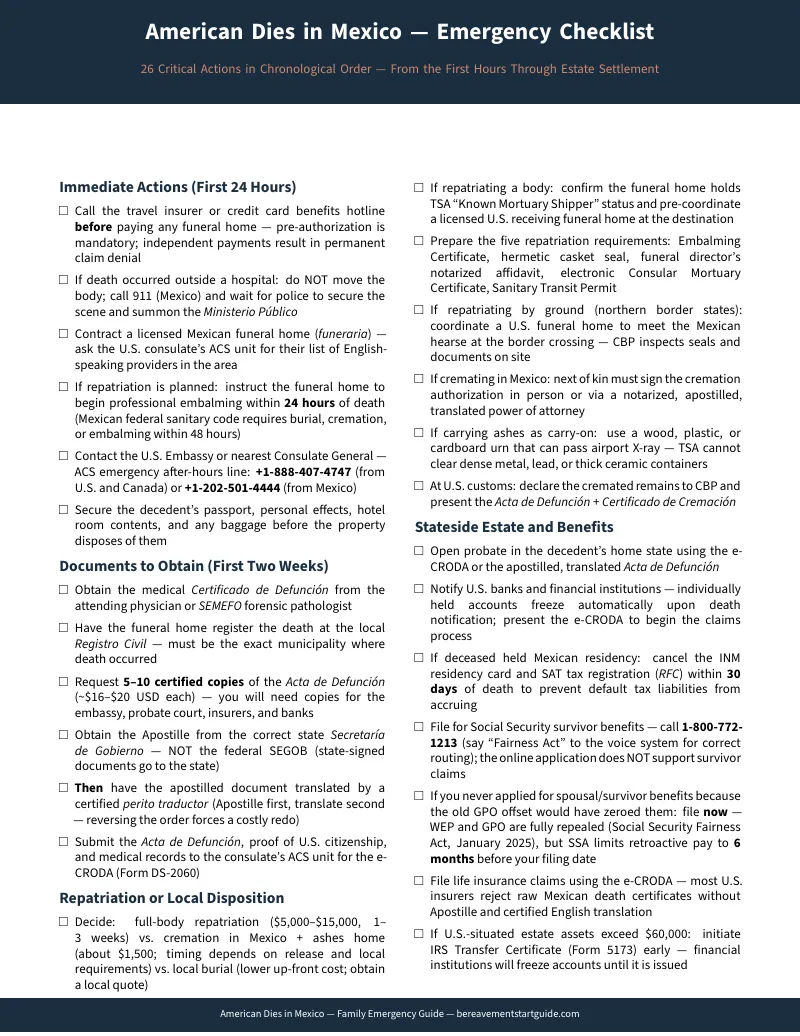
The guide costs — once, no subscription. It covers every procedure, every document, every deadline, every cost range, and the specific corridor mistakes that cost other families time and money — plus six printable worksheets and trackers: document tracking, repatriation cost comparison, insurance claims log, agency communication log, SSA benefits filing checklist, and a 72-hour emergency triage sheet. The printable emergency checklist lets you start triaging the situation immediately.
Not ready for the full guide? Download the free Emergency Checklist — a printable reference with the critical actions, contacts, and deadlines for the first 48 hours. The full guide is there when you need the complete cross-border procedure.