New Brunswick Requires a Lawyer for Every Property Power of Attorney. The Rest of the Plan Is on You — and Nobody Tells You What "the Rest" Looks Like.
You searched for a New Brunswick power of attorney form. What you found is a tangle of American templates, Ontario advice, and government pages that stop at "consult a lawyer." Here is the part most New Brunswickers discover at the worst possible moment: this province requires a practicing lawyer to witness every Enduring Power of Attorney that touches property or finances. No exceptions. No DIY workaround. No notary alternative. A property EPA without a lawyer's certificate of capacity is invalid — and every financial institution in the province knows it.
But the lawyer appointment is the easy part. The hard part is everything the lawyer doesn't do for you. Choosing between immediate and springing activation. Understanding that a personal care EPA is always springing and cannot be activated while the grantor is capable. Knowing that a combined property-and-personal-care document triggers the stricter lawyer-execution rule even though a standalone personal care EPA only needs two adult witnesses. Navigating the 2024 Supported Decision-Making and Representation Act when capacity is already lost. Challenging a bank that rejects your validly executed EPA because it is "too old" or not on their internal form. Maintaining the financial records that General Regulation 2020-43 requires from the day you start acting as attorney. And understanding that every power of attorney terminates instantly at death — leaving your family in the hands of probate law and a new tiered tax structure that took effect June 12, 2026.
The New Brunswick Power of Attorney Kit is built as a Capacity-to-Probate Roadmap — the only New Brunswick planning resource that follows your family's legal authority across its entire lifecycle: setting up both types of EPA correctly, getting the mandatory lawyer execution done efficiently, activating the documents when capacity is lost, fighting institutional rejections, fulfilling the attorney's statutory duties, and managing the transition when the grantor dies and the executor takes over. Twelve chapters, written in plain language, built for the New Brunswick system as it exists right now.
What's Inside the Capacity-to-Probate Roadmap
A 12-chapter guide, a 20-item Quick-Start Checklist, and the complete New Brunswick substitute decision-making framework — from setting up your first EPA through the estate handoff no other resource connects to it:
Chapter 1: How Substitute Decision-Making Works in New Brunswick
The two legislative overhauls that rewrote the rules — the 2020 Enduring Powers of Attorney Act and the 2024 Supported Decision-Making and Representation Act. The three documents you need to understand (Property EPA, Personal Care EPA, Health Care Directive), when to combine them and when to keep them separate, and the features that make New Brunswick different from every other province — including the mandatory lawyer rule and official bilingualism.
Chapter 2: Setting Up Powers of Attorney While Capacity Exists
Choosing your attorney (must be 19+, not an undischarged bankrupt for property, not a paid caregiver unless they are a relative), the monitor option most families don't know exists, immediate vs. springing activation, drafting the scope with your lawyer, and the complete execution procedure — step by step, separately for property EPAs and standalone personal care EPAs. Plus the remote execution rules permanently authorized since December 2022 and how to distribute copies before a crisis.
Chapter 3: The Attorney's Legal Duties and Record-Keeping
What Regulation 2020-43 actually demands from the day you begin acting — the initial asset inventory, liabilities list, income sources log, transaction ledger, gifts log, and compensation tracking. Miss any of these and an interested party can apply to the Court of King's Bench to have you suspended, replaced, and ordered to account for every transaction. This chapter prevents that.
Chapter 4: The Emergency Pathway — When No Power of Attorney Exists
The old guardianship process under the Infirm Persons Act is gone. The 2024 SDMRA replaced it with three tiers: Decision-Making Assistant (no court needed), Supporter (court application), and Representative (last resort). The Form 3 Capacity Assessment that anchors any Tier 2 or 3 application — who can complete it, what it costs ($500 to $2,500), and why courts reject incomplete ones. The complete court filing package: Form 71.1A, the affidavit, the financial summary, the $125 filing fee, service requirements on every adult family member, and the 20-day objection window. Plus the Public Trustee as a fallback — and why their $300 file-opening fee and $75–$150/hour administration charges make private EPAs worth every effort.
Chapter 5: When the Grantor Dies
Both EPAs die with the grantor — immediately and completely. The attorney's final duties before authority transfers, the death-certificate process, and the new tiered probate tax structure effective June 12, 2026: $200 flat for estates under $20,000, $5 per $1,000 for $20,001–$100,000, and $15 per $1,000 above $100,000. An estate worth $250,000 now owes $2,850 in probate tax alone. This chapter maps the handoff so your family is ready.
Chapter 6: Handling Banks and Financial Institutions
The chapter free resources skip entirely. Why banks reject valid EPAs — "stale" document claims, joint-donor errors, insistence on internal forms, missing lawyer certificates — and the five-step escalation process: written refusal, branch manager, compliance department, Financial Consumer Agency of Canada (federal banks), Financial and Consumer Services Commission (provincial credit unions). Plus the proactive steps that prevent rejection before it happens.
Chapters 7–12: Revocation, Land Registry, Edge Cases, Contacts, Forms, and Deadlines
Revoking an EPA correctly so an old version cannot resurface. Registering an EPA as a land encumbrance under Land Registry Directive 3900-013 (the $85 registration fee and the notarization requirement). Cross-border complications for families straddling provincial lines. Every government office, court registry, and phone number in one directory. A complete forms and fees reference. And a deadline calendar — from the 20-day SDMRA objection window to the probate filing timeline — so nothing slips through.
Who This Kit Is For
- The adult child who just became a caregiver — a stroke, a fall, a dementia diagnosis, and you suddenly have no legal authority over your parent's accounts or care. The kit gives you the correct documents, the mandatory lawyer execution process, and the capacity-assessment pathway in the order you need them, before the family ends up in a court-ordered representation application
- The family facing an emergency with no documents — capacity is already lost and the old guardianship process no longer exists. The kit walks you through the 2024 SDMRA court application so you know every step, every form, and every cost before you contact a lawyer
- The proactive planner — you want your finances and your healthcare covered properly, with alternates named and the conversations had. The kit walks you through both EPA types as one coordinated plan on a fixed-income budget
- The couple doing this together — you each need your own documents, and neither of you can witness the other's. The kit's execution checklist prevents the witness-exclusion error that quietly invalidates New Brunswick EPAs
- The appointed attorney unsure of their duties — Chapter 3 lays out every record-keeping obligation under Regulation 2020-43 so you stay compliant from day one and protected if anyone questions your management
- The executor-in-waiting — you hold your parent's EPA and know it terminates at death. Chapter 5 maps the handoff and the new probate tax structure so the transition is a checklist, not a scramble
Why Free Resources Will Not Build This Plan
The information is scattered across government sites, legal aid pamphlets, and advocacy organizations. None of it connects into a plan you can act on. Here is what you actually get from the free options:
- PLEIS-NB (Public Legal Education and Information Service) provides high-quality informational booklets and a free downloadable EPA for Personal Care template. They offer no Property EPA template at all — and no guidance on bank disputes, record-keeping obligations, probate, or the 2024 SDMRA court application.
- Dying with Dignity Canada offers free, province-specific personal care EPA and health care directive templates. Excellent for clinical planning — and absolutely nothing on property management, banking, or estate administration.
- Inclusion NB provides deep coverage of the SDMRA's human rights framework. Invaluable for understanding the legislation's principles — and completely lacking in practical filing guides, templates, or probate resources.
- LawDepot and online will platforms generate polished documents through questionnaires — then stop. No lawyer-execution guidance, no bank-acceptance strategy, no record-keeping framework, no estate-transition chapter. And LawDepot's subscription model often costs more than this kit over time.
- New Brunswick law firms provide thorough, customized protection at $300 to $500 per hour, with planning packages running $500 to $1,500+. The right call for complex estates — and unreachable at 9 p.m. on a Sunday when a parent is admitted to hospital.
Free resources hand you pamphlets and, at best, one personal care template. The Capacity-to-Probate Roadmap gives you the complete New Brunswick system — both EPA types, the SDMRA emergency pathway, bank rejection strategies, statutory record-keeping, and the estate handoff — assembled in the order you do the work, written for the person doing it.
Standalone Worksheets & Reference Sheets (Included)
Seven printable standalone tools — extracted from the guide so you can print just the page you need and bring it to the lawyer appointment, the bank, or the Land Registry office:
- EPA Setup Planning Worksheet — organize every decision (documents, attorneys, execution method, copy distribution) before your mandatory lawyer appointment so the meeting is focused and flat-rate
- Attorney Record-Keeping Tracker — fillable asset inventory, liabilities list, transaction ledger, and gifts log structured to satisfy Regulation 2020-43 from day one
- Critical Deadline Reference — every SDMRA, benefit, and estate filing deadline on one page, with consequences for missing each one
- Forms and Fees Reference — every EPA, SDMRA, Land Registry, and probate form with where to get it and the current fee
- Key New Brunswick Contacts — government agencies, legal resources, and federal contacts, plus a fillable section for your personal contacts (lawyer, attorneys, physician, bank)
- Probate Fee Estimator Worksheet — calculate the new tiered probate tax (effective June 2026) and estimate total administrative costs before filing
- Land Registry & Real Estate Worksheet — property inventory with PIDs, EPA registration checklist, and transaction fee tracker for real estate under the EPA
— A Fraction of One Hour of a Lawyer's Time
A New Brunswick estate lawyer charges $300 to $500 per hour. A court-ordered representation under the SDMRA means a capacity assessment ($500 to $2,500), a $125 court filing fee, legal representation if contested, and months of delay. The Public Trustee charges a $300 file-opening fee plus $75 to $150 per hour. This kit costs less than a single hour of professional time and gives you the complete system: twelve chapters covering both types of EPA, the 2024 SDMRA emergency pathway, bank rejection strategies, record-keeping under Regulation 2020-43, the estate transition, and the new probate tax structure. Plus the Quick-Start Checklist you can print and start working through tonight. And a money-back guarantee, no time limit — if the kit does not give you clarity and a completed plan, email us for a full refund. No questions asked.
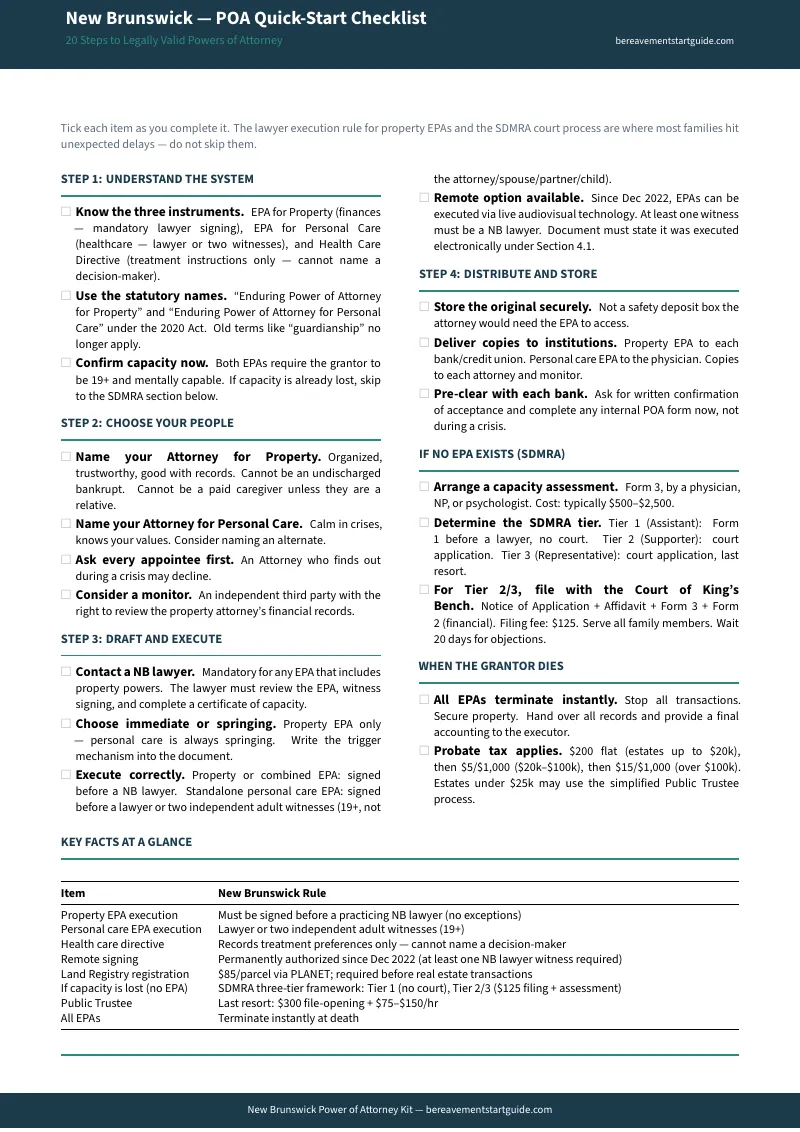
Not ready for the full kit? Download the free New Brunswick — POA Quick-Start Checklist — 20 steps covering what documents you need, the mandatory lawyer execution rule, the witness requirements, how to handle bank rejections, and your duties as attorney. It is enough to get the critical moves right. The full kit is there when you want the complete roadmap.
A capacity crisis does not wait for you to finish researching. This kit turns an afternoon into a concrete plan — the correct documents, the right execution process, and a bank-acceptance strategy your family can act on.