
Your Partner Died. The World That Was Supposed to Have Changed Has Not Changed Enough.
Marriage equality is the law of the land. But the hospital receptionist who does not recognise your marriage certificate, the funeral director who calls your partner's estranged mother first, the employer whose bereavement policy covers "spouses" but whose HR department has never processed a same-sex claim — these are not hypothetical. They are Tuesday morning, the week your partner dies.
If you were not married, the gap is worse. In most jurisdictions, intestacy law treats you as a legal stranger. Their biological family — the parent who stopped speaking to them, the sibling who never accepted your relationship — inherits everything by default. You inherit nothing. The home you shared, the accounts you both funded, the children you raised together: none of it is automatically yours.
You could spend the worst week of your life searching Reddit threads, downloading generic estate checklists built for heterosexual married spouses, and hoping your situation fits into a framework that was never designed for you. Or you could open one resource that starts from where you actually are — a same-sex partner navigating grief, legal systems, and institutional gatekeeping at the same time.
The Same-Sex Partner Bereavement Toolkit
This is not a grief memoir. It is not a generic estate checklist with a rainbow sticker. It is a crisis manual — a structured system for protecting your home, your finances, your children, your partner's identity, and your right to grieve openly as the person they loved. Every chapter pairs the legal reality with the emotional reality, because the benefits claim and the sobbing happen in the same week and you need a resource that treats them that way.
Built for the specific intersection that no other bereavement resource covers: the legal vulnerabilities unique to same-sex couples (married and unmarried), the institutional non-compliance that persists after Obergefell, the post-mortem identity protection needs of transgender and non-binary partners, the disenfranchised grief that comes from mourning a relationship parts of the world still refuse to fully recognise, and the chosen-family dynamics that mainstream resources do not account for.
What You Get
- First-48-Hour Triage Sequence — secure your home before hostile family arrives, retrieve critical documents, designate a communications shield from your chosen family, establish your standing with the funeral director, and order death certificates. One sentence per action, sequenced for a brain running on cortisol and no sleep.
- Your Legal Standing Explained — the concrete difference between married, civil-unioned, domestically partnered, and unmarried. What Obergefell v. Hodges (2015) guarantees and what it does not. The jurisdictions that offer partial cohabitant protections (British Columbia's WESA, the UK's 1975 Inheritance Act, Washington State's CIR doctrine) versus those where unmarried partners inherit nothing. Written so you understand your legal position before making any decisions.
- Social Security Survivors Benefits — eligibility rules for married same-sex spouses, the nine-month marriage duration requirement, and the Thornton and Ely v. Saul class-action pathways for couples who were prevented from marrying before 2015. Step-by-step filing instructions and the documentation SSA requires.
- Housing Defense — Joint Tenancy with Right of Survivorship versus Tenancy in Common, what to do when the lease or deed is in your partner's name only, how to negotiate with a landlord who wants you out, and rent-succession rules in applicable cities.
- Financial Account Recovery — which accounts remain accessible (joint with survivorship), which require a named-beneficiary claim to bypass probate, and which are locked as estate assets. Life insurance and retirement account claims. Why the Power of Attorney expired the instant your partner died.
- Post-Mortem Identity Protection — a dedicated chapter for transgender and non-binary partners. How to prevent deadnaming and misgendering by coroners, funeral directors, and obituary writers. Establishing legal authority over the name, pronouns, and gender markers used in death certificates, memorials, and published obituaries when biological family attempts to erase your partner's identity.
- Custody for Non-Biological Parents — de facto parentage doctrine, what evidence to gather immediately (school records, pediatrician letters, photographs, sworn statements), and why a family law attorney must be retained before a custody petition is filed against you by biological relatives.
- Boundary Scripts — word-for-word messages for the relative who arrives to claim belongings, the parent who wants to exclude you from the funeral, the family member who calls you a roommate, the employer who does not recognise your loss, and the well-meaning person who minimises your grief. Copy, customise, send.
- Disenfranchised Grief — The Science of Invisible Loss — Dr. Kenneth Doka's framework, the Acceptance-Disclosure Model of LGBT+ bereavement, prolonged grief disorder screening, and why the intersection of minority stress and grief creates a psychological burden that generic resources never address.
- First-Year Timeline — month-by-month sequence covering estate deadlines, tax filing transitions, household restructuring, and the emotional milestones that hit without warning. The Dual Process Model: why oscillating between grief and restoration is healthy, not a sign you are failing.
- Printable Worksheets — First 30 Days Support Plan, Document Retrieval Checklist, Jurisdictional Rights Audit, Social Security Claim Preparation Worksheet, Financial Takeover Tracker, Milestone Safety Plan Calendar, Estate Planning Action Log, and Agency Communication Log. Forms you fill in by hand, not pages you read once and forget.
- Printable Boundary Scripts — Six word-for-word messages for hostile family, funeral exclusion, relationship minimisers, employers, institutions, and well-meaning people who say the wrong thing. Copy, customise, send.
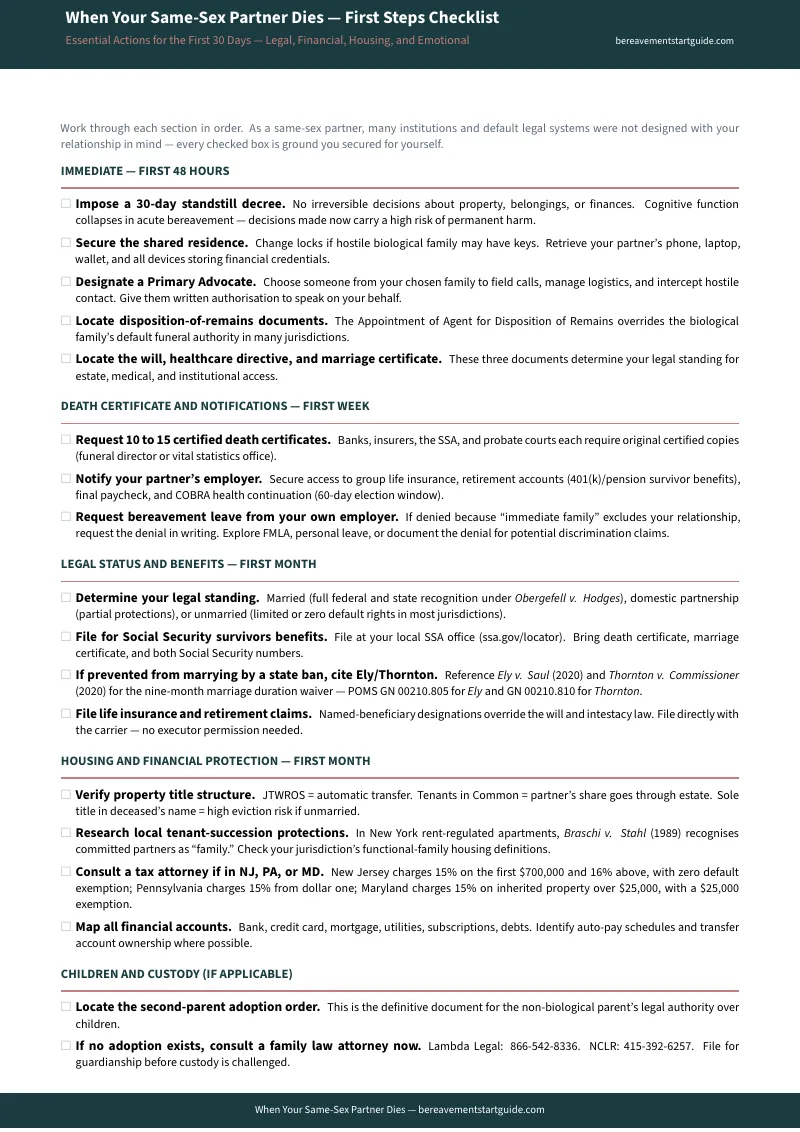
- Printable Checklist — 21 prioritised action items across five phases, from the hour of death through the one-month checkpoint. Designed for your fridge door or nightstand.
Who This Is For
- Surviving same-sex partners — married or unmarried — who need someone to say "do this first, then this" because right now your brain cannot sequence anything
- Unmarried partners facing the legal void where intestacy law treats them as strangers to the estate they helped build
- Partners of transgender or non-binary people who need to protect their loved one's identity through the death administration process
- Non-biological parents facing a custody crisis because the legal system does not recognise the years they spent raising these children
- Chosen-family members organising everything — fielding calls, managing the funeral, mediating between the partner and the biological family, and quietly falling apart
- Supporters — friends, allies, or coworkers who want to do something more useful than "let me know if you need anything"
Why Not Free Resources?
Free resources exist — and nearly all of them assume either a heterosexual relationship or a legally recognised marriage. Hospice handouts are built around the nuclear family. Government websites explain survivor benefits using language that presumes a different-sex spouse. Grief books validate pain but offer no legal defense, no boundary scripts, no identity-protection protocols, no custody triage. LGBTQ+ organisations provide advocacy and referrals but not the kind of step-by-step operational toolkit you can open at two in the morning and follow when your brain has stopped working.
The gap is not emotional — it is structural. No single free resource combines the legal defense, the housing protection, the identity safeguards, the custody guidance, the Social Security pathways, the boundary scripts, and the grief psychology that same-sex partners specifically need. This toolkit fills that gap because you do not have the cognitive bandwidth to assemble it yourself right now.
Satisfaction Guarantee
Full refund, no time limit. If this toolkit does not help you, email hello@bereavementstartguide.com and you will get your money back. No questionnaire, no justification required.
Start With the Free Checklist
Download the free checklist to see the format and the first critical steps. When you are ready for the full crisis manual — the 49-page, 13-chapter guide, printable worksheets, boundary scripts, identity-protection protocols, and the multi-jurisdiction legal guidance — the complete toolkit is here. It costs less than a single hour of grief counseling and you keep it for life.