
Your Spouse Just Died. The World Wants Paperwork.
You are standing in the middle of the worst thing that has ever happened to you, and the institutions that ran your married life — the bank, the mortgage company, Social Security, the school, the insurance — have already started demanding things from you. Death certificates. Account transfers. Filing-status changes. Probate paperwork. They all have deadlines, and none of them care that you cannot remember what day it is.
You could spend the next six months piecing together free checklists from hospice pamphlets, government websites, and Reddit threads — each one covering one country, one benefit, one slice of the problem. Or you could open one resource that gives you the full sequence, in order, in language your grief brain can actually process.
The Spousal Bereavement Triage System
This is not a grief book. It is not a devotional. It is a triage system — a structured toolkit that tells you exactly what to do, in what order, and what can safely wait. Every chapter pairs the practical step with the emotional reality underneath it, because you cannot separate the paperwork from the grief. They are happening at the same time, and you need a resource that treats them that way.
Built for the specific legal and financial complexity that married spouses face: joint property rules, survivor benefit applications, filing-status cascades, insurance enrollment windows, and the family dynamics that get harder when in-laws and an estate are involved.
What You Get
- First-72-Hour Triage Sequence — who to call, in what order, what to secure at the residence, how many death certificates to order. Written for grief brain: one action per line, no paragraph you have to decode.
- Next-of-Kin Authority Guide — who has the legal right to make burial, cremation, and organ-donation decisions. What changes when there is a will versus when there is not, and what to do when the family cannot agree.
- Marital Property Breakdown — community property versus common-law states, how joint tenancy with right of survivorship works, and the commingled-property trap that catches thousands of surviving spouses who assumed everything was automatically shared.
- Four-Country Survivor Benefits Walkthrough — step-by-step applications for US Social Security survivor benefits, UK Bereavement Support Payment, Canada Pension Plan survivor's pension, and Australia Centrelink bereavement payment. Eligibility rules, required documents, and phone numbers — not a summary, the actual process.
- Tax Transition Blueprint — the filing-status cascade from Married Filing Jointly through Qualifying Surviving Spouse to Single, with a worked numerical example showing how your tax bill changes year by year. Covers UK inheritance tax, Canadian deemed disposition, and Australian capital gains at death.
- Household Role Mapping Worksheet — a printable worksheet for inventorying every responsibility your spouse handled (finances, home maintenance, insurance, childcare) and deciding what gets delegated, learned, or hired out. Most surviving spouses do not realize what their partner managed until the first bill goes unpaid.
- First 30 Days Cash Flow Triage Worksheet — a fill-in worksheet for stabilizing your finances in the first month: what accounts are accessible, which bills are due, how to keep the mortgage current, and a cash-gap line so you can see the shortfall on paper.
- Fraud Protection Checklist — the four most common scams that target newly widowed people (obituary-scraping identity theft, funeral-home payment spoofing, government-agent impersonation, and romance/friendship targeting), plus credit freezes and deceased alerts with the three major bureaus.
- Digital Legacy Access Guide — how to get into your spouse's phone, email, and cloud storage using Apple Legacy Contact, Google Inactive Account Manager, and Microsoft's account process. Why keeping their phone number active is critical for two-factor authentication codes.
- Solo Parenting Through Grief — how children process death at different ages, specific language for telling them, and the estate-planning steps you need to take now that you are the sole parent. Written without assuming a specific family structure.
- Boundary Scripts — eight pre-written messages you can copy, fill, and send: the in-law who wants the belongings sorted now, the relative who says it was God's plan, the employer who expects you back too soon, the friend who keeps asking if you are okay, plus school, social media, and a sudden-death notice.
- Grief Psychology Grounded in Research — the Dual Process Model (why oscillating between grief and daily tasks is healthy), the emotions nobody warns you about (anger, relief, guilt about the relief), and why "moving on" is the wrong frame. No toxic positivity, no stages-of-grief mythology.
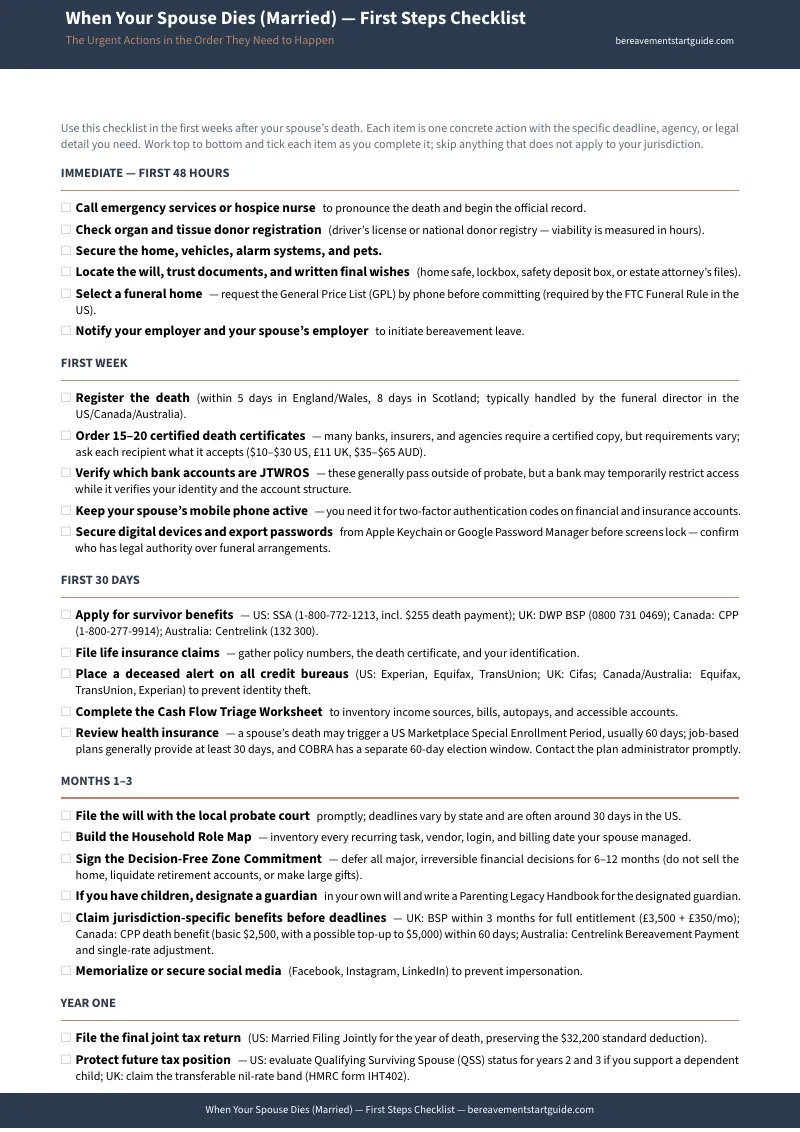
- Printable Checklist — 25 prioritized action items across five phases, from the hour of death through the first year. Designed for your fridge door or nightstand.
Who This Is For
- Surviving spouses in the first hours or days — you need someone to say "do this first, then this" because your brain cannot sequence anything right now
- The person handling everything — the one fielding calls from the funeral home, mediating between family members, dealing with the bank, and quietly falling apart
- People in complicated marriages — if your relationship was difficult, strained, or involved unresolved conflict, your grief is no less valid. This toolkit addresses the full range of what you might feel, including relief
- Adult children helping a surviving parent — when your mother or father has just lost their spouse and you are trying to protect them while managing the logistics
- Supporters — partners, friends, or coworkers who want to do something more useful than "let me know if you need anything"
Why Not Free Resources?
Free resources exist. Hospice handouts cover the clinical basics in photocopied pamphlets that have not been updated since 2019. Government websites explain one benefit at a time, in bureaucratic language, and assume you already know which agency to contact. Grief books offer beautiful prose about the emotional journey — and no checklist, no worksheet, no template, no boundary script.
The gap is structural. No single free resource combines the practical administration, the legal nuance across multiple countries, the emotional scaffolding, and the physical tools (worksheets, scripts, checklists) in one place. This toolkit fills that gap because you do not have the cognitive bandwidth to assemble six different resources right now.
Satisfaction Guarantee
Full refund, no time limit. If this toolkit does not help you, email hello@bereavementstartguide.com and you will get your money back. No questionnaire, no justification required.
Start With the Free Checklist
Download the free checklist to see the format and the first critical steps. When you are ready for the full triage system — the 48-page, 13-chapter guide, nine fillable worksheets, eight boundary scripts, and the country-specific benefits walkthrough — the complete toolkit is here. It costs less than a single hour of grief counseling and you keep it for life.