
Your Brain Is Running a Survival Protocol. This Toolkit Gives It a Sequence to Follow.
You are standing in a hospital room, or sitting in your car in a parking lot, or staring at a wall after the phone call that split your life into before and after. The world expects you to call the funeral home, tell your siblings, find the will, decide about organ donation, notify Social Security, and show up at work on Monday — while your nervous system is still trying to process the fact that your father is gone.
The internet will hand you two things right now, and neither of them meets you where you are. Estate checklists that treat your father like a case file: close account, notify creditor, terminate lease. Or grief articles that tell you to "sit with your feelings" without explaining how to stop the electricity bill from going to collections while you cannot hold a grocery list in your head.
The When Your Father Dies toolkit is built for the space between those failures — what we call The Triage-to-Integration Framework. It gives you the administrative structure of a legal checklist and the emotional scaffolding of a trauma-informed guide, designed specifically for the cognitive impairment that follows losing a father. Short sentences. One action per line. Nothing that requires the sustained concentration your grief has taken from you.
What's Inside the Complete Toolkit
- First 48 Hours: Emergency Triage Sequence — who to call and in what order, what to secure at the residence, how many death certificates to order, and how to verify prearranged funeral plans before contracting with a funeral home. Built for grief brain: you can navigate this section when you cannot remember your own phone number.
- Estate and Admin Logistics Across Four Countries — step-by-step guidance for the US (probate pathways, Letters Testamentary, EIN for the estate, Social Security survivor benefits), UK (Tell Us Once, Grant of Probate, Inheritance Tax), Canada (CRA Final Return and Clearance Certificate, provincial probate), and Australia (superannuation death benefits, state probate). No legal jargon without a plain-language translation.
- Sibling Dynamics and Family System Framework — when a father dies, childhood roles resurface under acute stress. The Responsible Leader, the Evader, the Truth-Teller, the Golden Child, the Lost Child — the guide maps each pattern, explains what drives it, and provides strategies for preventing disputes from calcifying into permanent estrangement. Includes a Sibling Role Redistribution Worksheet for reassigning the specific tasks your father handled: bill payment, property maintenance, family communications, and kin-keeping.
- Family Communication Script Book — pre-written templates for notifying siblings, extended family, your father's friends, your employer, your children's school, and social media. Separate scripts for sudden death, death after long illness, and complicated circumstances. Copy, paste, send — you do not need to find the words yourself when your language processing is running on fumes.
- Boundary-Setting Language That Works Verbatim — specific phrases for the sibling who wants the estate distributed this week, the relative who disagrees about the funeral, the well-meaning friend who says "he's in a better place," and the employer who expects you back Monday. These are not vague suggestions — they are complete sentences you can use word-for-word.
- Attachment-Informed Grief Guide — your father was often the structural anchor of the family system, the symbolic barrier between you and your own mortality. Losing him can trigger the "adult orphan" identity shift even if your mother is still alive. This section explains why your grief might look like anxiety, numbness, explosive rage, or relief depending on your attachment history, and offers exercises targeted to each pattern. No spiritual bypassing. No toxic positivity. No pressure to "find closure" on someone else's timeline.
- Continuing Bonds and Milestone Planning — Father's Day, his birthday, the anniversary of his death, holidays he anchored. These dates will ambush you if you do not have a plan. The workbook helps you build a flexible ritual for each one — something that honors the relationship without performing grief for an audience. Based on Continuing Bonds Theory, which rejects the outdated goal of "letting go" in favor of an evolving, enduring connection.
- Printable worksheets — First 30 Days Family Support Plan, Sibling Role Redistribution Worksheet, Financial Account Audit Register, Government Benefits Navigator, Anniversary and Milestone Calendar, Legacy Sifting Worksheet, Estate Document Tracker, Agency Communication Log, Sibling Communication Agreement, and Somatic Stress Tracker. Print them. Write on them. Leave the 50-page guide on the table.
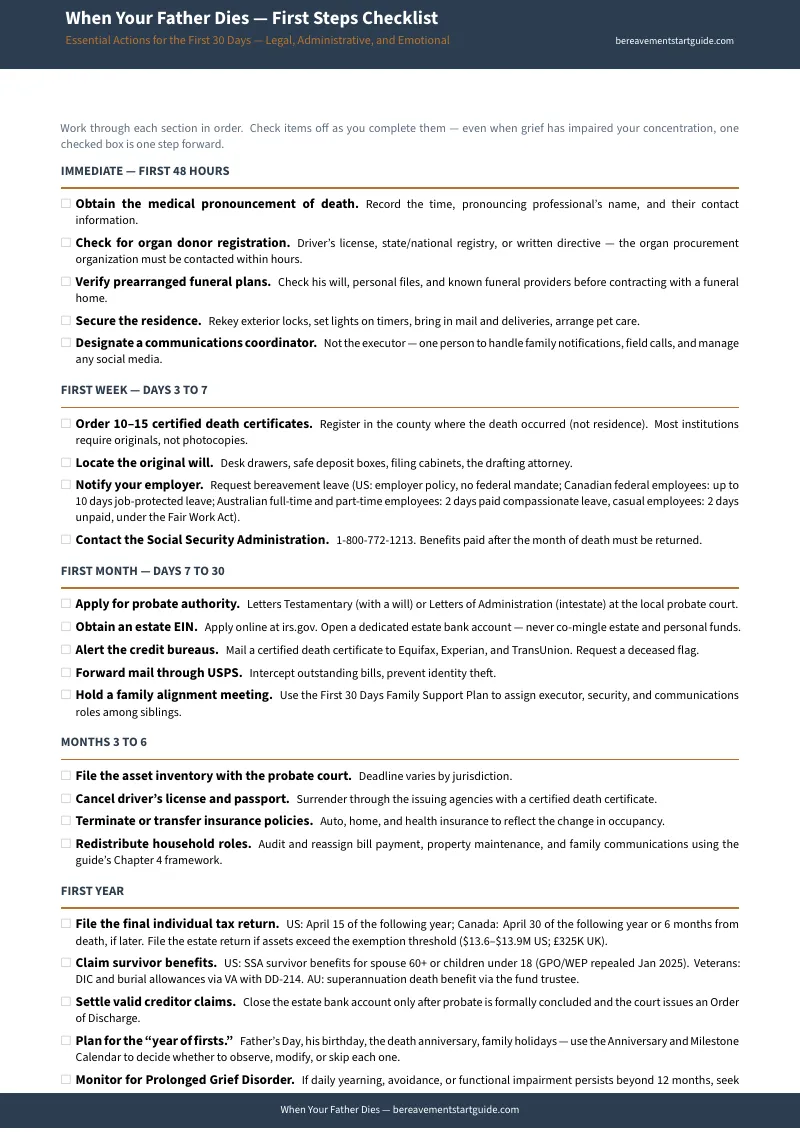
- Printable 23-Item Checklist — prioritized by urgency from Day 1 through Month 12. Designed to live on your fridge or nightstand, not buried in a PDF you will never reopen.
Who This Toolkit Is For
- Adult children in the first hours or days who need someone to say "do this first, then this" — because right now your brain cannot sequence anything on its own
- Executors and next-of-kin navigating probate, Letters Testamentary, and estate bank accounts for the first time, unsure what creates legal liability and what can wait
- Siblings trying to hold the family together when childhood roles are resurfacing, the estate is creating friction, and no one knows who is in charge anymore
- Adult children with complicated father relationships — estrangement, abuse, emotional absence, or the disorienting relief that follows a difficult death. The guide does not assume a close relationship
- Friends and partners of someone who just lost their father who want to offer something beyond "let me know if you need anything"
Why Free Resources Are Not Enough Right Now
You could Google every step individually. You could tab between an estate checklist on one site, a grief article on another, a probate explainer on a third, and a Reddit thread about sibling conflict on a fourth — piecing together your own system from fragments written for a general audience, none of which know your father just died.
The cost of that approach is not money. It is cognitive bandwidth you do not have. Every tab opened, every contradictory piece of advice evaluated, every broken link followed burns processing capacity that your grief-impaired brain needs for the decisions that actually matter this week: whether to authorize an autopsy, which funeral home to trust, how to tell your children their grandfather is gone.
This toolkit consolidates everything into one chronological sequence. Open it. Follow the next step. Put it down. That is all your brain needs to do.
Complete Privacy. No Subscriptions. No Tracking.
The toolkit downloads as a PDF to your device. It does not require an app, an account, or an internet connection to use. No one will ever know you bought it. Your family's private information stays private — on your device, on your printer, in your hands. One purchase, yours to keep.
Full Refund, No Time Limit
If the toolkit does not help, email hello@bereavementstartguide.com and you will receive a full refund. No questions, no forms, no time limit. Grief does not follow a calendar and neither does this guarantee.
You do not need to read the whole thing tonight. You do not need to have a plan. Start with Chapter 1 — The First Hours — and let the rest be there when you are ready for it.