
West Virginia Rewrote Its Small Estate Rules in July 2025. Most Online Templates Haven't Noticed.
If you die owning your home outright in West Virginia, your family can no longer use a Small Estate Affidavit to claim it. As of July 9, 2025, real property is completely excluded from the simplified small estate process — personal property only, capped at $50,000. Real estate now travels its own separate track through a § 41-5-18 affidavit recorded in the county deed books. National form vendors are still selling templates built on the old rules.
That's just one of several West Virginia-specific mechanisms that catch families off guard. Co-owned property defaults to tenancy in common — without the exact "joint tenancy with right of survivorship" language, a co-owner's share goes straight through probate. Electronic wills are banned outright; no DocuSign, no video witnessing. Mineral rights are separate real estate that fractionates with every unprobated generation until a distant cousin's sliver ends up sold at a county tax auction. And an out-of-state executor will almost always be forced to buy a surety bond — even if your will explicitly waives it.
Each of these has a specific fix. The problem is coordinating all of them before the one you missed becomes the one that costs your family.
The Mountain State Estate Protection System
The West Virginia Basic Estate Planning Kit is a plain-English walkthrough of every document, decision, and filing requirement that determines whether your family settles your affairs in a weekend or spends a year under a Fiduciary Commissioner's supervision.
This isn't a stack of blank forms with instructions to "consult an attorney." It's a coordinated system: which documents to prepare, in what order, how they interact, and the West Virginia-specific execution rules that make or break each one. Your will coordinates with your Transfer on Death Deed. Your beneficiary designations work alongside — not against — the elective share. Your mineral inventory connects to your address updates with lease operators and the county assessor. And every chapter tells you the exact statute, filing office, deadline, and threshold.
What You Get
- Complete Estate Planning Guide (11 chapters) — covers West Virginia common-law property rules and the tenancy-in-common trap, will execution under § 41-1-3 (including the self-proving affidavit), the out-of-state executor bond trap, the $200,000 Fiduciary Commissioner threshold, Transfer on Death Deeds under the Uniform Real Property Transfer on Death Act (ch. 36, art. 12), mineral rights and heirs' property protection, the elective share and family allowances, Medicaid estate recovery under § 9-5-11c, digital assets, the post-2025 settlement roadmap, intestacy defaults, and exactly when to call a professional.
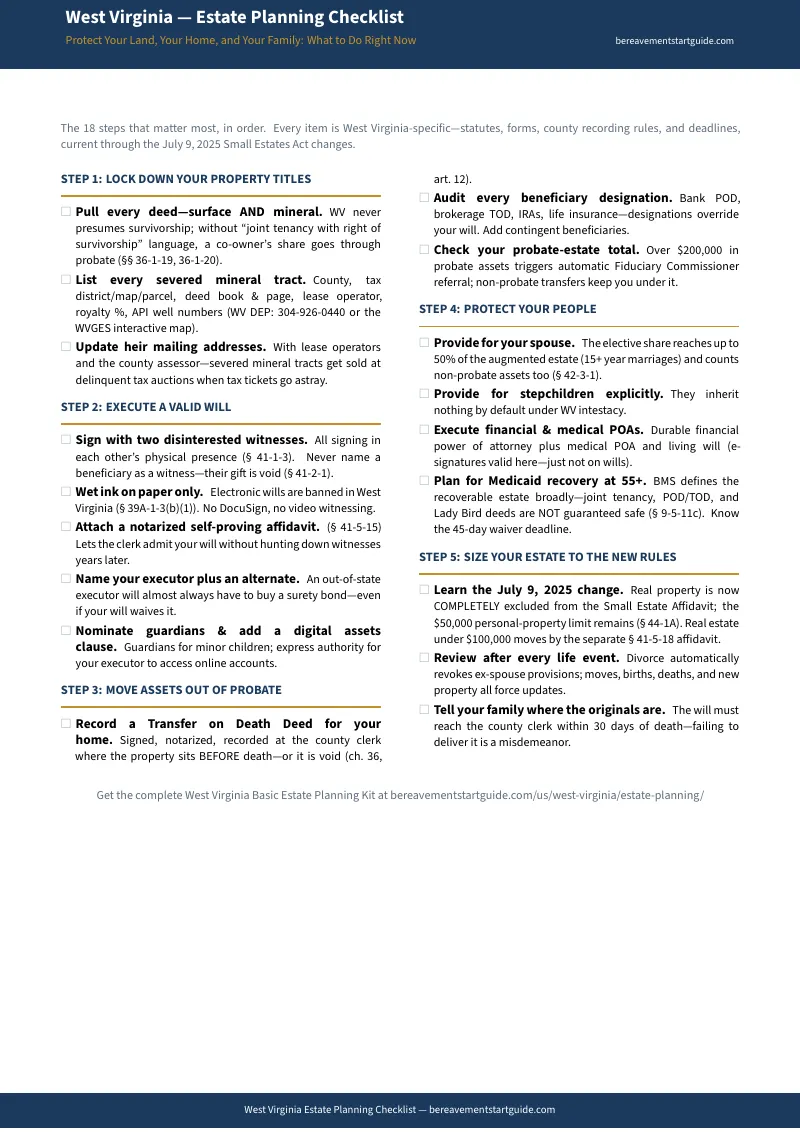
- Quick-Start Checklist — 18 actionable items in priority order with the West Virginia-specific thresholds, deadlines, and code sections that determine which steps apply to your situation. Print it, work through it, check things off.
- 3 standalone fill-in worksheet PDFs — Property & Mineral Inventory (deed book/page, tax district/map/parcel, API well numbers, lease operators, royalty percentages), Account & Beneficiary Audit, and Document & Decision Checklist. Print each one separately and complete them at the kitchen table — they become your executor's roadmap or your attorney's intake package.
West Virginia-Specific Coverage You Won't Find Elsewhere
- The July 2025 small estate shift — the Small Estate Affidavit (§ 44-1A) now covers personal property only, and solely-held real estate moved to the separate § 41-5-18 affidavit track recorded in county deed books. Templates built before this change will send your family down the wrong path.
- Mineral rights and split estates — how severed subsurface interests fractionate across generations, how tracts get lost to delinquent tax auctions when heir addresses go stale, and how the Uniform Partition of Heirs Property Act (ch. 36, art. 13) now gives families appraisal rights, buyout options, and open-market sale protections.
- The executor bond trap — why an out-of-state executor will almost always have to purchase a fiduciary surety bond regardless of what your will says, plus statutory executor commissions and how the $200,000 probate-asset threshold triggers automatic Fiduciary Commissioner referral.
- Transfer on Death Deed execution — signed, notarized, and recorded in the county where the property sits before death, or it's void. It can't be revoked or overridden by your will, and it doesn't affect your taxes or benefits during life.
- Medicaid estate recovery reality — why the Bureau for Medical Services' broad definition of the recoverable estate means joint tenancies, TOD deeds, and Lady Bird deeds are not guaranteed shields, plus the $5,000 floor, statutory exemptions, and the strict 45-day hardship waiver deadline.
- Will formalities that hold up — the simultaneous-presence signing rule under § 41-1-3, why a beneficiary who witnesses loses their gift, the ban on electronic wills, and the notarized self-proving affidavit that lets the clerk admit your will without tracking down witnesses years later.
- Spousal and blended-family protections — the sliding-scale elective share reaching 50% of the augmented estate (which counts non-probate assets), immediate support allowances, and why stepchildren inherit nothing unless you say so explicitly.
Who This Is Built For
- Mineral and rural landowners in coal, oil, and gas country who own or inherited severed subsurface interests — and want them to pass cleanly instead of fractionating into untraceable slivers
- Homeowners who want the house to transfer outside of probate with a properly recorded Transfer on Death Deed instead of an expensive living trust
- Adults 55 and older who want the family home protected from Medicaid estate recovery — and want to know which popular "protections" don't actually guarantee safety in West Virginia
- Out-of-state adult children helping aging parents get wills, powers of attorney, and beneficiary designations in order before a hospitalization forces the issue
- Blended families navigating West Virginia's intestacy splits and making sure stepchildren are provided for explicitly
- Anyone quoted $1,500+ by an attorney for a straightforward estate — or anyone who wants to hand their attorney a complete, organized intake package instead of paying hourly rates for information gathering
Why Not Just Use the Free County Forms?
County clerks across West Virginia provide legitimate probate and small estate forms — the same ones attorneys file. But the clerk's staff is legally barred from telling you which forms you need, how to complete them, or how they fit together. You're held to the same standards as a licensed attorney, and no one at the courthouse can explain what those standards are.
The free forms don't tell you that a Transfer on Death Deed is void unless recorded before death. They don't warn you that co-owned property defaults to tenancy in common. They don't explain the July 2025 split between the personal-property Small Estate Affidavit and the real-estate affidavit track. And they don't help you inventory severed mineral tracts or coordinate beneficiary designations with your will.
The state provides the pieces. The kit shows you how they fit together — and which ones you can skip entirely.
Why Not Hire a West Virginia Estate Planning Attorney?
For straightforward estates, there's a real question of whether $1,500 to $3,000+ in attorney fees is the right investment. West Virginia estate planning attorneys typically charge $250 to $400 per hour. A standard will, deed, and powers of attorney package runs well into four figures. That's real money for documents that many families can prepare correctly with proper guidance.
The kit doesn't replace an attorney for complex situations — and it tells you exactly when you need one: severed mineral title disputes, taxable estates, business succession, contested family dynamics, or Medicaid planning with significant assets. But for the majority of West Virginia families with a home, some accounts, maybe a mineral interest or two, the kit covers every document and decision point.
And if you do hire an attorney later, the completed worksheets become your intake package — saving hours of billable time.
— Less Than One Hour of Attorney Time
West Virginia estate planning attorneys bill $250 to $400 per hour. The kit covers what would take multiple consultations to accomplish — document coordination, beneficiary audits, mineral inventory, and a step-by-step action plan.
One-time purchase. No subscriptions, no annual renewal fees, no paywall between you and your own estate plan.
Money-Back Guarantee, No Time Limit
Download the kit, review the guide and worksheets. If the plain-English instructions don't clarify the exact steps needed to protect your family under West Virginia law, email us at any time for an immediate, full refund. No questions asked.
Important notice: The materials and templates provided in this kit are self-help resources and do not constitute legal advice or the practice of law. No attorney-client relationship is created by purchasing or utilizing these documents. While this kit is designed to satisfy West Virginia statutory requirements, it is not a substitute for the advice of a licensed attorney. If your estate involves complex assets, active title disputes, or specialized Medicaid planning, you should consult a licensed West Virginia elder-law attorney.