A mandatory forensic autopsy is already in progress. Every other step is frozen until it finishes.
An American family member just died in the Dominican Republic. You are sitting in the United States, trying to figure out what happens next. The U.S. Embassy website gives you a phone number. A local funeral home — Blandino or Jerusalen — is quoting a price you cannot evaluate and demanding full upfront payment before they will touch anything. Google returns expat forum posts from people who navigated a different situation in a different province three years ago.
Meanwhile, the mandatory forensic autopsy has already started. Dominican law requires that every foreign death be examined by an INACIF forensic pathologist — you cannot opt out, you cannot speed it up, and until the forensic pathologist issues the preliminary Certificado de Defunción, the civil registry cannot register the death, the U.S. Embassy cannot issue the eCRODA, and no repatriation or cremation can proceed. If a criminal investigation is involved, the District Attorney (Fiscal) takes custody and the body stays in INACIF until they release it — which can take weeks.
The Cross-Border Emergency Navigator exists because the U.S.–Dominican Republic death corridor runs on a Napoleonic Code civil system with a five-step document legalization chain — and every mistake in that chain costs time, money, or both.
What makes this different from free embassy resources
The U.S. Embassy publishes consular guidelines and emergency numbers. It does not give you a step-by-step family workflow. It does not explain the three-layer death certificate system — forensic certificate, civil registry Extracto, and eCRODA — or the JCE–MIREX–Embassy legalization chain that connects them. It does not warn you about the sequencing errors that force families to restart the entire authentication process. It does not map the judicial track for suspicious deaths, or the Known Shipper requirement that forces you to hire funeral homes on both ends of the corridor.
The Cross-Border Emergency Navigator is a procedural system — it puts every step in order, with deadlines, cost ranges, and the specific mistakes that other families made so you do not repeat them.
What's inside
The First 24 Hours — Emergency Triage Protocol
Who to call first depending on whether the death occurred at a resort, in a hospital, in a private residence, or under suspicious circumstances. How the mandatory forensic pathway works: local police secure the scene, the regional Medico Legista dispatches, and the remains transfer to the nearest of INACIF's five regional forensic laboratories — Santo Domingo, Santiago, San Francisco de Macorís, San Pedro de Macorís, or Azua. How to reach the U.S. Embassy's American Citizens Services Unit and navigate their emergency system.
The Three-Layer Death Certificate System
The forensic pathologist's Certificado de Defunción certifies the cause of death but carries no civil authority. The Extracto de Acta de Defunción from the local Oficialía del Estado Civil is the official death certificate — and it cannot be issued until the forensic certificate is released. Dominican civil regulations require the death to be reported within three days of its occurrence to avoid late-filing procedures. The eCRODA from the U.S. Embassy is the document that U.S. courts, banks, and insurers ultimately accept. The guide maps all three layers and the exact sequence connecting them.
The JCE–MIREX–Embassy Legalization Chain
Dominican death documents are worthless in the United States until they pass through a mandatory five-step authentication sequence: civil registry issuance, Central Electoral Board (JCE) digital verification, Ministry of Foreign Affairs (MIREX) Hague Apostille, certified translation into English, and eCRODA issuance at the U.S. Embassy. Get a step out of order, submit to the wrong MIREX office, or translate before the apostille is attached, and the receiving institution rejects the entire package. The guide maps each step with office locations, required supporting documents, processing times, and fee schedules.
The eCRODA Filing and Fallback Process
Since May 2023, the U.S. Department of State issues the Consular Report of Death Abroad as a digitally signed PDF with an electronic seal verifiable online. Most institutions accept it. Some conservative probate courts and older insurance companies demand a physical document with a raised seal. The guide covers both tracks — the standard eCRODA filing through the U.S. Embassy in Santo Domingo or its consular agencies in Punta Cana and Puerto Plata, and the fallback request through the Department of State's Record Services Division in Washington, D.C.
Repatriation Cost Breakdown and the Known Shipper Requirement
Base repatriation fees run $3,000 to $10,000, and Dominican funeral homes require full upfront payment. The guide breaks down every cost category — local mortuary services, embalming, hermetically sealed casket, TSA-approved shipping container, international air cargo freight, consular and apostille fees, and the U.S. receiving funeral home — with cost ranges for each. It explains the TSA Known Shipper requirement that makes it illegal for private individuals to book airline cargo for human remains, and shows you where provider fees overlap so you can identify duplicate charges.
Local Disposition — The Five-Year Exhumation Rule
Not every family repatriates. Local burial in the Dominican Republic costs a fraction of cross-border transport, but Dominican law prohibits exhumation of interred remains for five years — this is irreversible once you choose it. Cremation requires specific documentation and cannot proceed if the Fiscal is holding custody in a judicial investigation. The guide covers the decision framework, the cost comparison, the legal requirements for each option, and the scenarios where local disposition is the only realistic path.
Cross-Border Estate Settlement Mechanics
Dominican bank accounts freeze when a death is registered. U.S. financial institutions often reject the first submission of Dominican death documents. The guide covers the eCRODA as the anchor document for U.S. estate settlement, the certified translation standards that U.S. probate courts require, travel insurance repatriation claims, life insurance claim procedures, and the documentation sequence that prevents institutional rejections.
Post-Repeal Social Security Survivor Benefits
WEP and GPO are permanently repealed. If the deceased was receiving reduced benefits, SSA has automatically adjusted and paid retroactive amounts back to January 2024. If they never applied because the old formulas would have zeroed out the benefit, a new application is required — it is not automatic. The guide covers both tracks, including the phone and in-person filing procedures and the documentation requirements.
Who this is for
- The spouse or adult child coordinating from the U.S. — You are managing everything by phone across time zones, you may not speak Spanish, and you need the complete procedural sequence with bilingual terminology and the steps you can delegate to a local funeral home versus the ones that require your direct involvement or consular coordination.
- The family dealing with a suspicious or judicially held death — The body is in INACIF custody, the Fiscal has opened a case, and the remains cannot be released until the investigation clears. You need to know what you can do while waiting and how to track the judicial timeline.
- The executor managing a cross-border estate — You need the eCRODA, the apostilled Dominican death certificate, or both. The guide covers the full legalization chain, the institutional submission sequence, and the documentation that prevents the rejections that send you back to the beginning.
- The family trying to control repatriation costs — A Dominican funeral home quoted you thousands with upfront payment required. The cost breakdown lets you evaluate the quote, compare providers like Blandino and Jerusalen, and understand where fees are negotiable versus fixed by regulation.
Why free resources fall short in this corridor
- The U.S. Embassy website lists consular services and emergency numbers. It does not provide a sequential family workflow, does not explain the three-layer death certificate system, does not map the JCE–MIREX–Embassy legalization chain, and does not cover what happens when a U.S. institution rejects the eCRODA.
- Dominican funeral home websites are lead generation tools with opaque pricing and upfront payment demands. They will not explain the Known Shipper requirement, the judicial holds that can freeze a body in INACIF, or the five-year exhumation prohibition for local burial.
- Expat forums and Reddit threads are anecdotal, province-specific, frequently wrong on document sequencing, outdated on the eCRODA digital transition, and unreliable on autopsy timelines — especially when INACIF toxicology equipment has been reported offline.
- Generic "death abroad" checklists cover embassy phone numbers. They do not touch Dominican Napoleonic Code civil procedures, the mandatory INACIF forensic autopsy, the JCE–MIREX apostille chain, TSA Known Shipper requirements, or cross-border estate settlement mechanics.
Satisfaction guarantee
Full refund, no time limit. If the guide does not give you the procedural clarity you need, email hello@bereavementstartguide.com and we will refund the full purchase — no questions, no expiration, no hoops.
Start working the process within minutes
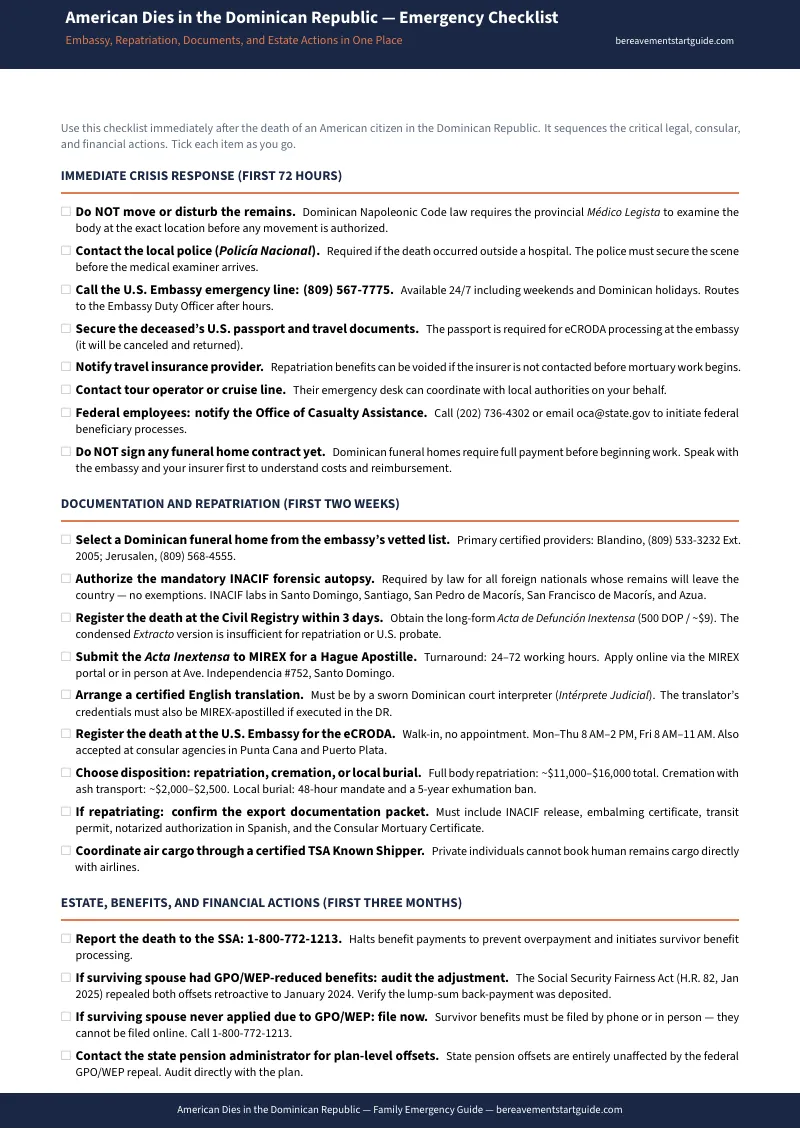
The guide costs — once, no subscription. It covers every procedure, every document, every deadline, every cost range, and the specific corridor mistakes that cost other families time and money — plus a printable emergency checklist, a disposition decision worksheet, a document tracking log, a funeral home comparison worksheet, an insurance and benefits claim tracker, and an agency communication log.
Not ready for the full guide? Download the free Emergency Checklist — a printable reference with the critical actions, contacts, and deadlines for the first 24 hours. The full guide is there when you need the complete cross-border procedure.