The 48-hour sanitary clock started when your loved one died. Philippine bureaucracy does not pause for grief.
An American family member just died in the Philippines. You are in the United States, 12 to 15 time zones away, trying to figure out what happens next. The embassy website gives you a phone number. The funeral home in Manila is quoting a price you cannot evaluate. Expat forums are full of conflicting stories from people who navigated a different situation in a different city three years ago.
Meanwhile, Philippine sanitation law requires that unembalmed remains be interred or cremated within 48 hours. There are four separate documents in a mandatory sequence — the Local Civil Registrar (LCR) certificate, the Philippine Statistics Authority (PSA) copy on security paper, the Department of Foreign Affairs eApostille, and the embassy's electronic Consular Report of Death Abroad (eCRODA). Submit the wrong document to a U.S. insurance company and the claim is rejected. Miss a step in the sequence and every filing downstream stalls. Run into a hospital billing department illegally withholding the body, and you lose days you do not have.
The Cross-Border Emergency Navigator exists because this corridor has a specific document sequence, specific legal protections, and specific traps — and every mistake costs time, money, or both.
What makes this different from free embassy resources
The U.S. Embassy publishes consular services and the ACS phone number. It does not give you a step-by-step family workflow. It does not explain the four-document sequence that U.S. institutions require, or the hospital detention law that protects you when a billing department tries to hold the body. It does not map the PNP/NBI medico-legal investigation track that applies to non-natural deaths, or the Section 97 bank withdrawal cap that freezes Philippine accounts pending estate tax clearance.
The Cross-Border Emergency Navigator is a procedural system — it puts every step in order, with deadlines, cost ranges, and the specific mistakes that other families made in this corridor so you do not repeat them.
What's inside
The First 72 Hours — Emergency Triage Protocol
Who to call first depending on whether the death occurred in a hospital, at home, at a resort, or under suspicious circumstances. How to distinguish the natural-causes track from the PNP/NBI medico-legal investigation track — because landing on the forensic track means the body stays in a state-authorized morgue until the investigating prosecutor issues a formal written release. The five immediate notifications — police, Municipal Health Officer, embassy ACS, funeral home, travel insurer — with contact numbers and exactly what each agency requires from you.
The Four-Step Document Sequence (LCR → PSA → eApostille → eCRODA)
The LCR death certificate is the foundation, but U.S. courts and insurance companies reject it. You need the PSA-encoded copy printed on SECPA security paper, then the DFA eApostille through the online platform, then the embassy's eCRODA. The guide maps each step with processing timelines, required supporting documents, and the sequencing errors that send families back to square one — including submitting a raw LCR certificate to an insurer that requires the PSA copy.
The U.S. Embassy — What They Will and Will Not Do
The embassy issues the eCRODA and the Consular Mortuary Certificate. It does not arrange funerals, advance funds, act as executor, or accelerate police investigations. The guide covers the complete eCRODA filing package, the mortuary certificate appointment process, and the specific assumptions families make about embassy authority that waste days of the timeline.
Repatriation Cost Breakdown and the Disposition Decision
Full-body repatriation runs $8,000 to $15,000 — embalming, hermetically sealed zinc-lined casket, outer shipping crate, airline cargo freight, consular fees, Bureau of Quarantine export permit, and the receiving U.S. funeral home. Cremation with urn transport runs $3,000 to $5,000. Local burial starts around $1,200, but Philippine public cemeteries operate on five-year lease contracts — if the lease is not renewed, remains are exhumed. The guide covers airline cargo standards, the TSA X-ray-transparent urn rule for carry-on ashes, and the complete cost breakdown for each option.
Hospital Billing Rights — RA 9439 and the Private-Room Exception
Republic Act 9439 prohibits hospitals from detaining a body or withholding a death certificate over unpaid bills. The promissory note mechanism forces release for covered patients. But Section 2 of the law excludes patients who stayed in private rooms — an exception most families do not learn about until the hospital cites it. The guide covers how to invoke RA 9439, what the promissory note must contain, and how to handle the private-room scenario.
Philippine Banking and Estate Settlement
Bank accounts freeze the moment a death certificate is registered. Section 97 of the National Internal Revenue Code caps total withdrawals at PHP 2 million across all banks pending the electronic Certificate Authorizing Registration (eCAR) from the BIR. The guide covers the eCAR process, the extrajudicial settlement procedure for dividing the Philippine estate without court, the one-year publication requirement, and the specific risks facing 13A visa holders with local real property.
U.S. Tax Compliance
The executor must report worldwide income through the date of death, disclose Philippine accounts exceeding $10,000 via FBAR, and file Form 8938 if foreign financial assets exceed the FATCA threshold. The guide covers each obligation, the deadlines, and the penalties for non-compliance — including the IRS Transfer Certificate process for estates with U.S.-situs assets exceeding $60,000.
Post-Repeal Social Security Survivor Benefits
WEP and GPO are permanently repealed under the Social Security Fairness Act (signed January 5, 2025). If the deceased was receiving reduced benefits, SSA has automatically adjusted and paid retroactive lump sums back to January 2024. If they never applied because the old formulas would have zeroed out the benefit, a new application is required — it is not automatic. The guide covers both tracks, including the phone and in-person filing process.
Insurance and Institutional Claims
Life insurance, travel insurance, and employer-sponsored policies each require a specific certified document package — and a missing copy suspends the claim. The guide covers the five-document package that clears most institutional submissions, the additional documentation required for accidental or violent deaths, and the sequence that prevents the rejection-and-resubmission cycle.
Who this is for
- The spouse or adult child coordinating from the U.S. — You are managing everything by phone across a 12-to-15-hour time zone gap, you have never dealt with Philippine civil registration, and you need the complete procedural sequence with the steps you can delegate to a local funeral director versus the ones that require your direct involvement.
- The Filipino-American family navigating two systems — Your parent retired to the Philippines with a 13A visa, local bank accounts, and possibly real property. Now you need to navigate Philippine estate settlement and U.S. tax compliance simultaneously — the guide covers both sides of the corridor in one document.
- The family dealing with a suspicious or accidental death — The body is in a PNP or NBI facility, the medico-legal officer has opened an investigation, and you do not know how to get the body released or how long the process takes. The guide maps the forensic track step by step.
- The executor managing a cross-border estate — You need to figure out which documents each institution requires, in what sequence, and how to prevent the rejections that send you back to square one with frozen accounts and stalled insurance claims.
- The family trying to control repatriation costs — A funeral home quoted you a price and you have no way to evaluate it. The cost breakdown lets you identify markup, compare providers, and understand where fees are negotiable versus fixed by regulation.
Why free resources fall short in this corridor
- The U.S. Embassy website lists consular services and the ACS phone number. It does not provide a sequential family workflow, does not explain the four-step document sequence, does not cover hospital billing rights under RA 9439, and does not address Philippine estate settlement or frozen bank accounts.
- Philippine funeral home websites are marketing materials with opaque pricing. They will not explain the hermetic sealing rejection risk at airline cargo, the Bureau of Quarantine export permit process, or the five-year cemetery lease trap.
- Expat forums and Reddit threads are anecdotal, city-specific, frequently outdated on the eApostille process, inaccurate on the RA 9439 private-room exception, and dangerously wrong on post-repeal Social Security rules.
- Generic "death abroad" checklists cover embassy phone numbers. They do not touch the Philippine civil registry sequence, the medico-legal investigation track, Section 97 bank withdrawal caps, the extrajudicial settlement publication requirement, or cross-border tax compliance.
Satisfaction guarantee
Full refund, no time limit. If the guide does not give you the procedural clarity you need, email hello@bereavementstartguide.com and we will refund the full purchase — no questions, no expiration, no hoops.
Start working the process within minutes
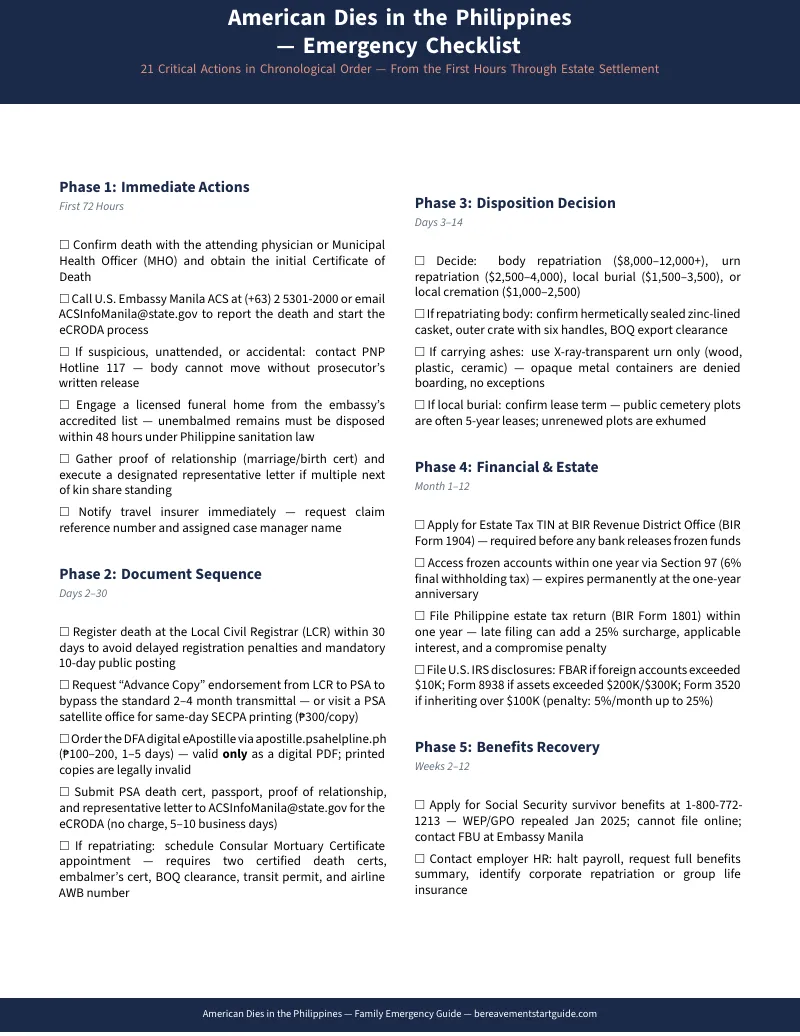
The guide costs — once, no subscription. It covers every procedure, every document, every deadline, every cost range, and the specific corridor mistakes that cost other families time and money — plus printable worksheets and trackers: document tracking, repatriation cost comparison, insurance claims log, agency communication log, SSA benefits filing checklist, and a 72-hour emergency triage sheet. The printable emergency checklist lets you start triaging the situation immediately.
Not ready for the full guide? Download the free Emergency Checklist — a printable reference with the critical actions, contacts, and deadlines for the first 72 hours. The full guide is there when you need the complete cross-border procedure.