Your parent's bank account is frozen. The care home needs paperwork you don't have. And the clock is running.
Here's what most families in Newfoundland and Labrador discover too late: there is no single document that covers both financial and medical decisions. The province splits authority across two completely separate statutes — the Enduring Powers of Attorney Act for finances and the Advance Health Care Directives Act for healthcare. A standard power of attorney from a national template site won't cover both. A healthcare directive won't unlock a frozen bank account. And if capacity is already gone, you're looking at a Supreme Court guardianship application, physician affidavits, a security bond, and months of waiting.
The Dual-Document Protection System inside this kit solves the problem most guides create: coverage gaps. Instead of handing you a generic template and hoping it works, it walks you through creating both documents with the exact statutory language that satisfies NL's unique requirements — from the one-witness rule for an EPA to the mandatory written SDM acceptance for an AHCD.
What's Inside
- Enduring Power of Attorney walkthrough — choosing your attorney, drafting explicit authority clauses that banks actually accept, and deciding whether your EPA activates immediately or only upon a written medical determination of incapacity
- Advance Health Care Directive creation — naming a Substitute Decision Maker, recording your treatment preferences, and completing the written acceptance step that national platforms routinely skip (without it, the appointment is legally invalid)
- Bank-acceptance safeguard clauses — specific authority language for sole-account access, registered account management (RRSPs, TFSAs, RRIFs), real property transactions, digital assets, and family maintenance payments. These clauses target the exact provisions compliance officers look for when deciding whether to honor or reject a power of attorney
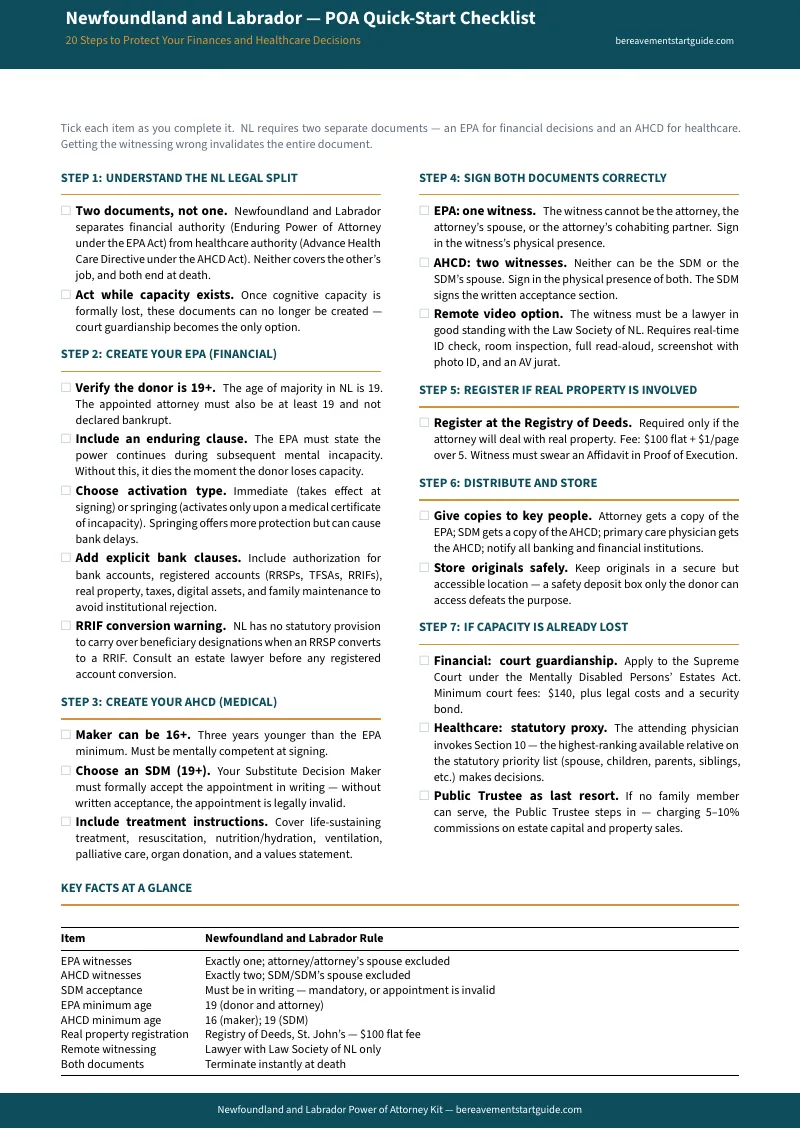
- NL signing and witnessing checklist — one independent witness for the EPA, two for the AHCD, with clear rules on who is disqualified. Get the count wrong and the document is invalid
- Registry of Deeds registration guide — how to register your EPA at the provincial registry so financial institutions can independently verify it exists, eliminating a common reason for bank rejections
- Springing vs. immediate activation — the tradeoffs of each approach, plus how to draft an unambiguous triggering clause so your attorney isn't stuck arguing with a bank manager over whether the EPA is "active yet"
- The RRSP-to-RRIF conversion trap — a uniquely dangerous gap in NL law where converting a registered plan under power of attorney can silently cancel the beneficiary designation, forcing the entire account through probate. The guide explains when a court application is necessary to preserve designations
- Incapacity activation procedures — what triggers your EPA or AHCD, who makes the capacity determination, and the step-by-step process your attorney or SDM follows to assume authority
- Revocation and amendment — how to cancel or update either document when circumstances change, including the notification steps that make the revocation effective against third parties
- Emergency path for lost capacity — if your loved one already lacks capacity and has no documents, this chapter walks through the Supreme Court guardianship application under the Mentally Disabled Persons' Estates Act: petition forms, physician affidavits, property inventory, guardian bond requirements, and filing fees
- SSWB Funeral Assistance Program — eligibility rules, current benefit amounts, the CPP Death Benefit clawback, and how independent fundraising campaigns can trigger dollar-for-dollar reductions to a family's Income Support payments
- Public Trustee fee exposure — statutory commissions of up to 8% on estate capital and 10% on personal property sales, and how proper planning keeps the Public Trustee out of your family's affairs entirely
Printable Worksheets Included
- EPA Execution Checklist — print-and-tick signing sheet for the one-witness EPA rule
- AHCD Execution Checklist — two-witness signing sheet plus the SDM acceptance step
- SDM Written Acceptance Form — the mandatory written acceptance record to attach to the directive
- Bank-Acceptance Clause Checklist — tick-off list of authority clauses banks look for before honouring an EPA
- Registry of Deeds Registration Checklist — package tracker, fee worksheet, and submission log for St. John's
- Fiduciary Log — landscape action log for attorneys and SDMs
- Revocation Notification Tracker — who you told, when, and how
- Incapacity Activation Checklist — medical certificate and bank-presentation log
- Guardianship Application Checklist — Supreme Court package when capacity is already gone
- Funeral Assistance Claim Tracker — SSWB 60-day claim worksheet
Who This Kit Is For
You're an adult child watching a parent's health decline — maybe during a short visit home between rotational shifts in Alberta. You need documents drafted, signed, and registered before you fly back out, and you can't spend three weeks waiting for a law firm appointment that may not even be available in your parent's community.
You're a spouse suddenly locked out of household accounts because the bank learned your partner lost capacity. You assumed marriage gave you automatic access. It doesn't. The bank needs a valid EPA with explicit account-access clauses, and your partner can no longer sign anything.
You're a sandwich-generation caregiver coordinating a parent's move into a personal care home. The facility requires an active AHCD before confirming the bed. You need the SDM acceptance form completed and witnessed correctly — not a generic template that skips the written acceptance requirement and gets rejected at intake.
You're a low-income family navigating funeral costs after a relative's death. You need to understand the provincial Funeral Assistance Program without accidentally triggering clawbacks that reduce your family's ongoing financial support.
Why Not Free Government Guides?
Free resources exist — and they're genuinely useful for understanding the law. The Public Legal Information Association of NL (PLIAN) publishes excellent educational materials. Eastern Health's palliative care division provides solid AHCD overviews. The Supreme Court posts guardianship forms.
None of them give you what you actually need to execute.
PLIAN explicitly states its materials are educational only — no templates, no forms, no execution instructions. The provincial AHCD booklet covers healthcare planning but says nothing about financial authority. The Supreme Court forms are for after-the-fact guardianship applications, not proactive planning. And national template platforms like LawDepot and LegalWills generate documents that miss NL-specific requirements: the SDM written acceptance, the one-witness EPA rule (most provinces require two), and the banking clauses that prevent account freezes.
This kit fills the gap between "understanding the law" and "having valid, institution-ready documents." It gives you the step-by-step execution instructions, the NL-specific statutory requirements, and the bank-acceptance language that free guides deliberately exclude.
Your Family's Safety Net
Without valid planning documents, your family faces a Supreme Court guardianship process that costs thousands in legal fees, takes months to complete, and may result in the Public Trustee managing — and charging commissions on — the estate. The kit costs a fraction of a single hour of legal consultation and gives you everything you need to protect both financial assets and healthcare decisions.
You also get the free POA Quick-Start Checklist — a 20-item action list covering the essential signing, witnessing, and registration steps for both documents. Download it now to see whether your existing planning covers the gaps most families miss.