Ontario's Healthcare Consent System Has Three Layers. Free Templates Cover One.
You typed "Ontario living will" or "advance directive Ontario" expecting a single form you could fill in and file away. Instead, you discovered that Ontario uses a completely different legal framework — and the American-style templates filling your search results have no legal standing here.
Here is what most people learn after the crisis, not before: Ontario's advance care planning runs on three separate systems that must work together. The legal layer (a Power of Attorney for Personal Care under the Substitute Decisions Act). The clinical layer (a Do Not Resuscitate Confirmation form that paramedics can actually act on). And the financial layer (a Continuing Power of Attorney for Property that survives mental incapacity). Free government forms cover the legal layer — one blank PDF with no instructions. The clinical and financial layers are left entirely to you.
The Ontario Advance Directive & Living Will Kit is a Three-Layer Consent System — a single, plain-language manual that assembles all three layers in the order you do the work, so your legal documents, your emergency protocols, and your financial protections are built as one coordinated plan.
What the Three Layers Actually Look Like
Layer 1: The Legal Documents That Give Your Family Authority
A Power of Attorney for Personal Care (POA-PC) that names your attorney and contains specific instruction directives — not vague phrases like "no extraordinary measures" that clinicians cannot interpret, but treatment-by-treatment clauses (CPR, ventilation, dialysis, tube feeding, palliative sedation) your attorney can cite at the bedside. Plus a Continuing Power of Attorney for Property (CPOA) with the explicit "continuing" clause that prevents banks from freezing your accounts the moment capacity is lost.
Both documents need two eligible witnesses — and your spouse, your attorney, and your attorney's spouse are all disqualified. The kit's signing-day checklist catches the execution errors that invalidate more Ontario documents than any substantive legal mistake.
Layer 2: The Emergency Protocols That Paramedics Actually Follow
Your POA-PC sits in a drawer. Paramedics do not read it. Under Ontario Ministry of Health standards, first responders are legally mandated to perform full CPR and life support unless they are presented with an original, signed DNR Confirmation Form (Form 014-4519-45) — a specific clinical document signed by a physician or nurse practitioner. The kit walks you through locating the form, getting the clinical signature, and the physical placement protocol (bright paper, near the refrigerator) that ensures first responders find it in time.
For families managing a terminal decline at home, the kit also covers the Expected Death in the Home (EDITH) protocol — the coordination framework between home-care nurses and your family that prevents an unnecessary 911 response.
Layer 3: The Financial Protections That Prevent Frozen Accounts
Without a valid CPOA, your family cannot access your bank accounts, pay your mortgage, or manage your investments once you lose capacity. The alternative is a guardianship application through the OPGT — $10,000 to $15,000 in legal fees, up to a year of delay, and ongoing management fees of 3% on receipts and disbursements plus 0.6% annually on assets under management.
The kit also covers the Pecore v. Pecore presumption — the Supreme Court of Canada decision that treats parent-child joint bank accounts as resulting trusts, not gifts. Unless you document the intent, those "convenience" accounts get pulled into the estate and taxed at Ontario's 1.5% Estate Administration Tax rate. The kit includes a Joint Account Intention Declaration template.
What Free Tools Get Wrong — Specifically
The OPGT statutory forms give you blank POA-PC and CPOA templates. They provide zero guidance on the SDM hierarchy, offer no custom instruction templates, say nothing about the DNR-C form, and assume you already know which witnesses are disqualified and why. The forms are legally valid. Knowing what to write in them is the expensive part.
Steps to Justice (CLEO) is the best free resource in Ontario — accurate, plain-language legal information. But it stops at the legal baseline. No clinical protocols, no Pecore defence templates, no financial self-defence, and no crisis-management guidance for the family navigating a sudden emergency.
Speak Up Ontario workbooks are excellent for the conversation — values exercises, SDM discussion guides. But they explicitly do not produce legally binding documents. A completed workbook cannot appoint an attorney, and a hospital cannot use it to determine consent.
Online platforms (Willful, Epilogue) generate clean documents through polished questionnaires — for $99 to $199. Then they stop. Rigid templates that bar custom medical instructions, no DNR-C protocol, no sibling-deadlock provisions, no Bill 245 remote-witnessing guidance, and no post-death administration roadmap. The document is the beginning of the planning job, not the end.
Who This Kit Is Built For
- The adult child racing a dementia diagnosis. Your parent is showing cognitive decline, and you have a 30-to-90-day window before capacity is legally lost. Without a valid POA-PC and CPOA, your only path is a guardianship application — months of delay and thousands in legal fees. The kit gives you both documents, the signing rules, and the capacity-assessment framework.
- The proactive planner over 60. A retirement milestone, a friend's health crisis, or planning a trip abroad made this real. You want your wishes documented properly — not left to a statutory hierarchy that could deadlock your adult children or hand authority to the OPGT.
- The family in a medical emergency. A stroke, an accident, a rapid decline — and nobody has authority to consent to treatment. The kit's SDM hierarchy chapter and emergency-protocols section give you immediate, step-by-step instructions.
- The northern or remote Ontario family. Access to estate-planning lawyers is limited, and a health crisis means a medevac to an urban hospital. The kit's Bill 245 chapter covers remote witnessing by video — execute valid documents without leaving your community.
- The couple doing this together. You each need your own POA-PC — and each of you is disqualified from witnessing the other's. The signing-day checklist prevents the single most common execution error in Ontario.
After Using This Kit, You'll Have
- A legally valid POA-PC with specific treatment instructions — not a generic form a clinician can set aside
- A Continuing POA for Property that survives incapacity — with the clauses banks actually accept
- A signed DNR-C form in the right format, in the right place, where paramedics are trained to look
- A Joint Account Intention Declaration that rebuts the Pecore presumption before it freezes your accounts
- A Bill 245 remote witnessing checklist — for families who cannot access a lawyer's office in person
- A sibling-deadlock prevention plan — one attorney, clear authority, no OPGT intervention
- A post-death administration roadmap — death registration, certificates, EAT calculation, probate timelines, and CRA clearance
The download is 12 PDFs: the 12-chapter guide, the Quick-Start Checklist, and 10 fillable worksheets you print and write on:
- Treatment Preferences Worksheet
- Attorney Selection Worksheet
- Witnessing Checklist
- Bill 245 Remote Witnessing Checklist
- Joint Account Intention Declaration
- Document Location Tracker
- DNR-C & EDITH Setup Checklist
- Complete Action Plan
- Post-Death Administration Roadmap
- Attorney Conversation Worksheet
Satisfaction Guarantee
If the kit does not give you a clear, actionable path through Ontario's advance care planning system — the legal documents, the clinical protocols, and the financial protections — email us and we will refund your purchase. No questions, no time limit.
Start Your Plan Today
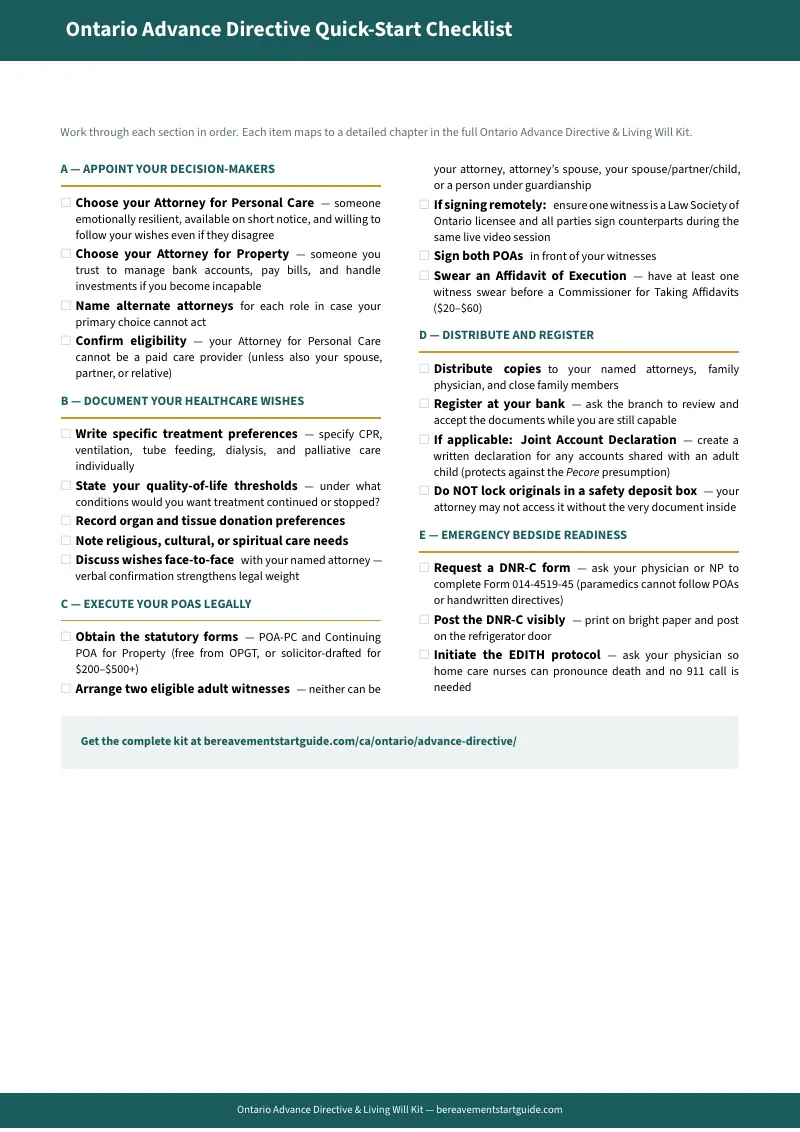
The free Ontario Advance Directive Quick-Start Checklist gives you 20 steps — the terminology, the signing rules, the SDM hierarchy, and the DNR-C placement protocol. It is enough to get the critical moves right.
The full Ontario Advance Directive & Living Will Kit — — gives you the complete Three-Layer Consent System: 12 chapters, 10 fillable worksheets, both Powers of Attorney, the DNR-C and EDITH protocols, the Pecore defence template, Bill 245 remote witnessing, post-death administration, and the Quick-Start Checklist. One afternoon. One plan. Every layer covered.