Saskatchewan Uses the Term "Health Care Directive" — Not "Living Will." Sign the Wrong Document, Witness It Incorrectly, or Store It in the Wrong Place, and Your Family Faces a Guardianship Application at the Worst Possible Moment.
You searched for an advance directive or a living will for Saskatchewan. The first thing to know: neither term exists in the statutes. The legal document is a Health Care Directive under The Health Care Directives and Substitute Health Care Decision Makers Act, 2015. An American template, an Ontario personal directive form, or anything labelled "living will" has no legal standing in a Saskatchewan hospital or courtroom.
And the document itself is only the first problem. If you lose capacity without a companion Enduring Power of Attorney under a different statute entirely, your bank accounts freeze. Nobody can pay your bills, manage your property, or sell a house to cover care costs. Your family's only path is a court-appointed guardianship under The Adult Guardianship and Co-decision-making Act — two professional medical assessments, thousands of dollars in legal fees, months of waiting, and ongoing reporting to the Public Guardian and Trustee, who can charge 2.5% of monthly receipts and 2.5% of payments from your estate.
Even if you sign both documents perfectly, there is a third trap that free resources never mention: emergency medical services do not read legal paperwork during a crisis. Saskatchewan paramedics are trained to look for one thing — a bright yellow plastic sleeve on your refrigerator door, loaded with your directive and emergency contacts. Without that Yellow Sleeve, your directive might as well be in a filing cabinet across town. And the clinical system has its own layer: Goals of Care Designations, the medical orders that translate your wishes into treatment decisions at the bedside. No free form walks you through connecting your legal document to the clinical system that acts on it.
The Saskatchewan Advance Directive & Living Will Kit is a Legal-Clinical Bridge System — the only Saskatchewan planning resource that connects the three layers other tools leave disconnected: the correct statutory documents under the 2015 Act with their precise signing and witnessing rules, the SHA's Yellow Sleeve and Goals of Care Designation system that makes your wishes visible to the people treating you, and the Enduring Power of Attorney that protects your finances when the Health Care Directive only covers medical decisions. Fourteen chapters, ten print-and-fill worksheets, and a standalone Quick-Start Checklist, written for Saskatchewan law as it works right now.
What's Inside the Legal-Clinical Bridge System
A 14-chapter guide and a 17-item Quick-Start Checklist covering every layer of Saskatchewan advance care planning:
Chapter 1: How Saskatchewan Law Handles Your Healthcare Wishes
Why "living will" and "advance directive" carry no statutory weight in Saskatchewan — the document that is actually binding is a Health Care Directive, and it only covers medical decisions. Includes who can make one (minimum age 16), what a directive can and cannot do (it cannot pre-authorize MAID or cover financial decisions), and a side-by-side comparison with the Enduring Power of Attorney showing exactly where each document's authority starts and stops.
Chapter 2: Drafting Your Health Care Directive Step by Step
Five concrete steps from deciding your treatment preferences through signing and distributing the completed document. Covers the specific treatment areas to address — CPR, mechanical ventilation, tube feeding, pain management, organ donation — and why vague language like "no extraordinary measures" gets overridden by clinical judgment. Includes the signing rules: self-signed requires no witnesses; signed-on-behalf requires a witness who cannot be the Proxy or the Proxy's spouse.
Chapter 3: Goals of Care Designations — Translating Your Directive into Medical Orders
The chapter free resources skip entirely. Goals of Care Designations are the medical orders — resuscitative, medical, or comfort — that clinicians actually follow during a crisis. Your legal directive tells your family what you want; a GCD tells the medical team what to do. This chapter explains how to get one recorded with your physician and how to confirm it matches your directive.
Chapter 4: Setting Up Your Enduring Power of Attorney
The financial half of the plan. Why the witnessing rules are stricter than for a Health Care Directive — either a practicing lawyer completing a Form D certificate, or two independent adult witnesses completing Form E. Neither witness can be a family member of you or the attorney. Covers what changed in 2015, remote witnessing rules, and the most common errors that invalidate an Enduring POA in Saskatchewan.
Chapter 5: The Homesteads Act Trap
The rule that catches nearly every Saskatchewan family by surprise. Under The Homesteads Act, 1989, selling or mortgaging the family home requires the non-owning spouse's written consent — and Section 6(4) explicitly prohibits an attorney acting under a Power of Attorney from signing that consent. If a non-owning spouse loses capacity, the family is locked out of selling the home without a costly Court of King's Bench application. This chapter explains the trap and what to do about it before it's too late.
Chapter 6: What Happens If You Do Not Have a Directive
Saskatchewan's statutory nearest-relative hierarchy — who makes medical decisions if no Proxy is named, the tie-breaking rules when relatives disagree, and what happens when no relatives can be found. Understanding the default system makes the case for creating a directive harder to postpone.
Chapter 7: Court-Appointed Guardianship — The Expensive Alternative
The full court process: two professional medical assessments, a formal Court of King's Bench application, ongoing PGT reporting requirements, and the statutory fee schedule that can drain the vulnerable adult's estate. Everything your family faces if you lose capacity without an Enduring POA — and why a completed plan today avoids thousands of dollars and months of stress tomorrow.
Chapter 8: Agricultural Land Succession Planning
Saskatchewan holds over 34 million acres of active farmland. If farmland ownership changes hands without proper planning, the Saskatchewan Farm Security Act restrictions on non-resident ownership can force a sale under pressure. This chapter covers ownership restrictions, the bequest grace period, corporate ownership changes, and penalties — because a parent's incapacity can freeze grain contracts, land titles, and lease agreements.
Chapter 9: Probate and Estate Administration After Death
What happens after death — immediate steps, the small estate summary process, full probate applications to the Court of King's Bench, transferring real property through the Land Titles Registry, advertising for creditors, and the 0.7% probate fee on solely owned assets. Your planning today simplifies the estate work your family does tomorrow.
Chapter 10: Updating, Revoking, and Replacing Your Directive
The life events that should trigger a review — marriage, divorce, a new diagnosis, the death of your Proxy — and how to revoke correctly so old copies floating around hospital systems don't create conflicts that stall care.
Chapter 11: First Nations Estate Considerations
Key differences for residents on Saskatchewan First Nations reserves — federal jurisdiction under the Indian Act for wills and estate administration, how Health Care Directives interact with federal and provincial authority, and where to get help.
Chapter 12: Emergency Action Plans
Three ready-to-use action plans for families in crisis: when a parent is hospitalized and losing capacity, when a death has occurred and immediate steps are needed, and when a non-resident child inherits farmland and faces ownership restrictions. Each scenario walks through what to do first, second, and third — the emergency response nobody thinks to prepare until it's needed.
Chapter 13: Conversation Guides
Three scripted conversation frameworks — how to talk to your doctor about Goals of Care, how to have the family conversation about healthcare wishes, and how to have the financial conversation about power of attorney. The conversations everyone postpones until a crisis makes them urgent and ten times harder.
Chapter 14: Forms, Fees, and Contact Reference
Every form, fee, phone number, and website address referenced throughout the guide — organized in one place so you do not lose two hours searching government websites.
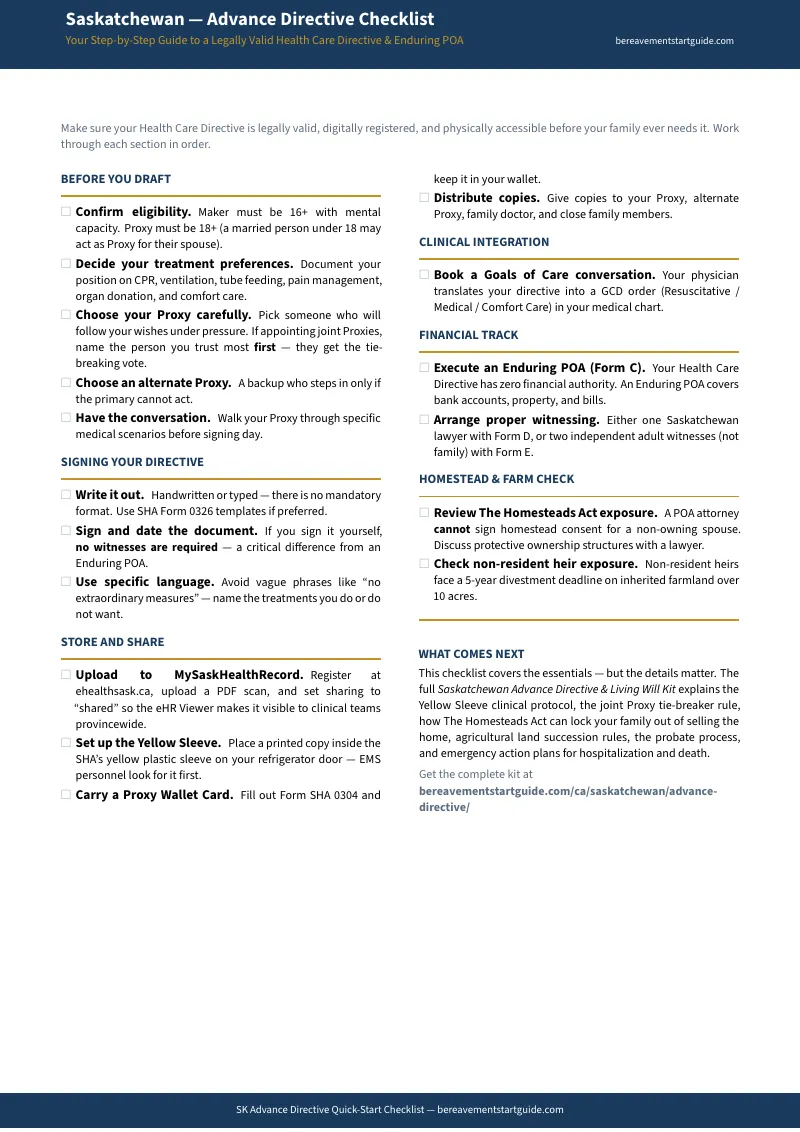
The Quick-Start Checklist
Seventeen items across six sections — Health Care Directive, Goals of Care Designation, Enduring Power of Attorney, property and homestead protection, agricultural land (if applicable), and regular review schedule. Each item references the guide chapter with full instructions. Print it, work through it, and know when you're done.
Ten Print-and-Fill Worksheets
Standalone PDFs you print and write on — not extra chapters of the same guide:
- health-care-directive-worksheet.pdf — treatment wishes and Proxy names, ready to copy into the signed directive
- yellow-sleeve-setup-checklist.pdf — load the SHA fridge sleeve so EMS can find your directive
- goals-of-care-conversation-card.pdf — bring this to the physician appointment that records your GCD
- enduring-poa-setup-worksheet.pdf — attorney choice, Form C / D / E witnessing route, and the Homesteads Act flag
- signing-witnessing-checklist.pdf — the signing-table sheet that keeps HCD and POA rules from getting mixed up
- homesteads-act-planning-worksheet.pdf — title, non-owning spouse, and the s. 6(4) consent trap
- document-distribution-tracker.pdf — who has a copy, and the same rows when you revoke
- emergency-action-plans.pdf — three crisis checklists (hospital, death, non-resident farmland)
- conversation-scripts.pdf — doctor, family, and financial conversations with write-in notes
- agricultural-land-succession-worksheet.pdf — acres, heirs, and the five-year Farm Security Act clock
Who This Kit Is For
- The adult child who just became a caregiver — a stroke, a fall, a dementia diagnosis, and you suddenly need legal authority to manage care decisions and finances. The kit gives you both documents, the correct signing rules, and the Goals of Care pathway in the order you need them, before the family ends up in a guardianship application
- The farm family planning a transition — if the principal operator loses capacity without both a Health Care Directive and an Enduring POA in place, grain contracts stall, land titles freeze, and the Homesteads Act consent trap can lock the family out of property decisions. The kit covers agricultural succession alongside medical planning
- The proactive planner — you want your healthcare wishes, financial protection, and clinical integration documented properly, not left to a statutory hierarchy of relatives who may disagree with each other or with your actual wishes
- The couple doing this together — you each need your own directive, and the Enduring POA witnessing rules exclude family members. The kit's signing-day instructions prevent the execution errors that invalidate Saskatchewan documents
- The recently diagnosed — a serious diagnosis makes the Goals of Care conversation immediate. The kit connects your directive to the medical orders your clinical team will actually use
- The out-of-province newcomer — your previous province's documents — personal directive, representation agreement, advance decision — carry no statutory weight in Saskatchewan. The kit explains exactly which documents replace them and adds the clinical layer your old documents never had
Why Free Resources Will Not Build This Plan
The forms exist. Connecting them to the clinical system, the financial system, and the agricultural realities of Saskatchewan life — that's the work free resources don't do:
- Saskatchewan Health Authority's "My Voice" workbook — excellent values-based reflection worksheets and proxy templates. Zero coverage of Enduring Powers of Attorney, witnessing rules, or financial planning. No explanation of how Goals of Care Designations translate wishes into medical orders. Great for thinking about what you want; not a plan that protects you
- PLEA (Public Legal Education Association) — highly accurate legal summaries of provincial statutes. No fillable templates, no crisis action plans, no conversation scripts. It tells you what the law says; it does not walk you through using it
- Dying With Dignity Canada — clear medical directive forms with good options for life support and comfort care preferences. Excludes all financial power of attorney guidance and property protection. Half a plan, clearly labelled
- Online will platforms (Willful, Epilogue, LawDepot) — polished questionnaires that generate documents, then stop. No Yellow Sleeve protocol, no Goals of Care integration, no Homesteads Act warning, no agricultural succession. The document is where the work begins, not where it ends
- Saskatchewan law firms — thorough, customized, and starting at $750 to $1,500+ for a full planning package, with office appointments and multi-week timelines. The right choice for genuinely complex estates — and unavailable at 9 p.m. on a Sunday when a parent is admitted to hospital
Satisfaction Guarantee
If the kit does not deliver what this page describes, email hello@bereavementstartguide.com and we will refund you — no forms, no delays. The risk is spending weeks assembling fragmented information from government websites while the window to act narrows.
Start With the Free Checklist — Or Get the Full Kit Now
The Saskatchewan Advance Directive Quick-Start Checklist is free. It covers what to do — the seventeen items, in order. The full Saskatchewan Advance Directive & Living Will Kit covers how — fourteen chapters of instructions, ten print-and-fill worksheets, conversation scripts, emergency action plans, and the clinical integration that turns paperwork into protection.