Your parent's bank account is frozen. The care facility needs a deposit. And nobody in the family has the legal authority to do anything about it.
A stroke, a fall, a dementia diagnosis — and within days, Saskatchewan's legal system locks the family out of every financial decision. The bank won't discuss the mortgage. The care home wants a signed agreement from someone who can no longer sign. The pension cheque is going into an account nobody can touch. And the clock is running: once capacity is lost, a Power of Attorney can no longer be executed. The family's only path is a guardianship application to the Court of King's Bench — two independent capacity assessments, a financial bond that can run to 20% of the estate's value, and months of waiting.
This is the crisis a Power of Attorney was designed to prevent. But Saskatchewan makes it harder than most provinces to get right.
The Saskatchewan Capacity Protection System — Property POA, Health Care Directive, and Estate Transition in One Manual
Saskatchewan splits decision-making authority into two completely separate statutes. Money and property fall under The Powers of Attorney Act, 2002. Healthcare and personal care fall under The Health Care Directives and Substitute Health Care Decision Makers Act, 2015. Most families discover this split after a crisis has already started — and most online templates, written for provinces with combined documents, get the Saskatchewan system wrong from the first page.
The Saskatchewan Power of Attorney Kit covers the complete system — both documents, the signing and witnessing rules that make them legally binding, the statutory accounting forms the law requires, the bank-acceptance playbook, the ISC land-transfer rules for farm families, and the full estate transition when the grantor dies. Eighteen chapters, organized in the order you actually do the work.
What's Inside — and What Each Piece Solves
- The Two-Document System Explained — the property POA vs. the Health Care Directive, which statute governs each, and why a complete plan always requires both. This is the foundation most guides skip, leaving families with half a plan and no idea what's missing.
- Saskatchewan's Statutory Forms (A through L) — which forms apply to your situation and where to find them, including the corporate registry trap that sends families to BN14/NP28/LLP11 business forms with zero authority over personal finances.
- Signing and Witnessing Rules — the two valid execution methods (lawyer with Form D, or two independent witnesses with Form E), the wet-ink requirement, the witness-exclusion list, and the narrow remote-witnessing rules. This is where most DIY documents die — national templates omit Form E entirely, and the document is invalid without it.
- Gifting Caps and Fee Limits — if your POA is silent, your attorney is locked into a $1,000 annual gifting cap, a 2.5% fee schedule for property management, and $15/hour for personal care. The kit shows how to set terms that match your family's actual situation instead of defaulting to limits that may be too restrictive.
- ISC Self-Dealing Clauses for Farm Land — the Information Services Corporation rejects any land transfer where the attorney is also the buyer unless the POA contains specific authorization language. Generic templates lack this clause. For farming families planning a succession, this single omission blocks the entire transition at the registry.
- Bank Compliance Playbook — why banks reject legally valid POAs (staleness policies, insistence on proprietary forms, demands for extra documentation), how to pre-clear your documents before you need them, and the escalation pathway when a branch manager says no.
- Statutory Accounting System — the prescribed forms (Form H and Form I for ongoing records, Form K and Form L for final accounting) that the law requires every attorney to maintain. Most families learn about these obligations from the PGT, after a complaint has already been filed.
- Health Care Directive Coordination — appointing a proxy, writing treatment instructions clinicians can act on, the hierarchy of substitute decision-makers when no directive exists, and how to align the HCD with your property POA so the two documents never conflict.
- The Complete Estate Transition — both documents terminate at death, instantly. The former attorney's final accounting obligations, the probate process through the Court of King's Bench, CRA deadlines, and intestacy rules — mapped as a step-by-step handoff, not a scramble.
- SHEPP Pension Compliance — why the Saskatchewan Healthcare Employees' Pension Plan refuses beneficiary changes unless the POA explicitly grants that authority, and what the document needs to say for SHEPP to accept it.
- First Nations and Reserve Land — when provincial POA law meets federal jurisdiction under the Indian Act. The ILRS certification requirements, the statutory declaration rules, and the distinct federal process for members who pass away on reserve.
- The No-POA Emergency Pathway — when capacity is already gone and no documents exist. The guardianship application, the two-assessment requirement, the bond, and the lighter alternatives that may apply to smaller estates.
Printable Worksheets Included
The paid kit is 12 PDFs — the 18-chapter guide, the Quick-Start Checklist, and these fillable worksheets:
- Attorney and Proxy Selection Worksheet — side-by-side vetting for property attorney and healthcare proxy, including the 10-year criminal lookback
- Signing-Day Execution Checklist — print and bring to the table: Form D or two Form E certificates, witness-exclusion screen, wet ink
- Opening Asset Inventory — baseline accounts, land titles, bills, and liabilities the day the attorney starts
- Statutory Accounting Ledger — working file for Forms H and I (annual) and Forms K and L (final, six months)
- ISC Land Transfer Checklist — register the EPOA against title, self-dealing screen, Homesteads Act consent
- Bank Preclearance Worksheet — what to bring, five-step refusal protocol, and a visit log
- Health Care Directive Worksheet — treatment notes to transfer onto SHA forms, plus Yellow Sleeve storage
- Document Distribution Log — where every original lives and who received each copy
- No-POA Emergency Pathway — Form J assessments, Form M bond, and the $250 King's Bench application tracker
- Estate Transition Checklist — first 48 hours after death, final accounting, and the probate path
Who This Kit Is For
- The adult child who just became a caregiver. Your parent's accounts are frozen and the care facility is waiting for a signed agreement. The kit gives you the correct documents, the signing rules, and the capacity timeline — before the family ends up in a guardianship application.
- The farming family planning a succession. Quarter sections, crop assets, corporate structures — and a Land Titles Registry that will reject every transfer executed under a generic POA template. The kit includes the ISC-compliant self-dealing clauses that make a farm transition possible.
- The couple doing this together. Each of you needs your own POA and Health Care Directive — and each is disqualified from witnessing the other's documents. The execution checklist prevents the most common signing error in Saskatchewan.
- The family trying to keep the PGT out of their affairs. Without a POA, the Public Guardian and Trustee can step in to manage even modest assets. A properly drafted POA with a designated accountability person keeps control where it belongs.
- The named executor preparing for a transition. You hold your parent's enduring POA and know it dies with them. Chapter 14 maps the handoff — final accounting to the PGT, probate, CRA deadlines — so the transition is orderly.
Why Not the Free Government Forms?
The PGT and Publications Saskatchewan provide the statutory forms (A through L) for free. They provide no instructions on how to fill them out, no witness coordination guidance, no bank-acceptance strategies, and no custom clauses for farm land, pension plans, or gifting limits. The forms are the raw legal instruments. The kit is the complete system that makes them work.
PLEA Saskatchewan publishes clear, accessible articles on POA law — but offers no templates, no execution checklists, and no institutional playbook. Online platforms like Willful and LawDepot generate documents from rigid questionnaires that omit Saskatchewan's mandatory witness certificates, the 2015 gifting and accounting reforms, and the ISC land-transfer rules.
A Saskatchewan estate lawyer charges $1,500 or more for a comprehensive planning package. For straightforward situations — appointing an attorney and proxy, drafting both documents, executing them correctly — the kit covers the same ground for a fraction of one hour of legal fees.
Satisfaction Guarantee
If the kit doesn't give you a clear path to properly executed Saskatchewan documents — both the property POA and the Health Care Directive — email hello@bereavementstartguide.com at any time for a full refund. No forms to fill out, no questions asked.
Get Started Today
The kit costs — once, no subscription. Eighteen chapters covering the property Power of Attorney, the Health Care Directive, execution and witnessing rules, the attorney's statutory duties and fee caps, ISC land-transfer compliance, bank acceptance, SHEPP pension rules, First Nations considerations, the guardianship pathway, and the complete estate transition at death.
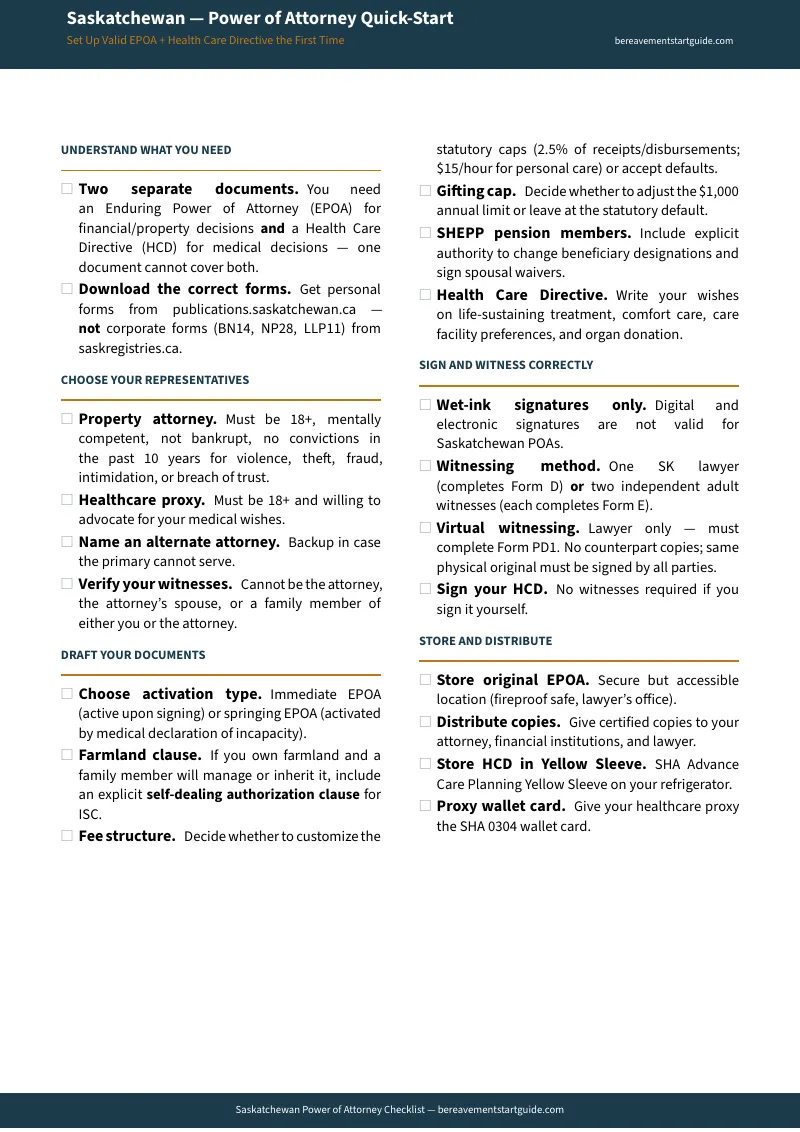
Not ready for the full kit? Download the free Saskatchewan POA Quick-Start Checklist — 20 items covering the two-document system, the signing and witnessing rules, and institutional acceptance. It's enough to get the critical moves right. The full kit is there when you want the complete roadmap.
A capacity crisis does not wait for you to finish researching. This kit turns an afternoon into properly executed documents and a bank-acceptance plan — plus a transition plan your family will need one day.