Yukon Has Three Decision-Making Documents, Two Statutes, and a Witness Certificate That Invalidates Everything If You Miss a Single Checkbox.
You decided to get your parent's affairs in order. Maybe a diagnosis made it urgent. Maybe distance made it terrifying — you are in Vancouver or Edmonton, they are in Whitehorse or Watson Lake, and you have no idea who is managing their accounts. So you searched for a Yukon power of attorney — and landed on a page of results for elder-law firms in Yukon, Oklahoma, government portals written for people who already know what an EPA is, and generic Canadian templates that do not comply with Yukon's territorial statutes. Here is the first thing nobody tells you plainly: Yukon does not have a single "power of attorney." Money and property run through an Enduring Power of Attorney (EPA) under the Enduring Power of Attorney Act. Healthcare and personal care run through a completely separate Advance Directive under the Care Consent Act. And for routine day-to-day decisions, a third instrument — the Representation Agreement under the Adult Protection and Decision Making Act — exists but expires automatically if the adult loses cognitive capacity.
Get the wrong document, or execute the right one with even a minor procedural error, and the consequences arrive during a health crisis. If advancing dementia, a stroke, or a sudden injury leaves your parent without capacity and no valid EPA exists, banks freeze sole accounts — pension deposits stop, utility payments bounce, and care-facility fees go unpaid. Your family cannot simply step in. The only remaining path is a Supreme Court of Yukon guardianship application: a physician's Incapability Assessment Report, formal court filings, months of waiting, and — once approved — guardian compensation capped at 2.5% on receipts and disbursements under OIC 2005/78. If nobody in the family can serve, the Public Guardian and Trustee steps in as guardian of last resort, charging separate administrative fees that steadily deplete the estate.
And even a properly chosen document can fail silently. When the 2026 amendments eliminated the requirement for lawyer-witnessed EPAs, they replaced it with something families were not prepared for: a mandatory Certificate of Witness that one of the two lay witnesses must complete in full and physically attach to the EPA. A single unchecked box. A missing occupation field. A certificate that was completed but not physically bound to the EPA. Any of these renders the entire document legally invalid — and you will not discover the problem until a Whitehorse bank manager refuses to honour it under Section 17, which grants financial institutions the explicit right to freeze accounts if they suspect financial abuse.
The Yukon Power of Attorney Kit is built as a Territorial Compliance System — the only Yukon planning kit that follows legal authority across its entire lifecycle: understanding the dual-track system, drafting both the EPA and the Advance Directive, executing them under the 2026 witness rules so they are actually binding, getting banks to accept them, navigating the Section 51 Indian Act carve-out when standard EPAs are restricted, managing the emergency window when capacity is slipping, and handling the moment every document ends — the adult's death, when authority passes to the executor and the estate work begins. Sixteen chapters plus appendices, in plain language, built for the Yukon system exactly as it stands right now.
What's Inside the Territorial Compliance System
A 16-chapter guide, 7 printable standalone worksheets, and a Quick-Start Checklist — covering the Enduring Power of Attorney, the Advance Directive, the Certificate of Witness, and the estate transition no other Yukon resource connects to them:
Chapter 1: Yukon's Dual-Track System — What You Actually Need
The strict legislative divide between financial authority (EPA under the Enduring Power of Attorney Act) and healthcare authority (Advance Directive under the Care Consent Act), plus the day-to-day Representation Agreement that expires on cognitive decline. The four substitute decision-making instruments, the terminology Yukon uses that no generic Canadian template shares, and why a single document downloaded from a national legal site leaves half your family's protection missing.
Chapter 2: Creating an Enduring Power of Attorney
Eligibility requirements for both the donor and the attorney, the immediate-vs.-springing decision (and why a springing EPA that banks cannot quickly verify stalls access during a crisis), customizing the scope of authority — from gifting powers to spending limits — and the specific clauses that determine whether a Whitehorse bank will accept or reject the document.
Chapter 3: The Certificate of Witness
The 2026 amendment's most consequential change: how the mandatory Certificate of Witness works, every field that must be completed, the physical-attachment requirement that invalidates detached certificates, and the field-by-field execution checklist that catches errors before the document leaves the signing table.
Chapter 4: The Advance Directive
Healthcare authority under the Care Consent Act: appointing a proxy for medical treatment, care facility admission, and personal assistance services. The abbreviated vs. long-form directive, medical preference worksheets, and how to coordinate the Advance Directive with the EPA so both documents speak to each other without contradiction.
Chapter 5: Springing and Activation Triggers
How to draft activation conditions that banks actually accept, the physician's written declaration process, the risks of immediate vs. contingent authority during a fast-moving health crisis, and the narrow window where a springing EPA can still be activated after a hospitalization.
Chapter 6: Fiduciary Duties and Record-Keeping
What the law demands of the attorney once authority is active: honest dealings, keeping the adult's money strictly separate, record-keeping obligations, the no-self-dealing rules, and the personal liability that well-meaning adult children discover when the Public Guardian and Trustee or their own siblings challenge their management of accounts.
Chapter 7: Getting Banks to Accept Your Documents
The chapter free resources skip entirely. Why Whitehorse banks routinely reject valid lay-witnessed EPAs under Section 17 — and the step-by-step Bank Acceptance Protocol: pre-drafted notification letters, the statutory-compliance cover sheet, the escalation pathway when a branch manager refuses your documents, and why signing the bank's in-house form can be a legal disaster. A document nobody accepts is a document you do not have.
Chapter 8: Revocation and Amendment
How to revoke an EPA or Advance Directive correctly so an outdated version cannot resurface, the written revocation requirements, notification obligations to the attorney and to financial institutions, and the narrow scenario where a new EPA automatically revokes an old one — and where it does not.
Chapter 9: Emergency Pathways When Capacity Is Slipping
When capacity is fading but not yet fully lost: the narrow window where a Representation Agreement may still be possible, the capacity assessment that determines whether the adult can still sign an EPA, and the crisis protocol for families who discover the problem during a hospital admission. This is the chapter the rest of the guide exists to prevent needing.
Chapter 10: Court-Ordered Guardianship
When it is genuinely too late for any document: the Supreme Court of Yukon guardianship process under the Decision Making, Support and Protection to Adults Act, the Incapability Assessment Report, filing requirements, the Community Care Branch investigation, private guardian fee caps under OIC 2005/78, and how the Public Guardian and Trustee's fees under OIC 2005/83 deplete the estate.
Chapter 11: First Nations and Section 51 of the Indian Act
The chapter no generic template addresses. For citizens of the Liard First Nation, White River First Nation, and Ross River Dena Council, Section 51 of the federal Indian Act restricts standard EPAs for property on-reserve. How Indigenous Services Canada assumes administrative control, the federal minister application process, and the alternative planning tools — joint accounts, inter-vivos trusts, and self-governing First Nation protections — that preserve family autonomy.
Chapter 12: Remote Communities
Executing valid documents in communities like Old Crow, Faro, or Haines Junction where no lawyers or notaries practice. The lay-witnessing rules that make remote execution legally possible, finding eligible witnesses, the travelling-notary circuit, and the communication tools for coordinating with attorneys in Whitehorse.
Chapter 13: Cross-Jurisdictional Issues
When the adult lives in Yukon but the attorney lives in Vancouver or Edmonton: portability rules for Yukon documents used out-of-territory, whether an Ontario or BC power of attorney is recognized in Yukon, and the safest approach for families split across provincial lines.
Chapter 14: Business Assets
Corporate accounts, business partnerships, sole proprietorships, and mining claims that freeze on incapacity: the specific EPA clauses business owners need, and the succession planning gap between the EPA's financial authority and the business's operating agreements.
Chapter 15: The Estate Transition
Every EPA and Advance Directive terminates instantly at the moment of death — and the myth that the EPA can pay for the funeral is exactly that. The handoff from attorney to executor under the Estate Administration Act, the bank pathway that releases funds directly to a funeral home, Yukon death certificate and probate basics, and the CPP death benefit.
Chapter 16: When to Hire a Professional
Real estate transfers, contested capacity, undue-influence allegations, complex business assets, or a guardianship petition already in progress — some situations genuinely need a Yukon lawyer. This chapter tells you which ones, what they cost, and how to arrive organized enough to cut billable hours significantly.
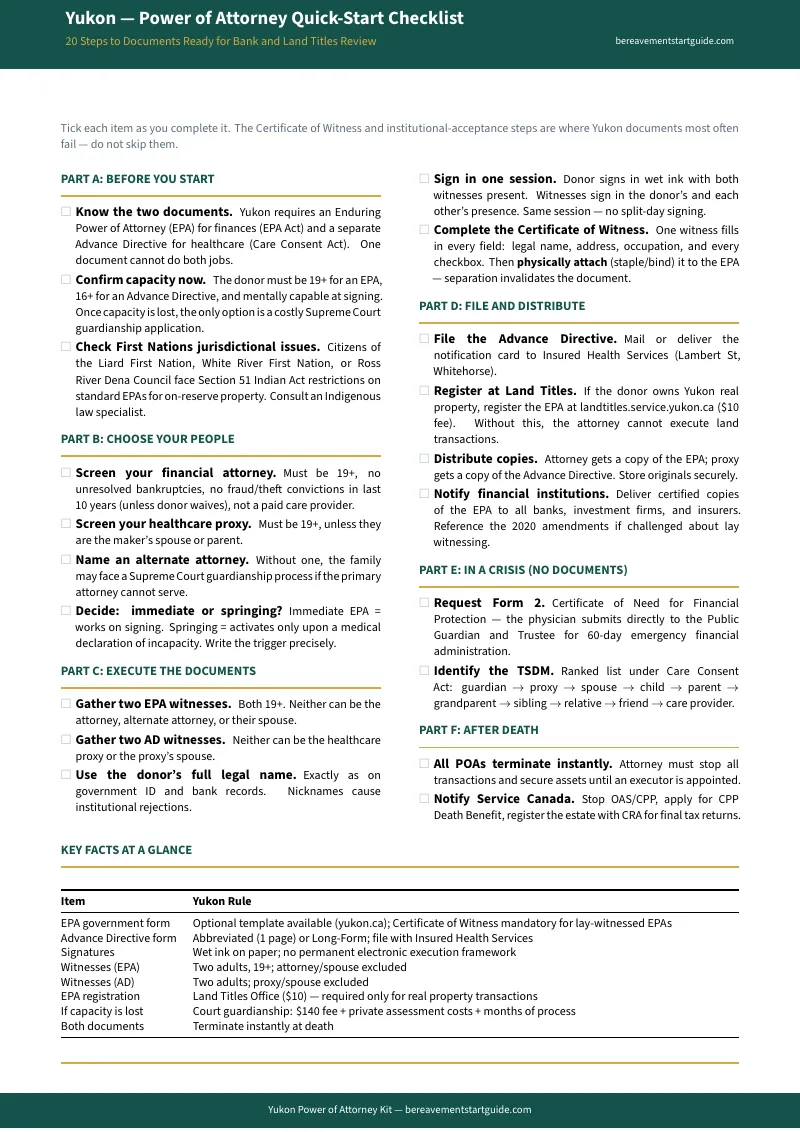
The Quick-Start Checklist
A standalone, print-and-pin reference covering every phase — from working out which of Yukon's instruments you need, through choosing your people, drafting, the witness and Certificate of Witness rules, to getting banks to accept your documents. Every witness eligibility rule, every execution requirement, and every filing deadline at a glance.
7 Printable Standalone Worksheets
Print-and-use tools you bring to the signing table, the bank counter, or the court registry:
- EPA Execution Checklist — signing-day walkthrough including every Certificate of Witness field
- Bank Acceptance Worksheet — institution notification tracker and the escalation protocol for rejected documents
- Fiduciary Record-Keeping Log — transaction journal for the active attorney's mandatory accounting
- Document Distribution Tracker — record who received copies of your EPA and Advance Directive
- Revocation Checklist — step-by-step revocation procedure with notification tracking
- Capacity Emergency Tracker — the 60-day certificate pathway and guardianship filing steps when capacity is lost
- Guardianship Application Checklist — Supreme Court of Yukon filing tracker with all required forms
Who This Is For
- The distant adult child — managing a parent's affairs from Vancouver, Edmonton, or Calgary while the parent lives in Whitehorse, Dawson City, or Watson Lake. You need documents that work across provincial lines and that a Yukon bank will actually accept from an out-of-territory attorney.
- The rural and remote planner — living in Faro, Old Crow, Haines Junction, or another community where no lawyer or notary practises. You need to know exactly how to execute valid documents locally with lay witnesses.
- The aging partner caregiver — watching a spouse's capacity decline and racing to get documents signed before the legal window closes. You need the simplest possible path from "we should do this" to "it's done and the bank has a copy."
- The First Nations family — navigating the overlap between territorial law, federal Indian Act restrictions, and self-governing First Nation agreements. You need guidance built for these specific jurisdictional layers.
Why Free Templates Fall Short in Yukon
The Yukon Department of Justice publishes blank EPA forms. The Department of Health and Social Services publishes blank Advance Directive forms. These forms are technically correct — but they are templates, not instructions. They tell you what to fill in without explaining how to fill it in correctly, which combination of documents you actually need, or what to do when a bank rejects your completed forms.
Generic Canadian legal platforms like LawDepot and Epilogue offer document builders — but their templates frequently lag behind Yukon's territorial amendments, omit the mandatory Certificate of Witness, and cannot address the Section 51 Indian Act carve-out. The Yukon Public Legal Education Association publishes excellent educational booklets — but they are designed for general awareness, not crisis execution, and they repeatedly advise you to "consult a lawyer" for every practical step.
And the Yukon-specific competitor you will find on the first page of results? That is Seda Law Firm — in Yukon, Oklahoma. Different country, different legal system, completely irrelevant to your situation.
This kit fills the gap between blank government forms and a lawyer's retainer: complete execution guidance, the mandatory certificates and notification letters, the bank acceptance protocol, and the crisis pathways that keep families out of Supreme Court — all built for Yukon's 2026 territorial rules.
Satisfaction Guarantee
If the kit does not deliver what you expected, email hello@bereavementstartguide.com and we will make it right.
Get Started
Download the free Yukon POA Quick-Start Checklist to see which documents you need, the witness rules that void most DIY paperwork, and whether you are still in time to act before capacity is lost. When you are ready for the complete system — the 16-chapter guide, the Certificate of Witness pack, the bank acceptance protocol, and the estate transition roadmap — the full Yukon Power of Attorney Kit is available for .