
You buried someone you love. Now the bank wants forms, the court wants filings, your sibling wants the house — and your brain can barely finish a sentence.
The funeral is over. The casseroles are gone. And somewhere between the condolence cards and the unopened mail, you realized that nobody is coming to tell you what happens next.
You need to close bank accounts — but the bank says you need Letters Testamentary. You need Letters Testamentary — but the probate court needs the original will, which you can't find. A credit card company is calling about a balance. Your brother wants to know when he'll get his share. And you just learned that paying off your mother's Visa before the estate taxes could make you personally liable for the difference.
This isn't a grief book. This is the Estate Settlement Roadmap — a week-by-week action plan built for someone operating on a brain that clinical research shows is working at a fraction of its normal capacity.
Why the first 30 days are the most dangerous
Neuroscience research has documented that acute grief suppresses prefrontal cortex activity — the brain region responsible for planning, sequencing, and evaluating consequences — while flooding the body with cortisol that impairs short-term memory. Depression rates among the newly bereaved spike to 38.2%, compared to a general population baseline of 8.7%. Clinicians call it "grief fog." You experience it as forgetting conversations from yesterday, losing documents you just organized, and staring at a form for twenty minutes without processing a single line.
This is the exact brain state in which you're being asked to make decisions that carry legal liability, affect family relationships permanently, and determine whether estate assets go to the right people in the right order.
The Estate Settlement Roadmap replaces the chaos with structure. It separates what is genuinely urgent (credit bureau freezes, government notifications, securing the home) from what feels urgent but can wait (asset distribution, property sales, investment changes). Every task is sequenced in the order that prevents mistakes — because the order matters more than most executors realize.
What's inside
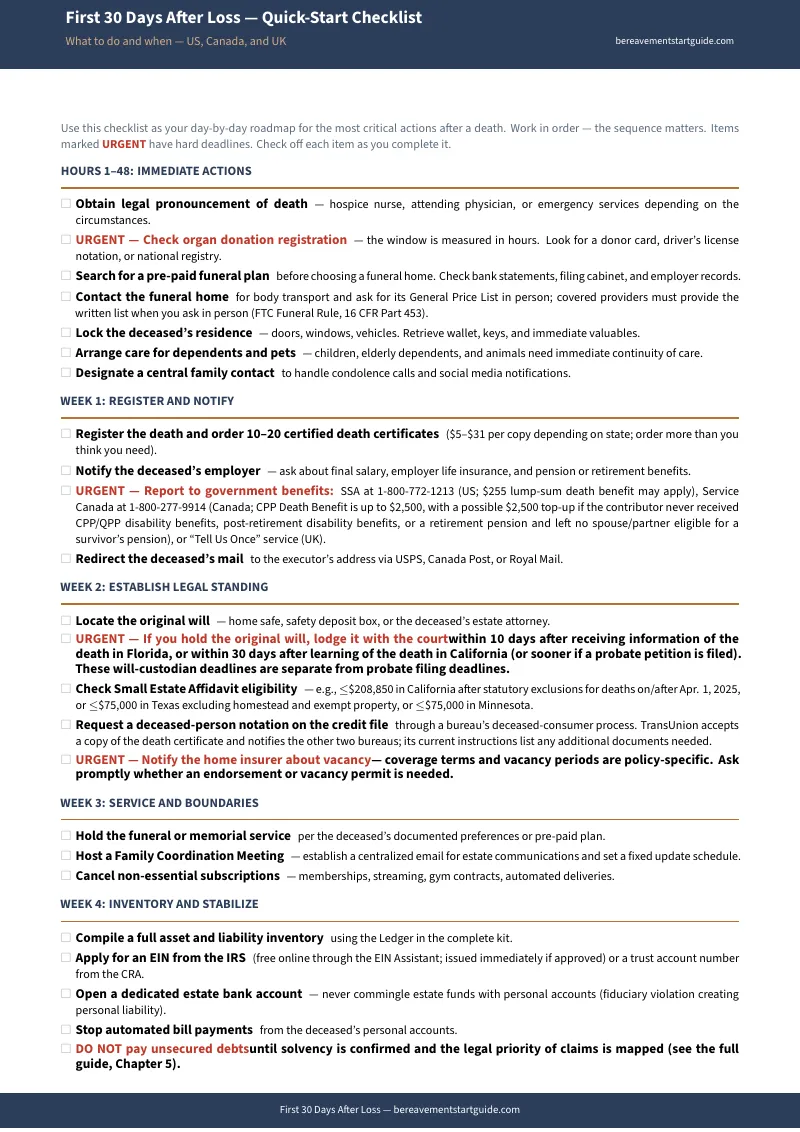
Week-by-week action plan covering the entire first month — not a vague "things to take care of" list. A chronological framework that separates Day 1–3 logistics (death pronouncement, funeral home selection, securing the property, checking organ donation windows) from Day 4–14 stabilization (credit bureau freezes at all three agencies, Social Security and pension notifications, insurance vacancy riders for the home) and Day 15–30 administration (EIN application, estate bank account, full asset inventory, creditor notification in the legally required priority order). Every task includes who to contact, what to say, and what documents you need in hand before making the call.
Grief neuroscience and cognitive pacing — why you cannot concentrate, why your memory is unreliable, and why that is a predictable neurobiological response, not a personal failing. The 24-48-7 pacing rule gives you a concrete protocol for every non-emergency decision: identify options on Day 1, gather written information on Day 2, decide on Day 7 when emotional reactivity has subsided. This section alone can prevent the kind of impulsive, grief-driven decisions that families regret for years.
Legal authority explained in plain language — the critical distinction between being named in a will and actually having the legal authority to act. Until a probate court issues Letters Testamentary (with a will) or Letters of Administration (without one), signing documents on behalf of the estate can violate probate law. The guide walks you through the filing process, small estate affidavit thresholds by jurisdiction, and which assets bypass probate entirely — so you know what you can access immediately and what requires court authorization.
The debt payment hierarchy that protects you from personal liability — probate statutes dictate a strict, mandatory order for paying creditors: court costs and legal fees first, then funeral expenses, then federal and state taxes, then secured debts, then unsecured debts. If you pay a credit card company before the estate's tax obligation and the estate later runs short, you can be held personally responsible. The guide maps this hierarchy clearly and explains the consequences of getting it wrong.
Family conflict scripts and communication protocols — inheritance disputes rarely start with bad intentions. They start with grief, exhaustion, unresolved family dynamics, and the fear of being treated unfairly. The toolkit includes the "No Ambush" rule for the first family meeting, a structured protocol for centralized estate updates (so no one feels left in the dark), and word-for-word scripts for the hardest conversations: "When do I get my share?" "Mom promised me the house." "Why are you in charge?"
Identity theft prevention protocol — within days of an obituary going live, the deceased's Social Security number becomes a target. The guide covers credit bureau freezes at all three agencies, IRS deceased-alert filing, secure obituary writing (what never to include), and mail-monitoring steps — all timed to the first week, when the risk peaks.
Country-specific tax guidance — quick-reference sections for U.S. federal estate and income tax (Form 1041, stepped-up basis rules), Canadian deemed disposition and CPP/OAS cessation, and UK inheritance tax thresholds and probate registry procedures. You'll know which deadlines are real, which can wait, and when a professional is genuinely worth the fee.
Quick-start checklist — a separate printable PDF with 25 items across five phases that you can tape to the fridge or carry in your bag. The checklist tells you what to do. The full guide tells you how, why, and what happens if you don't.
Who this is for
Newly appointed executors and personal representatives — you were named in a will or the court appointed you. Nobody explained fiduciary duty, personal liability, or the order in which creditors must be paid. This is the operating manual that should have existed before you needed it.
Surviving spouses and partners — joint accounts, survivor benefits, pension notifications, health insurance, vehicle titles. Every institution has its own forms and timelines. The toolkit sequences them by genuine urgency so you handle what matters this week and defer what can wait until next month.
Adult children handling a parent's estate — especially from a distance. Siblings are calling with conflicting opinions, mail is piling up, and you cannot physically be at the house. The scripts and communication protocols let you coordinate remotely without losing control of the process.
Families already in conflict over the estate — the will says one thing, someone remembers a verbal promise, and nobody agrees on what to do with the house or personal property. The guide gives you communication ground rules and a structured process for dividing assets — before the disagreements become legal battles.
Why this works where free online information doesn't
Every fact in this guide exists somewhere on the internet — scattered across funeral home blogs designed to funnel you into expensive service packages, government portals written in language that assumes you already understand probate terminology, legal sites that want to sell you a $350/hour attorney consultation, and Reddit threads where half the advice is jurisdictionally wrong.
At 2 a.m., running on three hours of sleep with a brain that cannot hold a paragraph, you do not have the cognitive bandwidth to find, filter, sequence, verify, and reconcile twenty sources. You do not have the executive function to determine which blog post applies to your state and which one doesn't. You certainly do not have the emotional capacity to parse contradictory advice about whether you're personally liable for your mother's credit card debt.
This guide does the filtering and sequencing for you. One document. One timeline. One set of priorities. In a format designed for a brain that is operating under documented neurological impairment.
Satisfaction guarantee
Full refund, no time limit. If the toolkit doesn't help, email hello@bereavementstartguide.com and we'll refund your purchase — no questions, no hoops, no expiration date.
Less than one hour with an estate attorney
The average initial consultation with a probate attorney runs $250 to $350 per hour. Many families spend thousands in legal fees during the first month — some of it necessary, much of it triggered by mistakes a structured plan would have prevented. A single misstep in creditor payment order can create personal liability that exceeds any attorney's bill.
This toolkit costs — a fraction of that first consultation — and it's ready right now, not next Tuesday at 2 p.m.
Start with the free checklist
Download the quick-start checklist at no cost. It covers 25 tasks across five phases — from the first 48 hours through estate administration. If you need the full week-by-week guide, grief neuroscience, legal explanations, debt hierarchy, scripts, and worksheets, the complete toolkit is one click away.