The estate crosses borders — and nobody told you the rules change at every one.
Someone you love died owning a bank account in one country, a house in another, and maybe shares listed on a third exchange. The domestic probate court gave you Letters Testamentary — and then the foreign bank told you those letters mean nothing in their jurisdiction. The transfer agent rejected your notarized signature and demanded something called a Medallion Signature Guarantee that your bank has never heard of. A cousin in Europe is claiming a mandatory share of the estate under forced heirship laws you did not know existed.
You are not a lawyer. You are not a tax specialist. You are a person in grief trying to navigate legal systems designed for professionals, in languages you may not speak, under deadlines you only discover after missing them.
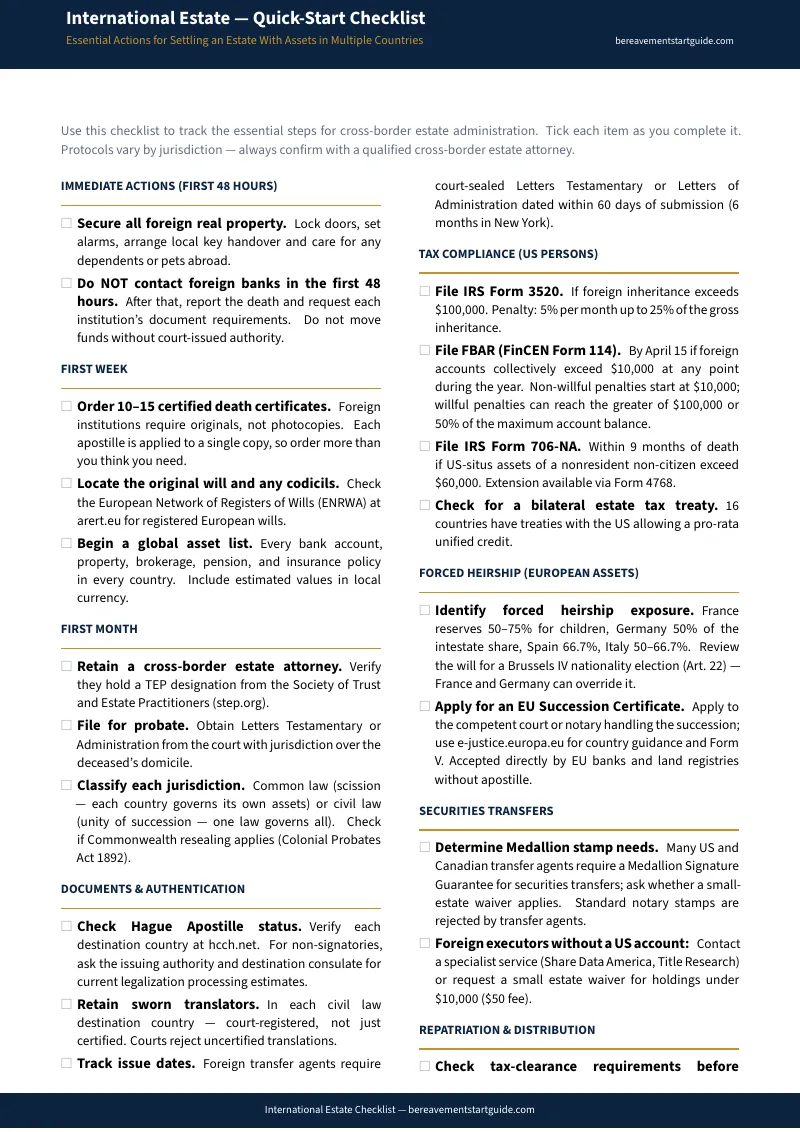
The cost of getting this wrong is not theoretical. Filing IRS Form 3520 late on a foreign inheritance over $100,000 triggers a penalty of 5% per month of the gross inheritance, up to 25%. Distributing assets before obtaining tax clearance in the foreign jurisdiction can leave you — the executor — personally liable for the unpaid tax. And initiating ancillary probate in the wrong court wastes six months and thousands in legal fees before you start over in the right one.
The Cross-Border Administration System
The International Estate toolkit is a structured administration system for executors and families settling an estate that spans multiple countries. It replaces the scattered law-firm blog posts written to funnel you into a $500-per-hour retainer, the grief books that offer emotional support without a single actionable template, and the government portals that assume you already know which form to file and where.
Every chapter is designed for a brain operating under grief — short sections, one decision at a time, explicit stopping points that tell you when you have done enough for today. The system works whether the estate involves two countries or twelve, whether you are the executor, the surviving spouse, or the adult child trying to help from across an ocean.
What's Inside
- Global Asset Inventory Worksheet — because you cannot administer what you have not found. A structured template that captures every bank account, brokerage position, real property, pension, insurance policy, and business interest across every jurisdiction, with columns for the governing legal system, authentication requirements, and local counsel contact information. Most executors discover assets they did not know about while filling this out.
- Document Authentication Tracker — because a rejected filing costs you months, not days. This tracker tells you exactly which documents each institution requires, whether each country accepts a Hague Apostille or demands full consular legalization, which translations must be sworn versus merely certified, and the issue-date window within which your Letters Testamentary remain valid (60 days for most transfer agents, 6 months in New York).
- Medallion Signature Guarantee Walkthrough — because this single stamp blocks more cross-border securities transfers than any other requirement. Step-by-step instructions for obtaining the guarantee as a foreign executor, including the small-estate waiver for holdings under $10,000, the specialist intermediary route through Share Data America or Title Research, and the exact documentation the guarantor institution needs before they will assume financial liability.
- Forced Heirship Exposure Calculator — because a will written in New York may not control a villa in France. Chapter 3 maps reserved-share rules in France, Germany, Spain, and Italy, explains how the Brussels IV regulation allows nationality elections, and documents the two major exceptions where courts have overridden those elections — the German constitutional public-policy ruling (IV ZR 110/21) and France's 2021 droit de prélèvement amendment. If any beneficiary is being told they are entitled to a share the will does not give them, this chapter explains whether they are right.
- Cross-Border Tax Compliance Checklists — because double taxation is not inevitable, but the relief is not automatic. Country-by-country checklists for IRS Form 706-NA (non-resident estates with US assets over $60,000), Form 3520 (foreign inheritances over $100,000), FBAR filing for foreign accounts exceeding $10,000, and the pro-rata unified credit available under the 16 bilateral estate tax treaties. Each checklist links the tax obligation to the specific document you need to file it.
- Repatriation Procedures Worksheet — because moving inherited money across borders is the final obstacle most executors underestimate. Fill-in wire-transfer procedures including India's NRO account requirement with Form 15CA/15CB, South Africa's tiered foreign allowance system, and the currency conversion strategies that save 3–5% over standard bank rates on six-figure transfers.
- Communication Scripts for Foreign Institutions — because the initial notification letter to a foreign bank determines whether your case moves forward or sits in a queue for months. Pre-written scripts for reporting a death to foreign financial institutions, requesting account freezes, initiating securities transfers, and updating co-heirs on realistic timelines — written for the specific formality expectations of institutional compliance departments, not recycled domestic templates.
- Timeline and Deadline Worksheets — because cross-border estates have cascading deadlines across jurisdictions and missing one can delay the entire settlement. Backward-planning worksheets that work from each country's statutory deadlines (9 months for US Form 706-NA, 60 days for most Letters Testamentary, 6 months in New York) and track parallel proceedings so you know which filing gates which next step.
- Agency Communication Log — a landscape log for every call, email, and letter with courts, banks, tax authorities, and transfer agents: date, institution, contact, what was requested, what was promised, and the follow-up date.
- Decision and Conflict Log — a contemporaneous record of significant decisions: date, asset and country, the conflict, legal and financial considerations, the resolution chosen, and the date executed.
- Family Communication Schedule Template — lock a monthly written-update cadence at the first family meeting, list every heir with send dates, and fill the monthly email (progress, next three actions, decisions needing input, tax-clearance reminder) before you type it.
Who This Is For
- You have been named executor of an estate that includes bank accounts, property, or securities in more than one country
- You are the surviving spouse or adult child trying to access foreign accounts that were frozen the moment the death was reported
- You are a US person who has inherited over $100,000 from a foreign estate and need to understand your IRS reporting obligations before the penalties start
- A foreign transfer agent has rejected your documents and you do not know what a Medallion Signature Guarantee is or how to get one from outside North America
- Beneficiaries in a European jurisdiction are claiming forced heirship rights that override the will and you need to understand whether the claim is valid
- You are coordinating the estate from a different country than where the assets are located and need a system that works across distance and time zones
Why Free Tools Get This Wrong
Law firm blogs about international estates are written by private client attorneys whose minimum retainer starts at $5,000. Their articles explain concepts like ancillary probate and the scission doctrine without giving you a single checklist to work through, a template to submit to the foreign court, or a script to send to the transfer agent who just rejected your paperwork. They want you to conclude that you cannot do this without them — and for complex estates, they are right. But for the dozens of procedural and administrative tasks that surround the legal work, you are paying partner rates for paralegal work.
Grief-tech platforms like Empathy and Cake handle domestic estates well — but their task lists end at "consult a professional" the moment foreign assets appear. They cannot tell you which documents need an apostille versus consular legalization, which transfer agents accept a small-estate waiver, or how to structure a foreign inheritance disclosure to avoid a 25% penalty.
Government portals — the IRS, HMRC, the EU e-Justice Portal — provide the official forms but assume you already know which form applies, which supporting documents to attach, and what the consequences are for getting it wrong. They are the destination, not the map.
This toolkit is the map. It connects the procedural dots between the lawyer you hire for the legal work and the government systems you navigate for the administrative work — the layer where executors actually lose money, miss deadlines, and get documents rejected.
The Guarantee
Full refund, no time limit. If the toolkit does not help you navigate your international estate more confidently, email hello@bereavementstartguide.com and we will refund your purchase completely.
Get Started
Download the free checklist for the essential first steps in any cross-border estate, or get the complete International Estate toolkit — the full Cross-Border Administration System with document authentication trackers, tax compliance checklists, communication scripts, and printable worksheets for .