
The Business Doesn't Stop. Neither Can You.
When a small business owner dies, the family doesn't just lose someone they love — they inherit an operational emergency. Within hours, banks freeze accounts. Employees wonder whether they'll get paid. Vendors demand answers. Licensing boards start countdown clocks the family doesn't even know exist.
And all of this lands on one person — usually a surviving spouse, adult child, or sibling — who has never run this business and is making critical decisions through a fog of grief.
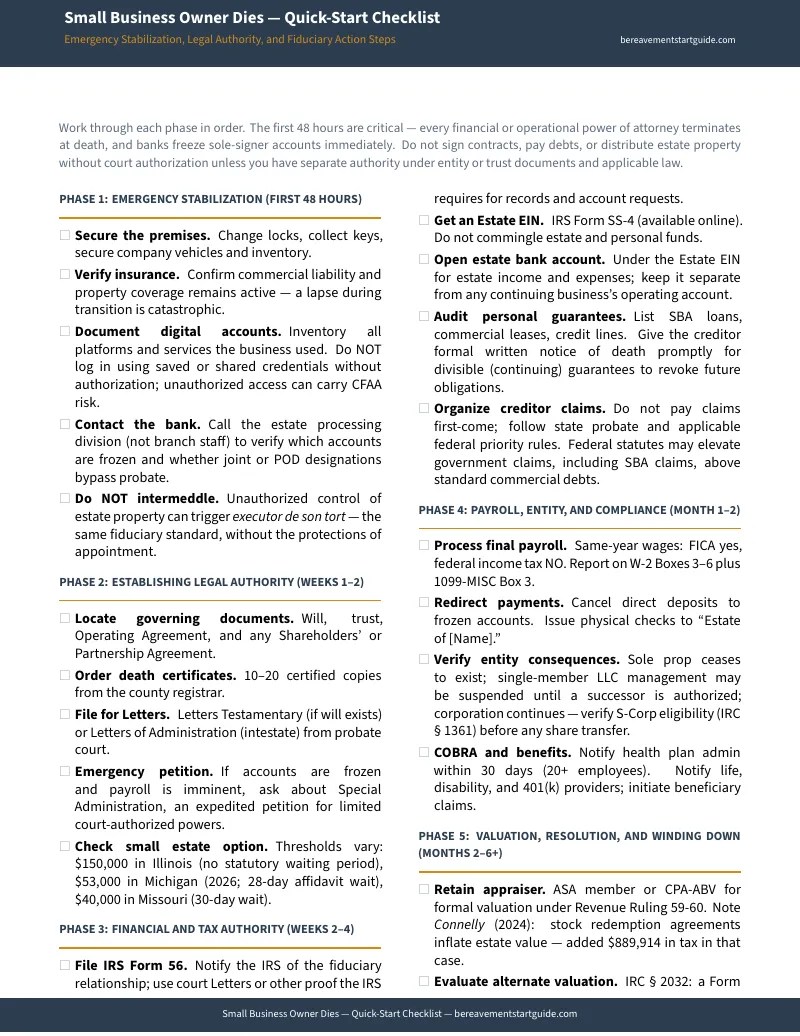
The Business Continuity Action Plan is the structured, phase-by-phase system that tells you exactly what to do and when, from the first 48 hours through the final tax filings six months later. It replaces the panic of "where do I even start?" with a clear sequence of steps organized around the timeline that actually matters.
What Makes This Different from Free Advice
Free resources exist. IRS publications explain tax rules. Law firm blogs answer one question at a time. State licensing board websites list their requirements. But none of them coordinate. They don't tell you that the payroll tax rules change depending on which calendar year you issue the final check. They don't mention that logging into the owner's email with a saved password may violate the Computer Fraud and Abuse Act. They don't explain that your state might let you skip probate entirely with a Small Estate Affidavit — or that the threshold varies from $40,000 in Missouri to $150,000 in Illinois.
This toolkit puts every step in the right order, with the right forms, the right deadlines, and the right language for each institution you'll deal with. Families who prepare with a structured checklist before meeting an attorney typically save thousands in billable hours because they arrive organized rather than starting from zero.
What's Inside
- The First-48-Hours Emergency Protocol — physical security, digital lockdown, the bank freeze playbook, and the executor de son tort trap that catches families who act too quickly without legal authority
- Entity Transition Roadmaps — sole proprietorship, LLC, S-Corp, C-Corp, and partnership — because each entity type has completely different rules for what happens when the owner dies, who can act, and what dissolves automatically
- The Bank Account Recovery System — which accounts freeze, which don't, what to say to the estate processing division, and how joint accounts, POD designations, and corporate resolutions affect access
- Employee Payroll Compliance Guide — the exact W-2 vs. 1099-MISC split, FICA and FUTA rules for same-year vs. next-year payments, accrued vacation payout requirements by state, and the commission pipeline trap
- Licensing and Regulatory Continuity Checklists — notification deadlines, temporary continuance applications, and the professional practice closure rules for law firms, medical offices, and licensed contractors
- The Digital Asset Access Framework — RUFADAA's three-tier priority system, platform-by-platform fiduciary access procedures, and what to document before you try to access anything
- Tax Filing Roadmap — final 1040, estate 1041, Form 56, estate EIN application, and the six-month alternate valuation election that can reduce estate tax liability on a declining business
- Family Conflict Resolution Playbook — the active-manager vs. passive-heir dispute, the incompetent-successor claim, and the liquidation vs. continuation deadlock, with mediation pathways for each
- 10 Fillable Worksheets and Planning Tools — security checklists, document trackers, payroll worksheets, creditor claim logs, S-Corp eligibility checkers, buy-sell execution checklists, decision logs, and family meeting agendas — all printable standalone PDFs
- Decision-Pacing Calendar — a visual timeline from Day 1 to Month 6 that prevents you from making irreversible strategic decisions during acute grief
Who This Toolkit Is For
- Surviving spouses and family members who suddenly need to keep a business running while managing grief and estate administration
- Named executors who are responsible for a business they may not understand operationally
- Business partners dealing with a co-owner's death and the buy-sell agreement process
- Estate attorneys and CPAs who want a client-facing resource that organizes the business owner's family before their first billable meeting
Why Free Tools Fall Short
Legal forms sites like LegalZoom give you blank forms but no operational sequence. Digital end-of-life platforms like Everplans focus on pre-death planning and personal memorials — not post-mortem business operations. Government portals provide authoritative rules in dense, siloed bureaucratic language that assumes you already know which form to file and when.
None of them solve the real problem: coordinating dozens of institutional requirements across banks, courts, the IRS, state licensing boards, employees, vendors, and family members — all while operating under the cognitive impairment that grief causes. Research shows that acute grief mimics mild cognitive impairment, affecting short-term memory, executive function, and decision-making capacity. This toolkit is designed for that reality: color-coded phases, plain language, and one-step-at-a-time pacing.
A Guarantee That Matches the Moment
If this toolkit doesn't give you a clearer path forward, email hello@bereavementstartguide.com for a full refund. No time limit, no questions, no hoops. You are going through enough already.
The free Quick-Start Checklist covers the critical first steps. The full toolkit goes deeper — with the templates, decision trees, entity-specific roadmaps, and tax filing guides that turn a six-month crisis into a structured process. Get the complete Business Continuity Action Plan →