You Downloaded the Free Government Form. It Has Blank Lines, No Instructions, and a Witness Rule That Disqualifies Half the People You Know. Meanwhile, the Registry Does Not Even Store Your Wishes.
Someone told you that you need an advance directive. Maybe your doctor brought it up at a routine appointment. Maybe a parent in Dawson City is starting to forget things and you need to act before the window closes. Maybe you received a diagnosis and want to make sure your treatment preferences are on record before someone else starts making decisions for you.
You went to the Yukon Health and Social Services website and downloaded the form. It is a two-page PDF with blank signature lines and a section labeled "instructions to proxy" that gives you no guidance on what to actually write there. You assumed you could simply list your wishes — no CPR, no ventilator, no tube feeding — and file it. Then you read the fine print.
Under the Care Consent Act, a valid advance directive in the Yukon must appoint at least one proxy. Not "may" — must. A document that only records your treatment preferences without formally naming a substitute decision-maker does not meet the statutory requirements. That national "living will" template you downloaded from a US website last year does not appoint a proxy. It is not valid in the Yukon.
Then you looked at the witness requirements. Your proxy cannot witness your signature. Neither can your proxy's spouse. Neither can anyone who provides you with health care or personal care for compensation. In a community of 300 people where everyone is related to everyone, finding two qualified witnesses is a real problem that no government form acknowledges.
And then there is the registry. After you sign everything, you are supposed to mail a Notification Card to Insured Health Services at 204 Lambert Street in Whitehorse. Reasonable enough. But the registry does not store a copy of your directive. It does not record your proxy's name. It does not list your treatment preferences. It places a single flag in the health insurance database that says "a directive exists" and notes the date. If you collapse at Whitehorse General Hospital and nobody can locate the physical document, the medical team knows a directive exists somewhere — and that is all they know.
The Yukon Advance Directive & Living Will Kit is a Care Consent Navigator — a complete execution system built for Yukon's unique proxy-mandatory framework, the witness restrictions that catch every rural family, and the registration gap that leaves most directives invisible in an emergency. Not a blank form with signature lines. Not a generic Canadian template with "Yukon" in the header. A step-by-step drafting, signing, filing, and distribution guide that produces a directive your hospital will actually be able to find and follow when it matters.
What's Inside the Care Consent Navigator
A comprehensive guide and a Quick-Start Checklist — covering every stage from your first family conversation through a fully registered, clinician-ready directive, built specifically for the Yukon's Care Consent Act framework:
The Care Consent Act Roadmap
The Yukon's advance directive framework is governed by the Care Consent Act (2003) — not the common-law "living will" tradition and not the same legislation that governs powers of attorney. The guide walks you through the three statutory form types: the abbreviated advance directive for straightforward proxy appointments, the detailed advance directive for comprehensive treatment instructions, and the Resuscitation and Care Form for patients who want to refuse CPR. Each form serves a different purpose, and most planners need at least two. The guide explains which combination applies to your situation, what each form legally authorizes your proxy to do, and where the boundaries are — because a healthcare proxy under the Care Consent Act has zero authority over your bank accounts, property, or financial affairs.
Proxy Selection and Appointment
Choosing a healthcare proxy is not the same as naming someone in your will. Your proxy must be someone who can make medical decisions under pressure — not just someone you trust generally, but someone who understands your values, can communicate with physicians, and is reachable when the hospital calls at 2 a.m. The guide provides a structured evaluation framework for comparing potential proxies: emotional readiness, geographic proximity, willingness to override family pressure, and the legal eligibility rules that disqualify certain people from serving. It includes a script for the conversation where you formally ask someone to be your proxy — the conversation most people dread and most guides pretend does not exist.
The Witness Trap
The Care Consent Act requires two witnesses. Your proxy cannot be one of them. Neither can your proxy's spouse. Neither can your healthcare provider. Neither can anyone who provides you with personal assistance services for compensation. In Whitehorse, finding two unrelated adults who meet all the eligibility criteria is straightforward. In Old Crow, Watson Lake, or Carmacks, it requires genuine planning. The guide includes a witness eligibility screening checklist and practical strategies for small communities — including who typically qualifies and how to handle the common scenario where the most obvious candidates are all disqualified by the spousal-connection rule.
Drafting Treatment Instructions That Clinicians Can Follow
The "instructions to proxy" section of the statutory form is where most directives fail — not because the wishes are wrong, but because the language is too vague for medical teams to act on. "No heroic measures" means different things to different physicians. "Keep me comfortable" is not a clinical instruction. The guide teaches you how to specify treatment preferences using language that clinicians can interpret without ambiguity: which interventions you want refused, which conditions trigger those refusals, what "comfort care" means in practice, and how to handle the grey areas where you want your proxy to use judgment rather than follow a rigid script.
The Lambert Street Filing System
Registering your advance directive with Insured Health Services is the step that bridges the gap between having a document and having a document the healthcare system can find. The guide provides the complete filing sequence: completing the Notification Card, mailing it to Box 2703 Whitehorse (or delivering it in person to the 4th floor at 204 Lambert Street), understanding exactly what the registry records and what it does not, and then distributing physical copies to the people and institutions that need them — your proxy, your physician, your hospital chart, and your bedside. It includes printable wallet cards and refrigerator notices designed to point emergency responders to the physical document when the registry flag alone is not enough.
The Planned Home Death Protocol
For terminally ill patients who wish to die at home, the Yukon has a specific emergency protocol that most families learn about too late. If a family member dies at home and someone calls 911, paramedics are legally obligated to perform CPR and other life-saving measures — regardless of what the advance directive says — unless the official Resuscitation and Care Form is physically present and immediately visible. The guide covers the complete planned home death sequence: obtaining the Resuscitation and Care Form through your physician, who to contact instead of 911 (your primary physician, your home care nurse, and the funeral home directly), the fact that there is no legal requirement for immediate death pronouncement in the Yukon, and how to prepare family members emotionally for a death that unfolds without sirens.
The Capacity Assessment Shield
If a healthcare provider questions your mental capacity, the Care Consent Act defines exactly what happens next. A capability assessment can be triggered by a physician, a social worker, or a care facility administrator. If you are determined incapable, your proxy steps in — but only if you have one. Without a designated proxy, the statutory hierarchy of substitute decision-makers takes over: guardian first, then spouse, then adult children, then parents, and so on. If family members disagree or no one in the hierarchy is available, the Capability and Consent Board gets involved. If the Board cannot resolve the issue, the Supreme Court may appoint a guardian — a process that costs thousands of dollars and takes months. A clear, properly executed advance directive with a named proxy prevents all of this.
First Nations Jurisdictional Intersections
Eleven of the fourteen Yukon First Nations operate under Self-Government Agreements — constitutionally protected agreements that can affect healthcare planning, housing, and estate matters. For citizens of self-governing First Nations, questions arise about which legislation governs care decisions on settlement land, whether First Nation health programs interact with the Care Consent Act framework, and how community-specific policies affect care facility admissions. The guide includes a jurisdictional reference section that identifies the key questions to resolve and the contacts within each First Nation government who can answer them.
Review, Revocation, and Life Changes
An advance directive is not a document you sign once and forget. A new diagnosis, a divorce, a move to another jurisdiction, or the death of your proxy — any of these can render your existing directive incomplete, outdated, or legally void. Divorce in the Yukon automatically revokes a proxy appointment of the former spouse, but it does not update your directive on file with Insured Health Services. The guide covers the formal revocation process, the notification steps most people skip, how to appoint a replacement proxy, and the recommended review schedule that keeps your directive current without requiring a full rewrite every year.
Who This Guide Is For
- Yukoners starting from scratch who want a legally valid advance directive but do not know the difference between the abbreviated form, the detailed form, and the Resuscitation and Care Form — and need someone to explain which ones they actually need
- Remote caregivers whose aging parent lives in Dawson City, Watson Lake, or Old Crow without an advance care plan, and who need to coordinate the entire process from Vancouver, Toronto, or Calgary
- Seniors with a will and a financial POA who assume their estate documents cover healthcare decisions — they do not; healthcare proxies are a separate legal instrument under a separate statute
- Families in crisis whose loved one has just been hospitalized and determined incapable of consenting to care, who need to understand the statutory decision-maker hierarchy right now
- Anyone who downloaded the free government form and realized it comes with blank lines, no definitions, no filing checklist, and no guidance on what to write
- Terminally ill Yukoners planning a home death who need the Resuscitation and Care Form protocol before the first emergency call
- First Nations citizens navigating the intersection of territorial health legislation and self-governing First Nation policies
Why the Free Government Forms Are Not Enough
The Yukon government publishes advance directive forms on the Health and Social Services website. They are free. They are legally authoritative. They are also completely blank. They do not explain who qualifies as a witness and who does not. They do not tell you what to write in the instructions section. They do not walk you through the proxy appointment process. They do not mention the Notification Card or the Lambert Street registry. They do not explain the Resuscitation and Care Form. And they do not tell you that a directive without a named proxy is legally invalid.
National online will platforms — LegalWills, Willful — offer generic Canadian advance directive templates through questionnaire-driven interfaces. Their forms are designed for provinces like Ontario and British Columbia. They do not account for Yukon's mandatory proxy appointment rule, the territory's specific witness disqualification criteria, the Lambert Street registration process, or the planned home death protocol. A template that is legally valid in BC may not meet the statutory requirements of the Care Consent Act.
Whitehorse law firms draft customized advance directives starting at $500 or more per document. For complex situations — multiple proxies, blended families, First Nations jurisdictional overlaps — a lawyer may still be the right call. For everyone else, the gap between a free blank form and a $500+ legal consultation is exactly where this guide sits: a self-directed execution system that costs a fraction of one billable hour and walks you through every step the blank form leaves out.
Your Planning Is Protected
If the guide does not give you a clear, actionable path to a completed advance directive — if you finish reading it and still do not know how to fill out the form, choose a proxy, find qualified witnesses, or register with Insured Health Services — email us and we will make it right. The goal is a signed, filed, clinician-ready directive. If the guide does not get you there, it has not done its job.
Start Planning Today
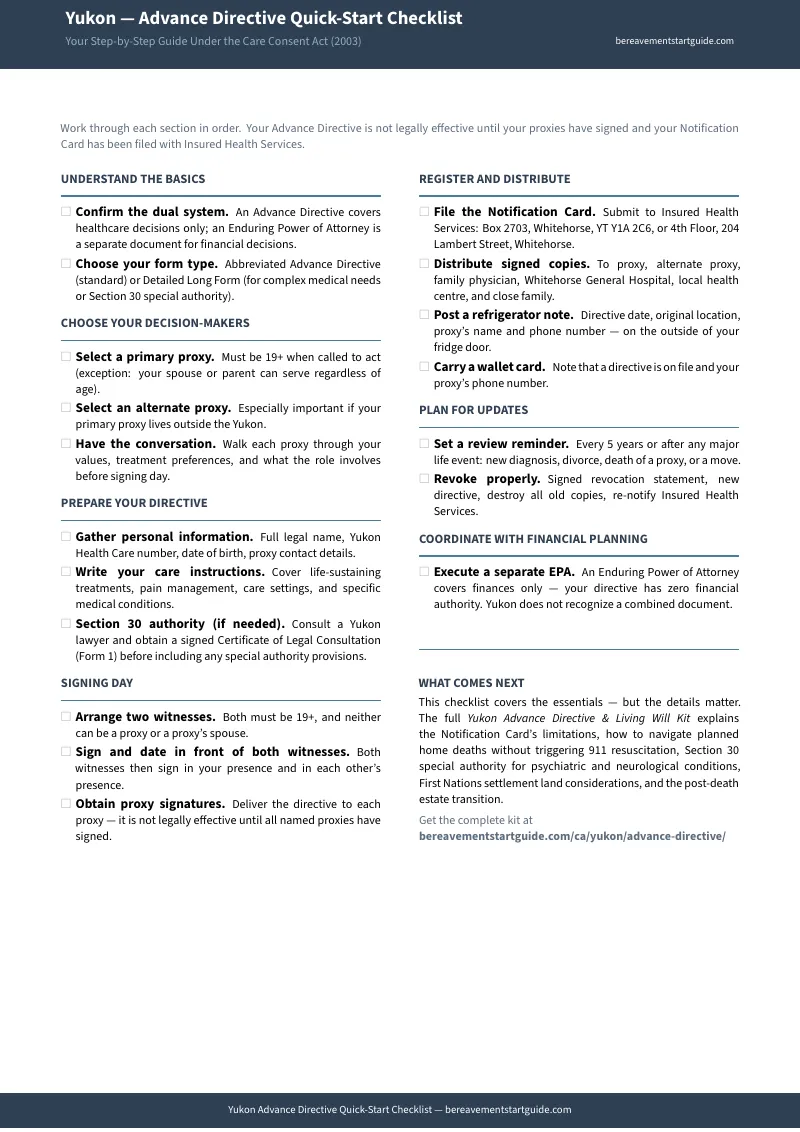
Download the free Yukon Advance Directive Quick-Start Checklist to see the 19 steps between you and a completed directive. When you are ready for the full drafting guide, proxy selection workshop, witness screening tools, filing checklists, and planned home death protocol, get the complete Yukon Advance Directive & Living Will Kit.
The Care Consent Act gives you the right to control your own healthcare decisions. This guide shows you exactly how to exercise it — step by step, form by form, signature by signature — so the people you trust can carry out the wishes you actually documented.