Your parent is one stroke away from the NSW Trustee & Guardian taking control of their estate.
It does not happen through negligence. It happens because New South Wales splits substitute decision-making across three separate legal documents — and most families prepare only one, or none.
Financial decisions — banking, bills, property sales — require an Enduring Power of Attorney under the Powers of Attorney Act 2003. Medical treatment, accommodation, and personal care need a completely separate Enduring Guardian under the Guardianship Act 1987. And specific treatment preferences need an Advance Care Directive that operates under common law, with no prescribed form and no statutory template to fall back on.
If your parent loses capacity with none of this in place, the family cannot step in informally. The only pathway is an application to the Guardianship Division of NCAT, where the tribunal can appoint the NSW Trustee & Guardian as manager — charging a $677 establishment fee, a 1.1% annual fee on gross invested assets, and stripping the family of decision-making authority entirely.
The Three-Document Protection System for NSW Families
The New South Wales Power of Attorney Kit is a complete system for financial, healthcare, and end-of-life decision-making — assembled in the order you do the work, written for the person doing it at their kitchen table.
This is not a form. It is the full NSW regulatory framework — the Powers of Attorney Act 2003, the Guardianship Act 1987, and common-law ACD requirements — distilled into 15 chapters of plain-language instructions that cover drafting, execution, registration, institutional acceptance, and the estate transition after death.
What Makes This Different from Free Government Forms
The NSW government provides downloadable EPOA and Enduring Guardianship forms. What they do not provide is any guidance on how to actually use them:
- No prescribed-witness instructions. An EPOA must be signed before a solicitor, barrister, licensed conveyancer, or Local Court Registrar — not a JP. The witness must explain the document's effect and sign a statutory certificate. Skip this and the entire document is invalid.
- No bank acceptance protocol. Major banks routinely reject valid EPOAs. The forms do not tell you why, and they certainly do not tell you how to fix it.
- No LRS registration guide. If the attorney needs to deal with real property, the EPOA must be registered with NSW Land Registry Services alongside a Deeds Index Particulars form that rejects for minor indexing errors.
- No coordination between the three documents. The EPOA forms come from one government department, the Enduring Guardian form from another, and the ACD from nowhere at all. Nobody shows you how to make them work as a single plan.
What's Inside
- The three-document framework — why an EPOA alone leaves your family locked out of hospitals, and how the Enduring Guardian and ACD complete the picture
- Prescribed-witness execution guide — who qualifies, where to find affordable witnesses (including Local Court Registrars at no charge), the statutory certificate requirement, and the witnessing mistakes that invalidate more self-prepared documents than any other error
- LRS registration walkthrough — field-by-field completion of the Deeds Index Particulars form, current fee schedule ($182.71 per instrument), and the indexing codes that cause rejection
- Bank acceptance playbook — why banks reject valid EPOAs, the Australian Banking Association guidelines you can reference, and the escalation pathway when a branch manager says no
- Springing-POA activation protocol — the medical certification pathway, the institutional delays it creates, and when a springing power makes sense despite the friction
- NCAT fallback mapping — what happens when no documents exist: the tribunal application, the evidence required, the costs involved, and the scenarios where the public trustee takes control
- Superannuation and pension coordination — how the EPOA interacts with super fund trustee decisions, binding death benefit nominations, and Centrelink authorisation
- Estate transition at death — the instant EPOA termination, death certificate through BDM, Supreme Court probate filing fees ($960 to $7,399), and the handoff from living authority to estate administration
- 10 printable worksheets — Three-Document Decision Worksheet, Decision-Maker Selection Worksheet, Signing-Day Execution Checklist, LRS Registration Checklist, Document Distribution Log, Bank Acceptance Playbook, Springing Activation Protocol, NCAT Fallback Checklist, Revocation Notification Tracker, and Estate Transition Checklist
Who This Is For
- Adult children watching a parent decline — you need financial and healthcare authority in place before capacity is lost, because afterwards the documents cannot be signed
- Spouses planning mutual protection — reciprocal EPOAs and Enduring Guardianships, including the witness rule that prevents your spouse from witnessing your documents
- Attorneys dealing with institutional rejection — your parent's EPOA is valid but the bank is refusing to honour it
- Executors who just lost POA access — the principal died, the EPOA terminated instantly, and the bank froze everything
- Regional families in Dubbo, Tamworth, or the Central Coast navigating the prescribed-witness requirement outside metro Sydney
- Anyone who has seen the public trustee take over — and is determined to prevent it from happening to their own family
Why Not Safewill, ezyWill, or a Generic Template?
Online platforms generate a single document through a questionnaire — then stop. They routinely miss the details that make an NSW document operational:
- Safewill standardises across states, glossing over the prescribed-witness requirement and the three-document split
- ezyWill does not offer a standalone Power of Attorney product at all
- Legal123 covers the EPOA but not the Enduring Guardian, the ACD, or the bank acceptance protocol
- Generic Australian templates may reference the wrong witnessing rules for NSW
A document that is technically valid but operationally rejected at the bank counter is not a solution.
Satisfaction Guarantee
If the kit does not give you a clear, actionable plan for securing financial and healthcare authority in New South Wales, email us and we will make it right.
Get Started Today
The full kit costs — once, no subscription. Fifteen chapters covering the Enduring Power of Attorney, the Enduring Guardian, the Advance Care Directive, prescribed-witness execution, LRS registration, bank acceptance, NCAT fallback, superannuation coordination, and the estate transition.
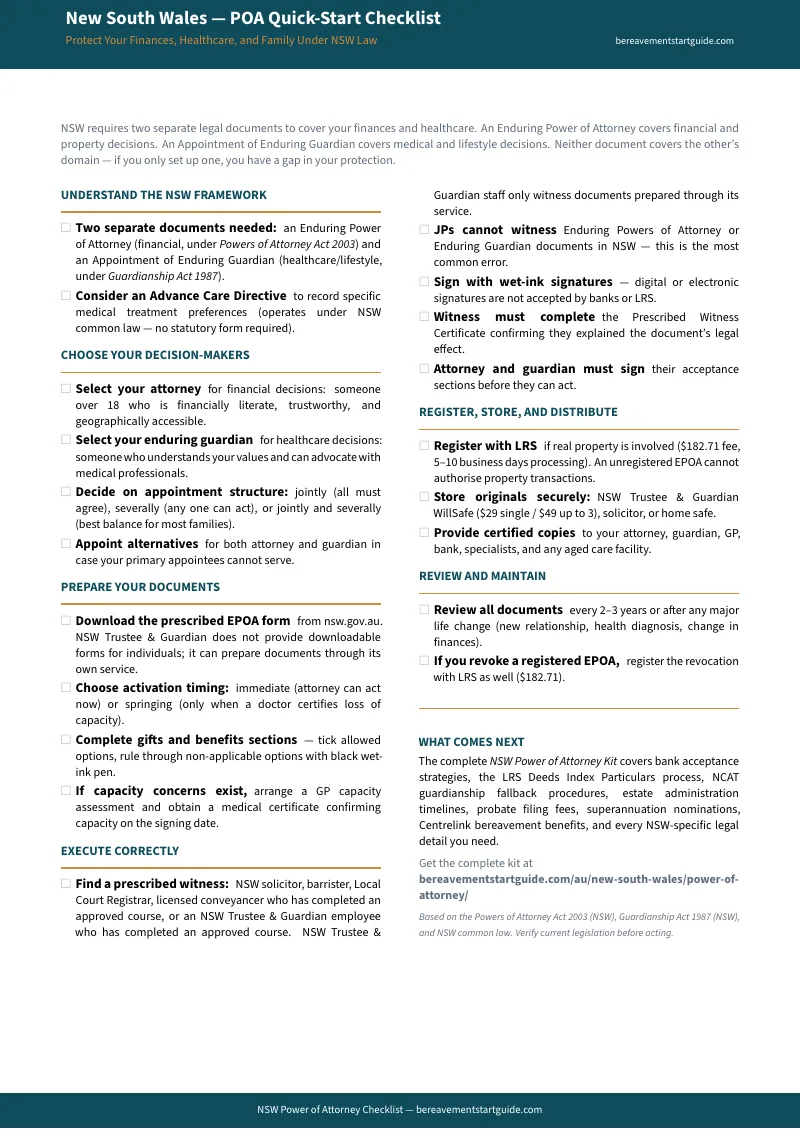
Not ready for the full kit? Download the free NSW POA Quick-Start Checklist — 20 steps covering the three-document system, the prescribed-witness rules, and how to get banks to accept your paperwork. It is enough to get the critical moves right.
A capacity crisis does not schedule itself. Every week without documents is a week the public trustee is one hospital admission away from becoming your family's financial manager.