The 2 a.m. Protocol — A Complete Crisis Response System for University Residence Life
It's 2:14 in the morning. Campus police just called. A student has been found unresponsive in a residence hall room. The RA who made the discovery is in the hallway, unable to stop shaking. The roommate won't speak. The floor group chat is already spiraling with speculation.
You know what to do for a fire alarm. You know what to do for an active threat. But nobody ever handed you a protocol for the call that begins with "we found a student."
The next six hours will define your institution's legal exposure, your staff's psychological trajectory, and a family's trust in the place their child called home. Every decision you make — what you say to the RA, whether you enter the room, who you call first, how you notify the family, when you send the campus-wide email — will be scrutinized by general counsel, grieving parents, and potentially a federal investigation.
The University Student Death Protocol is the operational system that sits between your institution's policy manual and the actual crisis. Your emergency plan says "activate the crisis team." This protocol tells you exactly what the crisis team does — minute by minute, role by role, document by document — from the moment you pick up the phone through the 90-day campus recovery.
What makes this different from your existing emergency plan
Your institution's crisis manual was written by a committee. It covers fires, weather events, active threats, and Title IX response in the same document. The student death section — if it exists — is two pages of bullet points that say "notify the Dean of Students" and "coordinate with campus police" without telling you what those conversations actually sound like.
Professional association resources from NASPA, HEMHA, and ACUHO-I are excellent for a summer training workshop. They are not designed to be opened at 2 a.m. while you're trying to figure out whether a deceased student's FERPA protections still apply (they don't, under federal law — but your state may say otherwise, and the decision tree matters).
CISM certification courses teach you the theory of crisis debriefing over three intensive days. They don't give you the debriefing agenda you can run tomorrow morning with your shell-shocked RA staff.
This protocol fills that gap. Every chapter is built for execution under cognitive overload — checklists, decision trees, scripts, and templates that work when your hands are shaking and your mind is racing.
What's inside the protocol
- Hour-by-hour crisis response sequence — the complete operational timeline from initial notification through scene coordination, chain-of-command activation, residence hall floor lockdown, roommate relocation, emergency counseling deployment, and first-morning campus communication, with decision gates at every stage so nothing falls through
- FERPA post-mortem disclosure decision tree — because the question "can the parents see the transcript?" sounds simple until you realize that federal law, state statutes, courtesy-hold policies, and estate executor authority all give different answers, and the wrong one exposes the institution to litigation from either direction
- SEVIS death termination workflows — step-by-step compliance procedures for F-1 and J-1 visa holders, including the correct termination reason codes, consulate notification protocols, remains repatriation logistics, and the immediate impact on pending work authorizations that nobody in your office has dealt with before
- Family liaison communication scripts — for the initial phone call, the in-person meeting, the belongings return, the academic record request, and the posthumous degree conversation, with emotional boundary frameworks that protect staff from absorbing grief-projected anger as personal failure
- Personal effects inventory and return protocol — the witnessed packing procedure, photographic documentation standards, itemized inventory forms, and chain-of-custody tracking, because a missing laptop or a misplaced journal turns grief into an accusation
- Staff CISM debriefing framework — structured Critical Incident Stress Management protocols for RAs, hall directors, and student affairs professionals, including the operational debrief agenda template, secondary traumatic stress screening tools, mandatory rest period scheduling, and the long-term wellness check-in schedule that catches the quiet attrition
- Postvention communication templates — floor announcements, campus-wide notifications, faculty briefing memos, social media monitoring checklists, and media holding statements, all aligned with AFSP safe messaging standards for suicide-related deaths
- Roommate and floormate support protocols — immediate relocation procedures, academic accommodation frameworks, psychological triage scoring for close contacts, and the structured referral pathway to campus counseling
- ADA and duty-of-care compliance — the direct threat standard, individualized assessment requirements, and procedural due process pathways for students exhibiting suicidal ideation, informed by Schieszler v. Ferrum College, Nguyen v. MIT, and Jain v. State of Iowa
- Posthumous degree administration — the complete pathway for awarding degrees, certificates of achievement, or memorial academic recognition, from faculty committee procedures through commencement ceremony coordination
- Campus memorial and commemoration framework — the uniform policy that prevents the precedent trap, with spontaneous memorial management timelines and family liaison coordination
- 90-day campus recovery plan — the structured response audit, unresolved needs identification, community mental health coordination, and anniversary planning framework
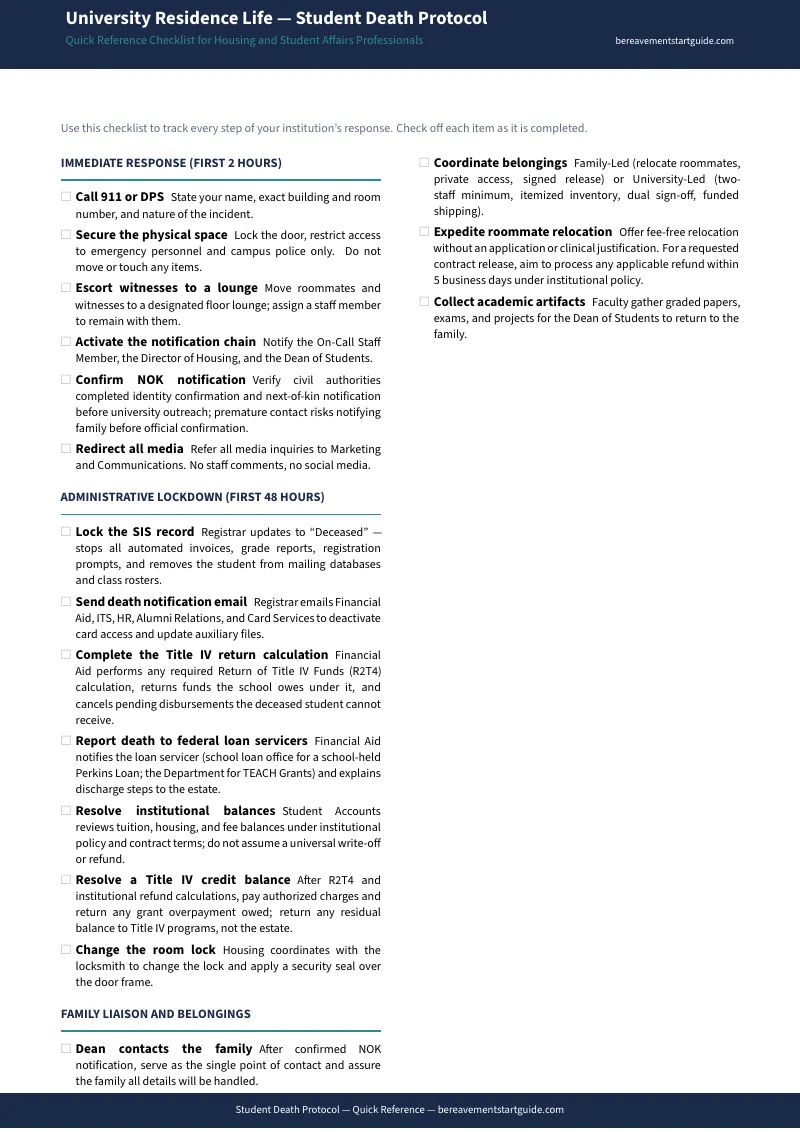
Plus a 27-item quick-reference checklist designed to be grabbed the moment the phone rings — covering every critical action from initial notification through the first month.
Who this is built for
- Directors of Housing and Residence Life who carry the on-call phone and need a protocol that works at 2 a.m., not a textbook that works at a conference
- Deans of Students and Associate Deans coordinating the institutional response across six or more offices and needing every handoff sequence documented
- Area Coordinators and Hall Directors who are first on scene and need to know what to do, what to say, and what not to touch before senior leadership arrives
- Student Affairs crisis response teams building or updating death response protocols across the institution
Why free resources aren't enough for this
You can find pieces of this information scattered across the internet. University policy manuals that are tailored to one school's specific systems. Law review articles that explain your tort exposure without giving you a single actionable template. Clinical postvention guidelines that assume you have three days of training and a counseling degree. Conference presentations that were brilliant in the session and useless at 2 a.m.
The cost of assembling all of this yourself isn't money — it's time you don't have during a crisis and cognitive bandwidth you can't spare. A single procedural error during a death response — releasing the student's name before family notification, entering the room and contaminating a potential crime scene, sending an automated billing notice to grieving parents, violating SEVIS reporting timelines — can expose your institution to wrongful death litigation, federal civil rights investigations, and the kind of media coverage that no crisis communications plan recovers from.
This protocol costs less than one hour of the legal consultation you'd need after a procedural failure. It's a one-time purchase with a full refund guarantee, no time limit — if it doesn't serve your needs, email hello@bereavementstartguide.com and we'll refund every cent.
Get the protocol before you need it
Download the free quick-reference checklist to see the framework. When you're ready for the complete system — every script, template, decision tree, and compliance workflow — get the full University Student Death Protocol at .