When a Student or Staff Member Dies, Your EOP Won't Save You
Your Emergency Operations Plan says "activate the crisis response team." It does not tell you what to say to your teaching staff at 7:15 a.m. when they walk in and learn that one of their students died last night. It does not tell you whether you can share the cause of death with parents. It does not tell you how to handle a memorial request for one student without setting a precedent that will haunt you for years. And it does not tell you how to write a parent notification email that is simultaneously compassionate, factually accurate, legally defensible, and compliant with FERPA's post-mortem privacy rules — all before buses arrive.
The School Principal's Death Response Plan is a Crisis-Ready Administrative Playbook — the operational system that sits between your district's policy manual and the actual decisions you make during the worst day of your career. It gives you the specific scripts, templates, timelines, and decision frameworks that clinical toolkits assume you already have and district EOPs never provide.
What's Inside
- Hour-by-Hour Crisis Protocol — the complete administrative sequence from fact verification through morning staff briefing, classroom announcements, safe room setup, parent notification, end-of-day debrief, and Day 2 re-entry, with decision checkpoints at every stage so nothing falls through during the cognitive overload of the first 24 hours
- Communication Script Library — staff notification memos for sudden accident, illness, and suspected suicide; parent email templates following safe messaging guidelines; classroom announcement scripts for elementary, middle, and high school; and media holding statements aligned with your district PIO — because a single careless sentence in the first two hours can define the entire community's response
- FERPA Privacy Decision Tree — the post-mortem privacy framework that maps whether the deceased was a minor or eligible student, identifies who holds consent authority, flags state-level statutory overrides, and separates discoverable education records from protected sole-possession notes — so your crisis documentation stays a shield, not a liability exhibit
- Suicide Postvention System — safe messaging protocols aligned with AFSP and SPRC standards, acoustic isolation rules for notifications, method suppression procedures, empty-chair peer surveillance deployment, social media monitoring, and the mandated reporting escalation path when screening reveals active ideation — the specific protocols that prevent a single death from becoming a cluster
- Documentation and Legal Defense Templates — crisis intervention tracking sheets, incident chronology logs, sole-possession note guidelines, record retention timelines, and litigation hold directive templates designed to be completed during the crisis rather than reconstructed from memory weeks later
- Psychological Triage and Risk Scoring — the structured assessment framework that identifies students at elevated risk, assigns triage priority levels, and coordinates parental notification with clinical referral — including worked examples showing how the scoring applies in real scenarios
- Staff Wellness Framework — the operational distinction between secondary traumatic stress and burnout, Day 1 crisis debrief agendas, substitute coverage for incapacitated staff, self-assessment tools, and the long-term check-in schedule that addresses the fact that principals and homeroom teachers carry higher PTSD and complicated grief symptoms than anyone else in the building
- Family Liaison Protocols — dedicated liaison assignment, compassionate communication scripts with emotional boundary guardrails, personal effects return procedures, and the memorial equity policies that prevent the precedent trap when commemorating students of unequal popularity
- Academic Accommodation Plan — flexible deadline frameworks, grading adjustments, classroom exit plans for distressed students, and attendance modifications that prevent truancy filings for traumatized students who cannot maintain normal schedules
- 90-Day Recovery Transition — acting principal handoff protocols, Day 30 response audit, community mental health coordination, and annual anniversary planning
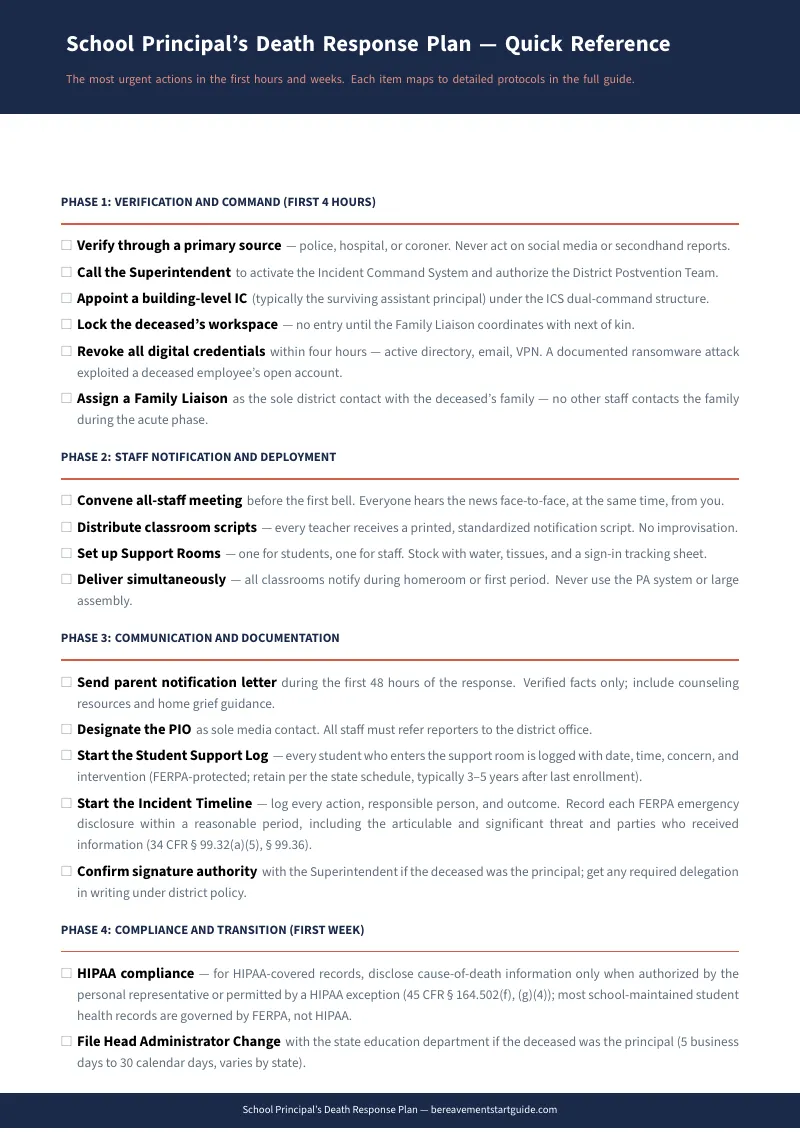
Plus a 25-item quick-reference checklist designed to be grabbed from your desk drawer the moment the phone rings — every critical action from verification through the first month on a single printable document.
And 9 standalone printable tools — a student support tracking log, FERPA emergency disclosure record, incident timeline template, staff debriefing agenda, commemoration decision flowchart, 30-day review checklist, communication scripts library, FERPA privacy decision tree, and litigation hold directive — each designed to be filled in during the crisis, not reconstructed from memory afterward.
Who This Is For
- School principals and assistant principals who will lead the crisis response and need operational protocols, not a clinical textbook
- District administrators and superintendents building consistent, board-compliant death response frameworks across multiple campuses
- School counselors and psychologists who need the administrative documentation and communication templates that complement clinical PREPaRE training
- School safety coordinators updating Emergency Operations Plans to include death response — not just active threats and natural disasters
Why Free Toolkits and CE Courses Leave You Exposed
The AFSP's After a Suicide toolkit is sixty pages of clinically rigorous postvention science. It is not something you can operationalize at 6 a.m. while your superintendent's office is already calling. The NASP's PREPaRE curriculum builds deep crisis competence over days of professional development but hands you nothing printable for this morning's staff meeting. Your district's EOP is a compliance artifact that says "contact the family" without providing the contact script or the FERPA decision tree that determines what you're legally allowed to tell them.
This plan translates all of those into the specific documents, scripts, and decision trees an administrator uses during the actual crisis — built for a shaking hand and a 7 a.m. deadline, not a summer professional development session.
Your Purchase Is Risk-Free
Every purchase comes with a full refund, no time limit. If the plan doesn't meet your needs, email hello@bereavementstartguide.com and you'll receive a complete refund — no questions, no deadline.
Download the free quick-reference checklist to see the structure and level of detail. When you need the full protocol library — the scripts, templates, decision frameworks, and legal documentation system — get the complete plan.