
The ACT Advance Care Navigation System — Because Three Separate Documents With Three Different Rules Should Not Be Your Family's Emergency Homework
Your parent is admitted to Canberra Hospital. The clinical team asks who has authority to make healthcare decisions. You assumed you did — you are next of kin, after all. But the ACT does not recognise "next of kin" as a legal decision-maker. Without a valid Enduring Power of Attorney, the treating clinician appoints a statutory Health Attorney from your family. That Health Attorney can consent to treatment. What they cannot do — and what nobody tells you until the worst possible moment — is refuse or withdraw life-sustaining treatment. If you want the ventilator turned off because that is what your parent always said they wanted, you have no legal authority to make that happen. The clinician must refer the matter to the Public Trustee and Guardian, and your family ends up in an ACAT tribunal hearing while your parent remains on life support.
This is not a hypothetical edge case. It is the default outcome in the Australian Capital Territory when advance care planning is incomplete — or completed with the wrong documents.
The ACT Advance Care Navigation System puts all three of the territory's planning instruments — the legally binding Health Direction, the combined Enduring Power of Attorney, and the clinical Statement of Choices — into one coordinated plan. Not three separate government PDFs with three separate instruction sets. One manual that explains what each document does, where they overlap, which one wins when they conflict, and the exact witnessing protocol that makes them legally valid.
What Free Government Resources Get Wrong
The ACT government provides the statutory forms for free. The problem is not the forms — it is everything that surrounds them.
ACT Health's advance care planning pages explain what a Health Direction is. They do not explain how to write one with enough clinical specificity that a doctor cannot dismiss it as too vague to follow. The Public Trustee and Guardian covers attorney duties but no longer drafts estate documents — they refer you to private firms at $879 or more for a basic Will and EPOA package. Advance Care Planning Australia offers a national framework but omits the local ACT mechanics: Access Canberra processes, land title registration fees, the Health Attorney hierarchy, and the witnessing requirements that invalidate more DIY documents than any other error.
Online legal platforms like Safewill and Willed generate polished PDFs through digital questionnaires. Then they stop. No witnessing walkthrough. No cross-border recognition guidance for the Canberra–Queanbeyan corridor. No post-death administration pathway. The document is the beginning of the job, not the end.
What Is Inside
The ACT's tripartite system decoded. Chapter 1 maps how the Health Direction, the Enduring Power of Attorney, and the Statement of Choices interact — including the chronological hierarchy that determines which document wins when instructions conflict. Most families learn this hierarchy exists only after a clinical dispute.
A Health Direction that clinicians must honour. Chapter 4 covers treatment-specific refusal instructions — CPR, mechanical ventilation, artificial nutrition, blood transfusions — with the drafting precision that turns a vague wish into a legally enforceable direction under the Medical Treatment (Health Directions) Act 2006.
The dual-witnessing protocol that invalidates most DIY documents. Chapter 3 details the execution requirements: two witnesses or one prescribed witness (JP, legal practitioner, court registrar), the statutory certificate of voluntariness, and the attorney acceptance requirement — your attorney must formally accept in writing, witnessed separately. Get this wrong and the document is void. You discover the error after the principal has lost capacity and cannot sign a replacement.
The Health Attorney trap explained. Chapter 5 covers the statutory gap that catches unprepared families: when capacity is lost without an EPOA, a doctor-appointed Health Attorney can consent to treatment but cannot refuse life support. Disputes among eligible family members trigger a Public Trustee referral and an ACAT guardianship hearing.
Cross-border planning for the Canberra–Queanbeyan corridor. Chapter 7 maps the recognition rules between the ACT and NSW — when an ACT EPOA is accepted by NSW institutions, when NSW Enduring Guardianship applies, and how to avoid dual-jurisdiction legal fees for unnecessary duplicate documents. Covers hospital transfers between ACT and NSW facilities.
Access Canberra Land Titles registration. Chapter 6 covers the step most attorneys discover too late: your EPOA must be registered before your attorney can execute any real property transaction. The registration process, current fees, and the separate revocation registration requirement.
Post-death estate administration. Chapters 10–12 map the first 90 days after death: Access Canberra death registration, certificate processing timelines, asset security, bank account notification, superannuation death benefit claims, intestacy distribution, and the Public Trustee's sliding-scale commission and hourly fee structure.
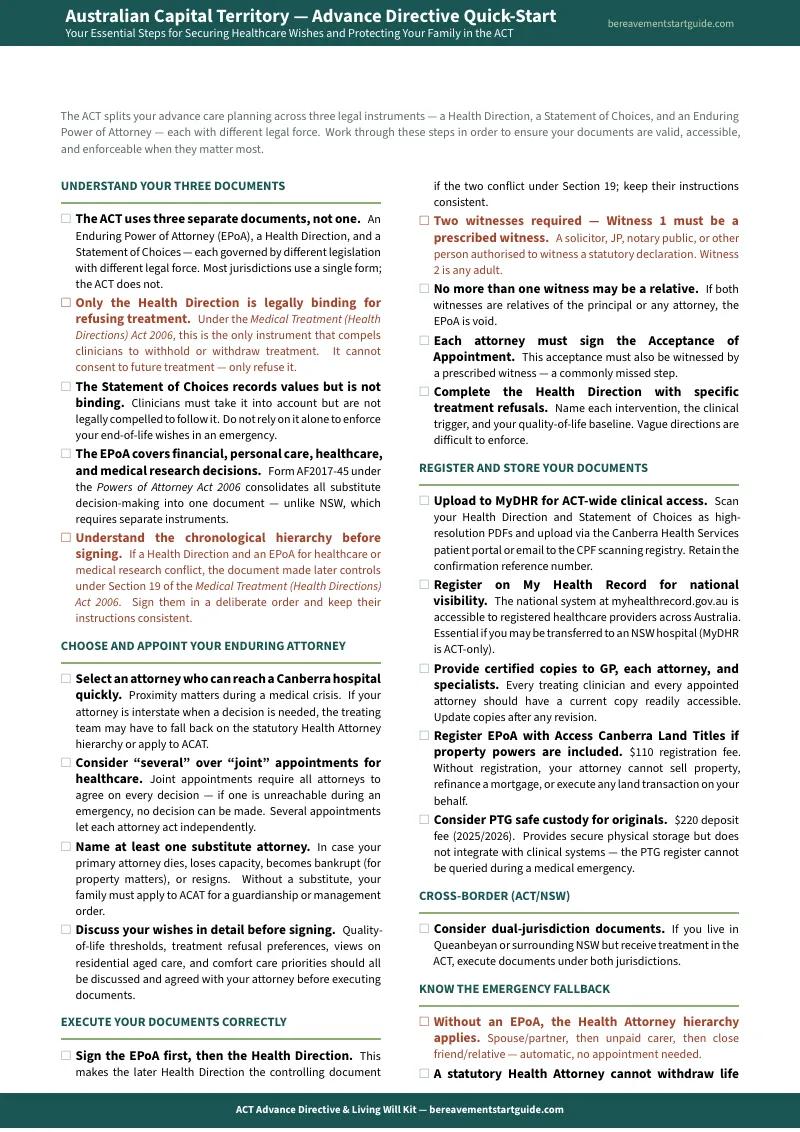
The complete ACT Advance Directive Quick-Start Checklist. A 29-item checklist across seven sections — from understanding the tripartite system through witnessing, registration, and post-death steps. Print it, work through it, tick the boxes.
Six printable planning tools. The Document Execution Tracker, the Values Conversation Worksheet, the Attorney Selection Scorecard, the Storage and Distribution Log, the Post-Death Administration Timeline, and the Agency Communication Log — each a fillable PDF designed to be printed and written on, referenced throughout the guide at the point where you use it.
Who This Is For
- The adult child managing a parent's hospital admission — you need legal authority to make care decisions, and you need it before the statutory Health Attorney default kicks in and strips your ability to refuse treatment on your parent's behalf.
- The Canberra–Queanbeyan cross-border family — your parent receives care in the ACT but owns property in NSW, or you live in Queanbeyan and work in Canberra, and you need to know which documents travel across the border and which do not.
- The proactive retiree — you have watched a friend go through an unmanaged health crisis and you want your wishes documented before you need them, by someone who explains the ACT system rather than handing you forms with no context.
- The couple planning together — each of you needs a separate set of documents, your spouse cannot serve as the sole witness, and your attorney must formally accept in writing before a prescribed witness. The execution protocol is unforgiving.
- The recently diagnosed — a serious diagnosis makes the Health Direction conversation immediate, and you need to know how to draft treatment-specific refusal instructions that clinicians are legally bound to honour.
- The executor — the EPOA dies with the principal, and you need the Access Canberra death registration process, the superannuation claim pathway, and the probate steps in order.
What You Get
- The Complete Guide (48 pages, PDF) — 14 chapters covering the ACT's tripartite system, attorney selection, the dual-witnessing protocol, Health Direction drafting, the Health Attorney vulnerability, document registration and storage, cross-border ACT/NSW recognition, ACAT guardianship avoidance, Voluntary Assisted Dying rules, post-death estate administration, intestacy, superannuation claims, and planning worksheets.
- The Quick-Start Checklist (PDF) — 29 items across 7 sections. Every witnessing requirement, registration step, and post-death action at a glance. Print it and start tonight.
- Six Printable Planning Tools (PDF) — Document Execution Tracker, Values Conversation Worksheet, Attorney Selection Scorecard, Storage and Distribution Log, Post-Death Administration Timeline, and Agency Communication Log. Fill them in as you work through the guide.
Satisfaction Guarantee
If the kit does not give you a clear, actionable plan for your ACT advance care documents, email hello@bereavementstartguide.com and we will make it right.
A Fraction of One Hour With a Canberra Estate Lawyer
A Canberra estate-planning firm charges $750 to $1,500 or more for a planning package. The Public Trustee refers low-means clients to private firms at capped rates starting at $879 for a basic Will and EPOA. Online platforms charge subscription fees and stop at the generated document — no witnessing walkthrough, no cross-border guidance, no post-death pathway.
The kit costs — once, no subscription. Fourteen chapters, six printable planning tools, and the complete ACT advance care planning system assembled in the order you do the work.
Not ready for the full kit? Download the free ACT Advance Directive Quick-Start Checklist — 29 steps covering the tripartite system, the witnessing rules that invalidate most DIY documents, and the cross-border basics. Enough to get the critical moves right.
A medical crisis does not wait for you to finish researching. This kit turns an afternoon into a legally binding, clinically actionable plan — the documents your family needs, executed correctly, with the post-death pathway mapped.
Frequently Asked Questions
What if the rules change after I buy?
We update the guide when the rules change. Email us any time, even years later, and we'll send you the current edition free.