A Will Left Someone Out in New South Wales. The 12-Month Clock Is Running. And You Need to Understand the Process Before the First Solicitor Meeting Costs Thousands.
Someone close to you has died. The will leaves you with far less than you expected — or nothing at all. Or you are the executor, and a solicitor's letter has just arrived threatening a family provision claim under Chapter 3 of the Succession Act 2006. The estate is frozen. Beneficiaries are calling. And you have no idea whether you can distribute a cent.
Either way, the deadline is the same: 12 months from the date of death. Not from probate. Not from when you found out. From the date someone died. Miss it, and a late application needs the Court to order otherwise on sufficient cause being shown, or the parties to the proceedings to consent to the application being made out of time.
So you start searching. Law firm blogs explain who can claim — then stop at "call us for a free consultation" (which is an intake call, not advice). LawAccess NSW publishes excellent overviews but does not provide document-gathering workbooks or explain what a half-day mediation actually looks like. The Supreme Court's Practice Note SC Eq 7 governs the entire family provision list, but it is written for solicitors, not for a grieving family member who has never seen the inside of an equity courtroom. And every other state works differently — Victoria and South Australia measure the deadline from a grant of probate or administration, while Western Australia uses the date the administrator becomes entitled to administer the estate there — so interstate advice is actively dangerous.
The New South Wales Family Provision Claims Guide is a Claim-Ready Preparation System for both sides of a family provision dispute — claimants working out whether and how to apply, and executors who need to protect the estate (and themselves) the moment a claim is threatened. Not a generic Australian will-disputes overview. Not a legal opinion on whether your claim will succeed. A structured, NSW-specific manual built around the Succession Act 2006, Practice Note SC Eq 7, and the Supreme Court's procedures — so you walk into the first solicitor meeting with organised facts, documented assets, and a clear picture of the process ahead.
What's Inside the Claim-Ready Preparation System
A 13-chapter guide and a Family Provision Deadlines Checklist — covering the full process from eligibility through final hearing, built specifically for the Supreme Court of New South Wales:
Chapters 1–2: The Statutory Foundation and Who Can Claim
Section 57 of the Succession Act 2006 defines six categories of eligible persons: a spouse or de facto partner (including same-sex partners), a child, a former spouse, a person in a close personal relationship with the deceased at the time of death, a grandchild who was wholly or partly dependent, and a household member who was wholly or partly dependent. The Act requires "factors warranting" only for a former spouse, a dependent grandchild or household member, or a person in a close personal relationship. These chapters explain what evidence each category needs — not just who qualifies, but what it takes to prove it.
Chapter 3: The 12-Month Deadline
Section 58(2) sets the clock at 12 months from the date of the deceased person's death. This catches people who assume — based on other states — that they have time until after probate. The chapter explains the deadline and the late-application options: the Court may order otherwise on sufficient cause being shown, or the parties to the proceedings may consent to an out-of-time application.
Chapter 4: The Two-Stage Test and Worked Examples
The court first decides whether the will (or intestacy) made adequate provision for the applicant's proper maintenance, education or advancement in life. If not, it decides whether to make an order and what provision to make. Section 60 lists 16 matters the court may consider — the nature of the relationship, the size of the estate, the applicant's financial need, contributions to the deceased's welfare or property, and competing claims from other beneficiaries. Two worked examples show how the stages interact for different family situations, in plain language.
Chapter 5: Notional Estate — Part 3.3
This is the chapter that does not exist anywhere else in a consumer-facing format. New South Wales is the only Australian state with a notional estate regime. Part 3.3 of the Succession Act allows the court to designate property that is not part of the actual estate — joint property that passed by survivorship, superannuation death benefits directed to a nominated beneficiary, gifts and property transfers made during the deceased's lifetime — and treat it as though it were estate property available to satisfy a family provision order. The chapter explains what counts as a "relevant property transaction," what the court considers before designating notional estate, and why both claimants and executors need to map these assets early.
Chapters 6–7: Filing the Claim and Mediation
How to start proceedings: the Summons (UCPR Form 4A or 4B), the plaintiff's affidavit adapted from Annexure 1, and the Notice of Eligible Persons in Annexure 2 of Practice Note SC Eq 7. Where to file, what the Supreme Court filing fees are, and what happens at the first return before the Registrar in Probate on the Thursday family provision list. Then mediation — the default under SC Eq 7. What a half-day court-annexed mediation involves, how settlements are structured, the significance of a Calderbank offer for costs, and what to expect if the matter proceeds to a final hearing.
Chapters 8–9: Costs and Executor Duties
The costs chapter every party needs before committing. Who pays in family provision matters, when costs come from the estate, the general rule versus indemnity costs, what a Calderbank offer means for financial risk, and how to assess whether the claim is financially viable before the legal bills start. Then the executor's side: the Court may restrain distribution while it determines a claim under Section 62(3) of the Succession Act 2006 (NSW). A Notice of Intended Distribution after a grant is optional; Sections 93–94 set out protections for certain distributions when their notice and timing conditions are met.
Chapters 10–13: Intestacy, Probate Caveats, Worksheets and Resources
When a family provision claim is made against an intestate estate — Letters of Administration, the statutory legacy, and how Chapter 4 interacts with Chapter 3. What a probate caveat can do: prevent a grant while a probate dispute is considered. It does not preserve a family provision claim or prevent distribution after a grant. The guide's printable tools include a Claim Chronology Log, Notional Estate Inventory, Financial Position Summary, Solicitor Consultation Preparation Worksheet and Document Service Register; the executor triage checklist is in Chapter 9. Key resources include LawAccess NSW (1300 888 529), Legal Aid NSW, the Law Society solicitor referral service, and Community Legal Centres NSW.
Who This Guide Is For
- The family member who was left out of the will — or left far less than they need — and wants to understand whether they have an eligible claim, how the process works, and what it will cost before spending $5,000 on a retainer just to learn the basics
- The executor who just received notice of a claim and needs to know, right now, whether distributing the estate exposes them to personal liability — and what to do in the first 72 hours to protect themselves and the beneficiaries
- The de facto partner, former spouse or grandchild checking whether they fall within one of the six eligible categories under Section 57 — and, where required, whether they can show factors warranting the application
- The beneficiary whose inheritance is at risk because a family provision claim has been threatened — who needs to understand the mediation and settlement process and what it means for their share
- The family helper assisting a grieving parent, sibling or grandparent who needs clear, printable guidance to work through before an $800-per-hour solicitor meeting
Why Free Resources Will Not Prepare You for This
- Law firm blogs explain the law, then stop at "call us." Estate litigation firms publish excellent summaries of Section 57 eligibility and the two-stage test. Those articles are intake funnels: they describe the complexity to demonstrate that you cannot handle it alone, then offer a free consultation that is really a 15-minute triage call. They do not provide document-gathering workbooks, deadline calculators, or the kind of step-by-step preparation that actually reduces your first billable hour from three hours of background explanation to 30 minutes of strategy.
- LawAccess NSW provides accurate information, not preparation tools. LawAccess publishes some of the best free overviews available — eligibility categories, the 12-month deadline, court factors. What it does not provide: worksheets for organising the evidence the court requires, a plain-English walkthrough of Practice Note SC Eq 7, or guidance on what happens during mediation. And Legal Aid NSW generally does not fund family provision claims except where the applicant risks losing their home.
- The Supreme Court's Practice Note is written for solicitors. SC Eq 7 governs the Probate and Family Provision List. It tells you that proceedings are listed on Thursdays before the Registrar in Probate, that mediation is the default, and that the plaintiff's affidavit and Notice of Eligible Persons use Annexures 1 and 2. It does not translate any of this into plain English for a person who has never been inside the Supreme Court.
- Interstate guidance is actively misleading. Victoria and South Australia measure the limitation period from a grant of probate or administration. Western Australia measures from when the administrator becomes entitled to administer the estate there. In New South Wales, it runs from the date of death. Reading the wrong state's rules can cost you the entire claim.
— Less Than Thirty Minutes With a Sydney Estate Litigation Solicitor
A single consultation with a specialist estate litigation solicitor in Sydney costs $400 to $800 per hour. Retainers for family provision claims start at $10,000 for a straightforward mediated settlement and can reach $50,000 or more for a fully contested hearing. This guide costs less than half an hour of professional legal time and gives you the NSW-specific preparation system — eligibility analysis, deadline tracking, evidence organisation, the full court process, and cost assessment — so you arrive at the first legal consultation ready to discuss strategy, not spend the first three hours on background.
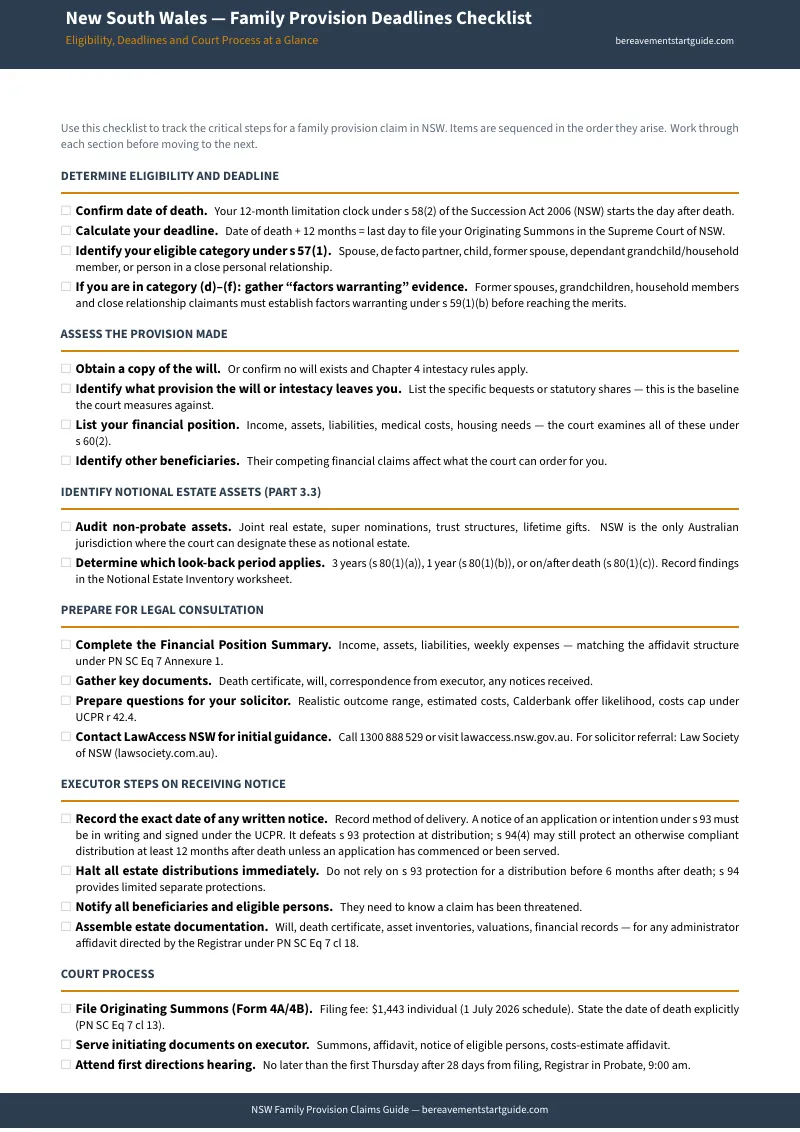
Your download includes the complete 13-chapter guide, the Family Provision Deadlines Checklist (22 items across 6 phases), and 5 printable worksheets — Claim Chronology Log, Notional Estate Inventory, Financial Position Summary, Solicitor Consultation Preparation and Document Service Register. Plus a full refund, no time limit. If the guide does not give you clarity on the process and what to do next, email hello@bereavementstartguide.com for a full refund. No questions asked.
Not ready for the full guide? Download the free New South Wales — Family Provision Deadlines Checklist — 22 items covering who can claim, the deadlines that apply, and what to do first. It is enough to see the full picture and decide whether to act.
The 12-month clock started when the person died. It does not wait for probate, it does not wait for family meetings, and it does not wait for the executor to respond. The guide helps you understand what you are dealing with before the deadline decides for you.
Frequently Asked Questions
What if the rules change after I buy?
We update the guide when the rules change. Email us any time, even years later, and we'll send you the current edition free.