The bank froze the accounts. The court wants forms you've never seen. And nobody left a will.
When someone dies without a will in New South Wales, some bank accounts, shares and property can sit locked behind a legal requirement: a Grant of Letters of Administration from the Supreme Court. Banks, share registries and NSW Land Registry Services may require a grant before releasing assets or transferring title; some asset holders release modest balances to next of kin without one, and a grant is required for solely owned or tenants-in-common real property.
The Supreme Court's own guidance tells you what the rules are. It does not tell you how to organise the paperwork, in what order, so the registry does not send it back.
The Administration Sequence System
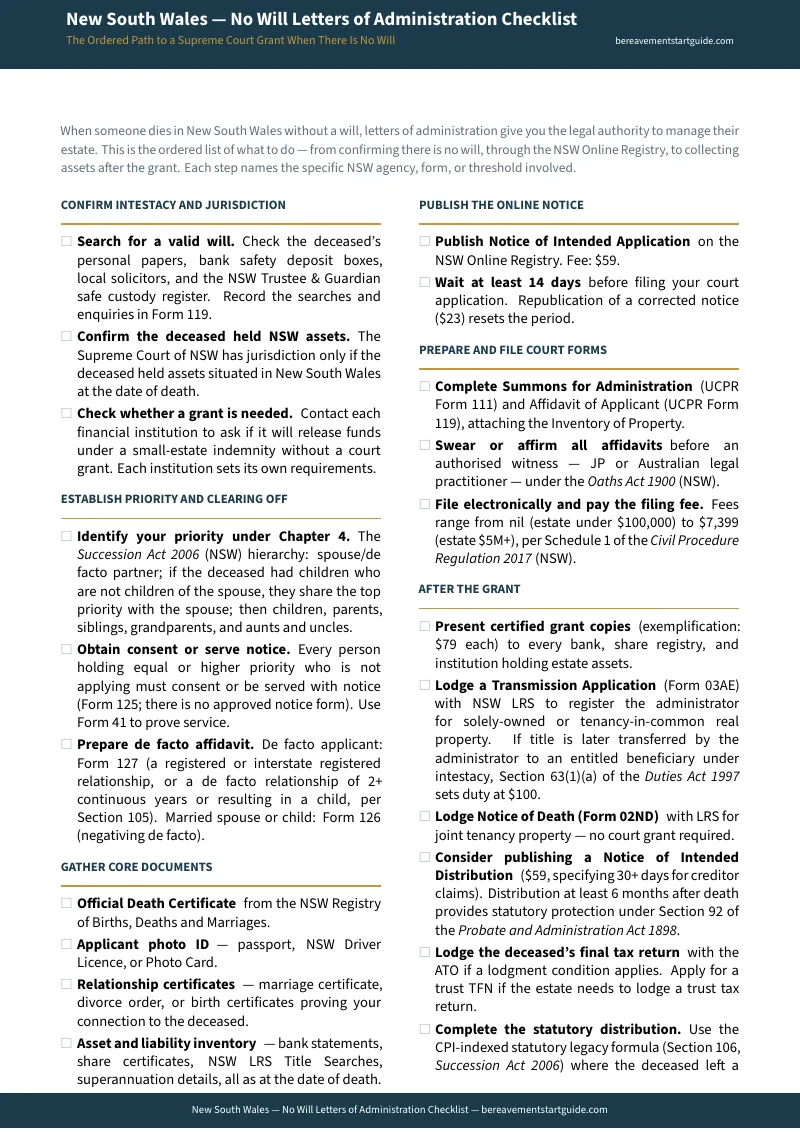
This guide maps the entire application from start to grant — and then through to collecting the assets — in a single, ordered sequence. Every step is numbered. Every form is named. Every waiting period is flagged before you hit it.
Instead of jumping between the Supreme Court portal, Legal Aid NSW, the Land Registry and half a dozen bank forms, you work through one document that connects them all and tells you what goes where.
What's Inside
- Priority and eligibility map — who can apply under Chapter 4 of the Succession Act 2006, how to clear off higher-priority relatives with consents or formal notice, and the extra rules for de facto partners, minors and overseas residents
- Intestacy share calculations with three worked dollar examples — the statutory legacy CPI formula, a four-quarter reference table, and step-by-step arithmetic for a spouse-only estate, a blended-family split and a per-stirpes distribution to grandchildren
- The full application sequence — publishing the 14-day notice on the NSW Online Registry, preparing the Summons for Administration, the supporting affidavit and the inventory of property, paying the filing fee and lodging
- Pre-lodgement audit checklist — the most common errors that trigger registry requisitions, laid out as a check-before-you-file list so you can catch them before the court does
- Post-grant asset release tracker — what each bank, share registry, super fund and NSW Land Registry Services needs to see before it releases funds or transfers title
- Administration bond and guarantee rules — when the court requires a bond, who the sureties are and when the requirement is waived
- Eight printable worksheets — asset and liability inventory, family tree and priority mapper, pre-lodgement audit checklist, requisition tracking log, post-grant asset release tracker, intestacy distribution calculator, agency communication log, and notice-period calendar
Who It's For
- The surviving spouse or de facto partner who needs to apply for the grant themselves
- An adult child, parent or sibling with priority when no partner survives
- A helper researching and organising the process for a bereaved family member
- Anyone weighing up whether to apply without a solicitor — the guide shows you exactly what the process involves so you can decide with the full picture
Why Not Just Use the Free Court Guidance?
You should. The Supreme Court of NSW publishes the rules, the fee schedule and the blank forms at no cost — and the guide links directly to every one of them. What the court does not publish is a step-by-step workflow that connects the notice period to the forms, the forms to the filing fee bands, and the filing to the post-grant release process. That is where most self-represented applicants stall: not because the rules are hidden, but because they are scattered across the court portal, Legal Aid NSW, the Land Registry, Moneysmart and individual bank websites.
The guide brings those pieces into one sequence, adds the worksheets and tracking logs, and flags the specific errors that trigger registry requisitions — the delays that cost weeks.
The Free Checklist vs the Full Guide
The free checklist gives you the six-step overview: confirm intestacy, verify priority, check small-estate thresholds, publish the online notice, assemble the court forms and find free legal help. It is enough to see whether this process is something you want to handle yourself.
The full guide gives you the detail behind every step — the statutory legacy formula with worked examples, the pre-lodgement audit checklist, the post-grant tracker, and the printable worksheets that keep everything organised from the first phone call to the final distribution.
Satisfaction Guarantee
Full refund, no time limit. If the guide does not help, email hello@bereavementstartguide.com and we will refund you — no questions, no deadline.
Frequently Asked Questions
Is this an official court or government publication?
No. This guide is an independent educational reference and organisational tool. It is not affiliated with, endorsed by or connected to the Supreme Court of New South Wales, NSW Land Registry Services, the NSW Trustee and Guardian or any government agency. It provides process navigation only and does not give legal, financial or tax advice.
Do I still need a solicitor?
Not necessarily. The Supreme Court accepts applications from self-represented applicants through the NSW Online Registry. Many straightforward intestate estates — a surviving spouse with shared children, a modest asset base, no disputes — are handled without legal representation. If the estate involves a contested family provision claim, a complex trust structure, real property in multiple states or a dispute between potential administrators, professional legal advice is strongly recommended.
What if the estate is very small?
Some institutions release funds without a court grant if the balance falls below their own threshold and you sign an indemnity form. If every asset can be released this way and no solely-owned real property needs to be transferred, you may not need a grant at all. The guide includes a decision framework for checking this, and the companion NSW Small Estate Without Probate Guide covers the small-estate path in detail.
How long does the application take?
The Supreme Court publishes weekly processing updates. For the week of 23–27 November 2026, it was assessing letters of administration applications filed 23 September–7 October. It was assessing routine requisition answers filed 7–13 November and complex answers filed 27 October–2 November. The guide's pre-lodgement audit checklist is designed to reduce the chance of a requisition.
Does the guide cover what happens after the grant?
Yes. Receiving the grant is an intermediate step — you still need to collect bank funds, transfer real property through NSW Land Registry Services, claim superannuation death benefits, lodge tax returns and distribute the estate. The guide covers the post-grant process and includes a release tracker for each asset class.
What about the intestacy share calculations?
The guide explains the statutory legacy CPI formula in plain language and works through three dollar-figure examples: a spouse-only estate, a blended-family split with the statutory legacy, and a per-stirpes distribution where a child has predeceased. The arithmetic is shown step by step so you can substitute your own figures.
Frequently Asked Questions
What if the rules change after I buy?
We update the guide when the rules change. Email us any time, even years later, and we'll send you the current edition free.