The bank says "you need probate." The estate is $38,000. The solicitor wants $3,500.
You're standing at the counter, death certificate in hand, and the person behind the glass tells you they can't release the money without a court order. You've just paid for a funeral, you're exhausted from grief, and now a legal process that costs more than the account balance is apparently the only way forward.
Except it isn't — not always. Banks in Australia don't follow a single statutory threshold. Each one sets its own internal release limit, and most will hand over sole-account balances under $100,000 without a formal grant, provided you bring the right forms and there's nothing complicating the picture. Share registries set their own small-estate requirements. Service NSW has a process for transfers after the registered owner dies, and NSW Land Registry Services has a Notice of Death process for joint tenancy titles.
The problem is that nobody puts all of this in one place. The Court explains its application process and the legal situations where a grant is required, but not every bank's internal release policy. The bank's bereavement page tells you what that bank requires, but not what the share registry or the land registry wants. And the first three pages of search results are solicitors explaining why you should hire them.
The Small Estate Settlement System
This guide replaces the scattered research with a single, structured workflow. For every asset in a modest NSW estate — bank accounts, shares, land, super, vehicles — it shows you the relevant release process, the forms covered, and the circumstances when the law or an institution requires a grant.
You work through it asset by asset. By the end, you can identify which parts may be settled without a grant and where the law or an institution requires one — before you've spent a dollar on legal fees.
What's Inside
- Big 4 bank release procedures — CBA, Westpac, ANZ and NAB each have different forms, different internal limits, and different conditions that force a grant. The guide covers each bank's current process, the specific forms to request, and what happens when there's a home loan or dispute on the account.
- Share registry small-holding transfers — Computershare and MUFG Corporate Markets (formerly Link Market Services) have small-estate transfer procedures that can avoid probate when their requirements are met. MUFG also offers a sale facility for participating issuers. The guide walks through both registries' forms and requirements.
- Joint tenancy land — Form 02ND — if the property is held as joint tenants, it doesn't form part of the estate. The surviving joint tenant registers the death with NSW Land Registry Services using Form 02ND (Notice of Death). No court grant is needed for this transfer. The guide explains the form, the evidence required, and the common mistake of confusing joint tenancy with tenants in common.
- Superannuation death benefits — when a valid binding nomination directs a fund to pay an eligible dependant directly, the benefit bypasses the estate. The guide shows how to check whether the nomination is valid, what happens when it isn't, and the tax implications that catch families off guard.
- Vehicle registration transfers — Service NSW allows transfers without probate, and executors and beneficiaries are exempt from both transfer fees and stamp duty. The guide covers the application process, what happens when you're selling the car instead of keeping it, and the Advice of Death form.
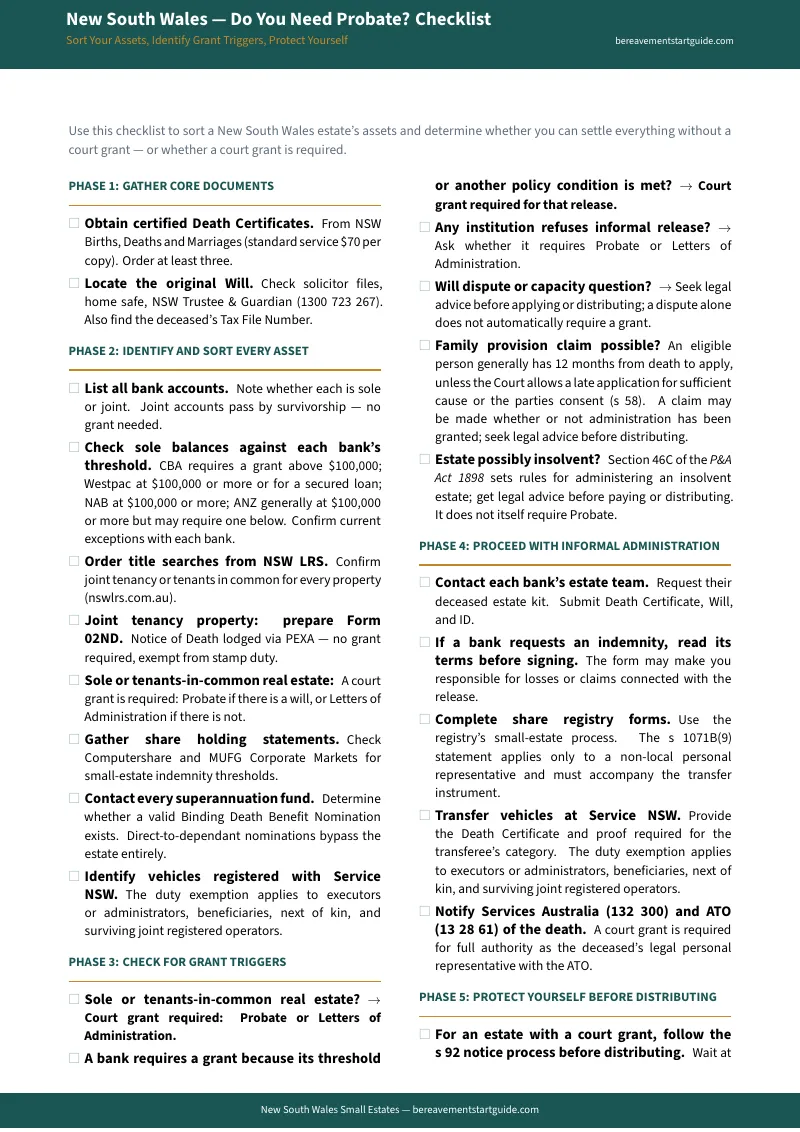
- Grant triggers checklist — the circumstances where the law or an institution requires a grant, including sole-name real property and holder-specific release rules. The guide also flags disputes and complex liabilities that call for legal advice. If a grant is required, the sibling NSW Probate guide takes over.
- Risks of informal administration — distributing assets without a grant carries real exposure. The guide explains what can go wrong (creditors, family provision claims, personal liability) and the statutory protections that apply.
- Printable worksheets and contacts log — asset inventory, institution contact tracker, document requirements per bank, and a timeline planner. Everything in one place, designed for printing and sharing among co-executors.
Who It's For
- Surviving spouses and partners who need to access joint accounts, update a land title, and sort the modest loose ends — without the cost and delay of a court application.
- Adult children acting as executor for a parent who left a few bank accounts, some shares, and a car — and who want to understand the process before committing to a solicitor.
- Co-executors splitting the work across the family, who need a shared reference and task list instead of separate phone calls to every institution.
- Interstate or overseas family handling NSW assets remotely, who need step-by-step jurisdiction-specific guidance rather than generic Australian advice.
Why Not Just Google It?
You can find each piece of this information separately — the CBA bereavement page, the Land Registry's form list, the Supreme Court's fee schedule. What you can't find is a single resource that shows which assets require a grant, which may be released without one, and where an institution's own rules control — then walks you through the release process for each one.
The free resources also carry blind spots. The Court explains its application process and the legal situations where a grant is required, but not every holder's release rules. Bank bereavement pages describe what that bank requires, but nothing about shares, super, or land. And generic "Australian estate" guides routinely mix NSW rules with Victorian or Queensland ones, sending you to the wrong forms.
This guide exists because modest estates shouldn't cost $3,500 in legal fees when most of the assets can be settled with the right paperwork and a clear understanding of each institution's rules.
Satisfaction Guarantee
If the guide doesn't help you, email hello@bereavementstartguide.com for a full refund, no time limit. We also offer a free checklist — download it first if you want to see the approach before buying.
Get Started
Download the free Do You Need Probate? checklist to sort your assets, or get the full Small Estate Settlement System for and work through every institution's release process step by step.
Frequently Asked Questions
What if the rules change after I buy?
We update the guide when the rules change. Email us any time, even years later, and we'll send you the current edition free.