Your Advance Health Directive Is Legally Binding — But Only If Doctors Can't Find a Loophole
Queensland is one of the few places in Australia where your Advance Health Directive carries the force of law. Under the Powers of Attorney Act 1998, doctors must follow your treatment directions when you lose capacity. That statutory protection makes Queensland a uniquely powerful jurisdiction for healthcare planning.
But here is the problem most families discover too late: when your directive uses vague language — "no extraordinary measures," "keep me comfortable," "don't prolong my suffering" — clinicians treat the ambiguity as permission to override it. They default to active, invasive treatment because vague instructions expose them to liability if they withhold care. Your legally binding document becomes functionally meaningless.
The Queensland Advance Directive & Living Will Kit is the Clinical Compliance System — a complete planning package that goes beyond filling in forms. It gives you the specific, enforceable clinical phrasing that closes the ambiguity loophole, the precise signing sequence that prevents technical invalidation, and the storage and registration roadmap that ensures your documents are actually accessible during an emergency.
What's Inside
- 12-Chapter Advance Care Planning Guide (guide.pdf) — covers Queensland's planning framework from the Advance Health Directive (Form 4) through both EPOA forms (Short Form 2 and Long Form 3), with chapter-by-chapter instructions for each statutory document
- Treatment Decision Worksheet (treatment-decision-worksheet.pdf) — fill-in consent, refusal, or attorney-fallback for CPR, ventilation, nutrition, dialysis, and related treatments, plus wording to copy onto Form 4
- GP Consultation Worksheet (gp-consultation-worksheet.pdf) — what to bring and what to ask so the Section 5 capacity certificate is completed before any witness signs
- EPOA Decision Worksheet (epoa-decision-worksheet.pdf) — choose Form 2 or Form 3, name attorneys, and record sole / joint / several / successive structure before you touch the statutory forms
- Signing and Witnessing Checklist (signing-witnessing-checklist.pdf) — signing-day timeline plus witness eligibility (JP, Commissioner for Declarations, lawyer, notary) and the exclusions that invalidate execution
- Document Storage and Distribution Log (document-distribution-log.pdf) — ACP Tracker / The Viewer, My Health Record, physical copies, and Titles Queensland Form 16
- Wallet Card (wallet-card.pdf) — cut-out card with attorney contacts and where the originals are stored
- Family Conversation Planner (family-conversation-planner.pdf) — one sheet per conversation so relatives hear your directions before an ICU dispute
- Revocation and Update Checklist (revocation-update-checklist.pdf) — Form 6 EPOA revocation, AHD replacement, and who to notify
- Public Trustee Avoidance Guide — in the main guide: the real costs of Public Trustee administration (including the "units of effort" fee structure and the 3.4% fee increase from 1 July 2026), with the private alternative laid out step by step
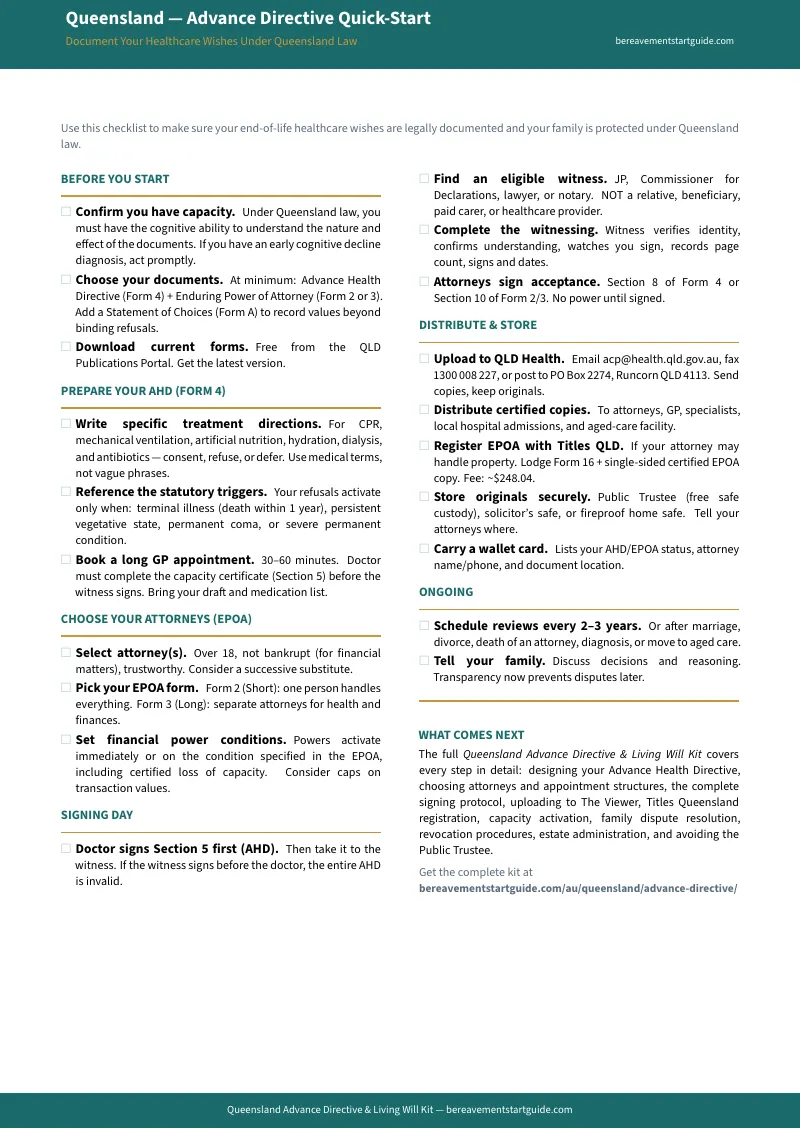
- 20-Item Quick-Start Checklist (checklist.pdf) — the complete planning sequence in a single printable reference, from initial family conversations through document execution and clinical registration
Who This Kit Is For
- Adult children helping an ageing parent — especially when cognitive decline is emerging and the window to execute legally valid documents is shrinking under the capacity threshold in Section 42
- Blended families — where you need to appoint different people for health and financial decisions using the Long Form (Form 3) EPOA, and where clear AHD instructions prevent disputes between step-families
- Anyone wanting to avoid state intervention — without valid planning documents, QCAT appoints a guardian or administrator, assets freeze during proceedings, and the Public Trustee may take over
- Queenslanders managing their own planning — who want to execute legally robust documents without paying solicitor fees that typically range from $350 to $1,000 for an EPOA and $2,000 to $4,500 for a complete estate plan
Why the Free Government Forms Are Not Enough
The Queensland Government publishes the statutory forms — Form 4 (AHD), Form 2 (Short EPOA), and Form 3 (Long EPOA) — for free. The forms themselves are not the problem. The problem is everything the forms do not tell you:
- The forms do not explain the signing sequence that prevents technical invalidation under Section 44
- The forms do not provide clinical phrasing that survives the ambiguity loophole
- The forms do not walk you through the doctor consultation required for the Section 5 capacity certificate
- The forms do not explain the difference between the Short and Long EPOA or when you need which
- The forms do not cover how to upload your completed documents to the ACP Tracker or My Health Record
- The forms do not address what happens when family members disagree about your care
This kit fills every gap between downloading a blank form and having a clinically actionable plan that your medical team will actually follow during an emergency.
What You Get
Your download includes 10 PDFs, formatted for A4 printing: the 12-chapter guide, the 20-item quick-start checklist, and eight fillable worksheets (treatment decisions, GP consultation, EPOA decision, signing and witnessing, document distribution, wallet card, family conversation, and revocation).
Satisfaction Guarantee: If the kit does not give you the clarity and confidence you need to complete your advance care planning, email us and we will make it right.
Start Your Plan Today
Download the free checklist to see the complete planning sequence — or get the full kit to access the treatment-decision worksheet, signing-and-witnessing checklist, EPOA decision worksheet, and Public Trustee avoidance chapter that turn a blank form into a legally binding, clinically clear plan.