The Bank Froze the Account. The Share Registry Wants a Grant. Service SA Says You Need a Signed Certificate. And Nobody Can Tell You Whether You Actually Need Probate.
Someone has died in South Australia. The estate is modest — a few bank accounts, a car, some shares, and a house held jointly. You were told probate would not be necessary for a small estate. Then you called the bank.
The bank froze the sole-name account the moment you notified them of the death. They told you they would release the balance with a statutory declaration and an indemnity form — but only up to their internal discretionary limit. You do not know what that limit is. They would not tell you over the phone. They asked you to fill out their bereavement forms and "see what happens."
You called the share registry. They have a different limit. You called a second bank. They have a third limit. Meanwhile, Land Services SA told you the house passes by survivorship because it is held as a joint tenancy — but you need to lodge Form A2 and meet its certification and identity-verification requirements. Service SA told you the car can be transferred without probate, but you need a "Registration Details Certificate" signed by the executor — and you are not sure whether you count as the executor when there is no grant.
The free government resources are accurate but fragmented. CourtSA explains how to apply for a grant — but says it does not decide whether you need one. The Legal Services Commission explains what probate means. Land Services SA explains property transfers. None of them tells you how to combine these processes into a single settlement plan for a small estate, or where informal release ends and a court application begins.
Law firms explain the risks in detail. Then they quote $3,000 to $6,000 for work that may be entirely unnecessary if every asset falls below the institutional thresholds.
Here is the reality: most small estates in South Australia can be settled without a formal court grant — if you know exactly which institutions release funds under an indemnity, which assets pass by survivorship, and where the statutory and institutional boundaries sit under the Succession Act 2023.
The South Australia Small Estates Guide is the Institutional Release Manual — the step-by-step workbook that maps every asset type against South Australia's real-world release thresholds, survivorship rules, and institutional requirements. Not a generic Australian overview. Not a pre-2025 guide citing repealed legislation. A South Australia-specific decision framework built on the Succession Act 2023 and the related South Australian property, vehicle, and creditor rules — covering every stage from "Does this asset need probate?" through final distribution, with the bank indemnity procedures, Land Services SA forms, Service SA steps, and creditor notice rules that no free resource assembles into one sequence.
What's Inside the Institutional Release Manual
14 chapters, a Do You Need Probate? Checklist, and five printable worksheets — covering every stage of informal estate settlement in South Australia under the Succession Act 2023:
The Asset Triage Matrix
Before contacting any institution, sort every asset into one of three categories. Category A: joint-tenancy assets that pass directly to the surviving owner by operation of law — no court grant is needed, but registering joint-tenancy land with Form A2 carries Land Services SA's $204 fee for 2026/27. Category B: sole-name bank accounts and shares that may be released under each holder's process; motor vehicles follow Service SA's transfer process, and personal effects generally need no special procedure. Category C: assets for which the holder requires a formal grant, or sole real property that requires a grant. The guide provides the decision framework for every common asset type so you know your position before making a single phone call.
Bank and Share-Registry Release Navigation
The critical chapter that maps the gap between what the law says and what each institution actually does. Section 100 of the Succession Act 2023 permits a person holding up to $15,000 of the deceased's money or personal property to transfer it to a surviving spouse, domestic partner, or child without a grant. Above that, each institution applies its own internal discretionary limit. The guide explains the indemnity form process — what it commits you to, typical documents to prepare, questions to ask each bank about its current requirements, and how to present your case for a discretionary release. This chapter alone can save you $1,020 or more in unnecessary court filing fees.
Joint-Tenancy Survivorship Through Land Services SA
Real property held as joint tenants passes outside the estate entirely — no probate, no court application, no solicitor. Lodge Form A2 (Application to Register Death by Survivor) with Land Services SA, satisfy the certification requirements, and the title updates to the surviving owner. The guide walks through every step of the form, the requirements for self-represented applicants, and the distinction between joint tenancy and tenants in common that determines whether this pathway is available.
Vehicle Transfers Through Service SA
Motor vehicles in South Australia can generally be transferred to a beneficiary without a formal court grant. The guide covers the Registration Details Certificate, the $33 transfer fee, the stamp duty exemption for a vehicle inherited under a will or intestacy, and the specific documents Service SA requires depending on whether the deceased left a will or died intestate.
The Executor's Year and Creditor Notices
How long can an executor hold estate money before distributing? When is a creditor notice under Section 29 of the Trustee Act 1936 necessary? What happens if you distribute and an unknown creditor surfaces? The guide explains the traditional executor's year principle, the Gazette advertising process, and the limited protection against liability for claims unknown when distribution occurs.
When Probate Is Unavoidable
The guide does not pretend every estate can skip probate. If a third party will not release an asset without a grant, or the estate contains solely owned real property, a formal CourtSA application is needed for that asset. The guide maps every trigger that shifts an estate from informal settlement to mandatory court involvement, and directs you to the sibling South Australia Probate Process Guide for the full CourtSA filing procedure.
Who This Guide Is For
- The executor of a modest estate who wants to avoid unnecessary court fees. CourtSA filing fees start at $1,020 and climb to $4,075. If every asset in the estate falls below institutional release thresholds or passes by survivorship, those fees are avoidable. The guide tells you exactly where you stand.
- The surviving spouse or domestic partner who cannot access the frozen bank account. The bank says they need a "grant of probate." The balance is well below their internal release limit, but nobody explained that a statutory declaration and indemnity form might be enough. The guide walks you through the exact process.
- The family navigating multiple institutions with different rules. One bank releases under an indemnity. The share registry demands a formal grant. Land Services SA needs Form A2. Service SA needs a Registration Details Certificate. The guide puts the key institutional steps into one sequence so you stop making separate phone calls and start working through a plan.
- The interstate adult child managing a South Australian estate remotely. You live in Sydney or Melbourne and need the key SA-specific forms, thresholds, and institutional contacts in one place — without flying to Adelaide to work it out in person.
Why Free Resources Will Not Get You Through This
The information exists across South Australian government websites. The instructions for combining it do not.
- CourtSA does not decide whether you need probate. The Supreme Court explicitly states that it does not determine whether a grant is required — that depends on each institution's internal rules. The guide provides the decision framework that CourtSA does not.
- Bank websites explain their own forms, not each other's. BankSA's bereavement page covers BankSA. CBA's covers CBA. Neither tells you how to coordinate releases across four institutions holding different amounts, or what to do when one demands a grant and the others do not.
- Land Services SA provides Form A2 guidance and self-represented checklists. The certification and Verification of Identity requirements are still technical. The guide translates these into plain-English steps for families.
- Most online content still cites repealed legislation. The Succession Act 2023 took effect on 1 January 2025. The majority of blog posts, law firm articles, and downloadable guides still reference the Administration and Probate Act 1919 and its thresholds. Following pre-2025 advice risks misunderstanding the current rules.
Free resources give you fragments across a dozen government websites. Law firm blogs explain risks to sell consultations. The Institutional Release Manual puts the complete post-2025 South Australian small-estate settlement procedure into one workbook — from "Does this asset need probate?" to final distribution — in the order you actually need it.
— Less Than Thirty Minutes With a South Australian Probate Solicitor
A single consultation with a South Australian probate solicitor costs $300 to $500 per hour. Full estate administration runs $3,000 to $6,000 or more. CourtSA filing fees start at $1,020. This guide costs a fraction of a single professional consultation and gives you the complete decision framework for determining whether you need any of those services at all.
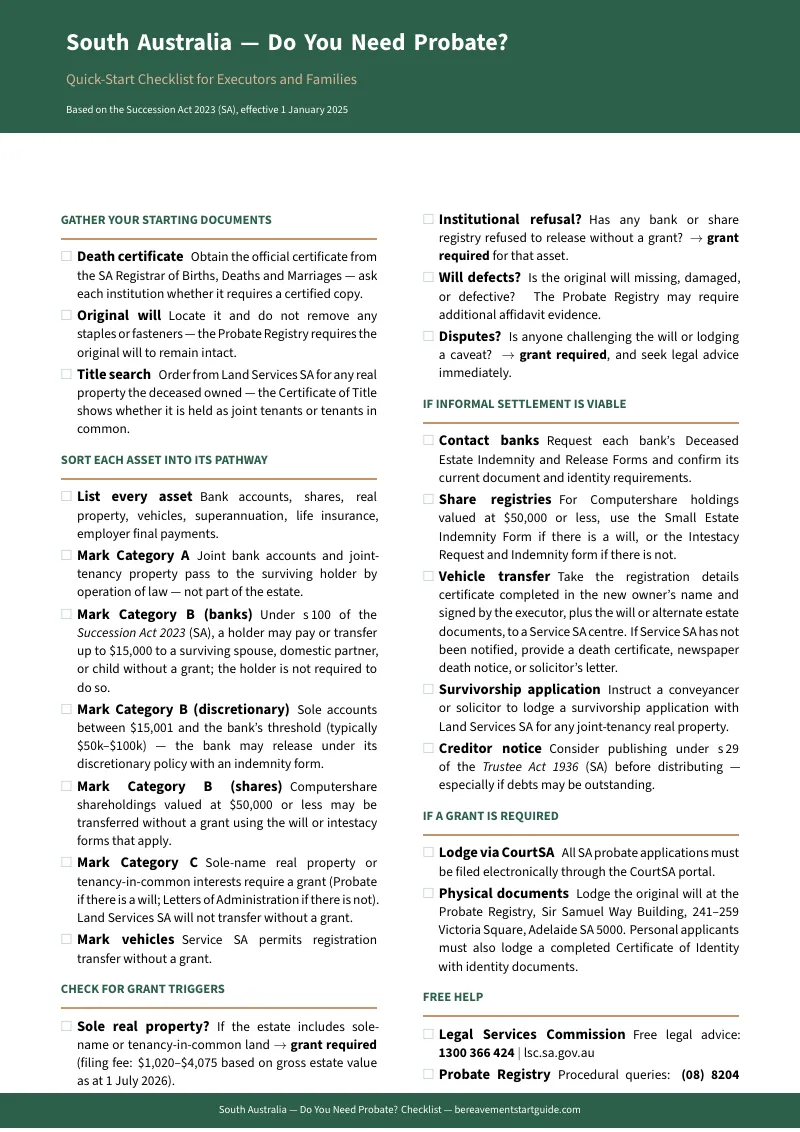
Your download includes 7 PDFs: the complete 14-chapter guide covering every stage of informal estate settlement in South Australia, the standalone Do You Need Probate? Checklist, plus five printable worksheets — the Asset Triage Worksheet (classify every asset into Category A, B, or C), the Bank Release Tracker (track each institution's requirements and release status), the Estate Settlement Ledger (master record of assets collected, debts paid, and distributions made), the Agency Communication Log (record every call and email), and the Beneficiary Distribution Record (distributions with signed receipt acknowledgments). Instant download, no account required.
Full refund, no time limit. If the guide does not give you clarity on which assets need probate and which do not, email hello@bereavementstartguide.com for a full refund. No questions asked.
Not ready for the full guide? Download the free South Australia — Do You Need Probate? Checklist — covering the key asset categories, the statutory $15,000 release threshold, and the basic decision framework. It is enough to understand your position and decide your next step.
The bank will not explain their internal thresholds. CourtSA will not tell you whether you need a grant. Law firms will not show you how to settle it yourself. This guide puts the key South Australia-specific thresholds, forms, and institutional requirements into one decision framework so you can stop guessing and start settling the estate.
Frequently Asked Questions
What if the rules change after I buy?
We update the guide when the rules change. Email us any time, even years later, and we'll send you the current edition free.