The BC Intestacy Filing System: Core P-Forms in Order, Every Field Explained
When someone dies without a will in British Columbia, there is no executor, no instructions, and no clear authority over anything. The bank freezes every account the day it hears about the death. The Land Title office will not register a transfer. Even the vehicle stays locked in the deceased's name until a court says otherwise.
The only way to unlock any of it is a Grant of Administration Without Will Annexed from the BC Supreme Court — and getting one means filling out a stack of P-forms that reference statutory sections nobody explains, delivering notices with a 21-day wait unless the court orders otherwise, and swearing an affidavit of assets under oath where a single miscategorization is a material misstatement.
The government website gives you the blank forms. What it does not give you is the filing order, the field-by-field instructions, or any warning about the errors that cause the registry to send your entire packet back to the bottom of the queue.
This guide is the BC Intestacy Filing System — the operational layer that sits between the blank court forms and a completed application the registry will accept. It puts the core P-forms in a practical sequence built around the required notice period and filing rules, explains every field, and flags the precise points where self-represented applicants get rejected.
What You Get
- The core intestate filing sequence — Forms P1, P2, P5, P9, and P10 or P11 organized around the 21-day notice period and Supreme Court filing rules; P10 or P11 may be filed with or after the other application materials
- WESA intestacy shares with four worked examples — the surviving spouse's preferential share ($300,000 or $150,000 depending on family structure), the residue split, the spousal home 180-day election, and the actual dollar distribution for estates of different sizes so you know exactly what each heir receives
- The WESA s. 130 priority ladder — who can apply and in what order, how majority consent changes children's priority, the out-of-province applicant rules, and the conditions that bring in the Public Guardian and Trustee
- Form P10 walkthrough — which assets use fair market value, why liabilities that charge or encumber property reduce the probate-fee base but unsecured debts do not, the distinction between P10 and P11, and the common classification errors that trigger registry requisitions
- Probate fee calculation with two worked examples — the tiered formula under the Probate Fee Act so you know the exact cost before you file
- Form P1 notice and delivery tracking — who must receive notice under Rule 25-2, when the PGT must be served because a required notice recipient is under 19 or mentally incompetent, how to prove service on Form P9, and a tracking method for multi-sibling families
- The 210-day distribution hold — why WESA s. 155 generally limits distribution during the 210 days after the grant is issued, the limited exceptions, and how to manage beneficiary expectations during the wait
- Post-grant administration — collecting assets, transferring real property through the LTSA, applying for the CRA clearance certificate (Form TX19), and the final accounting to beneficiaries
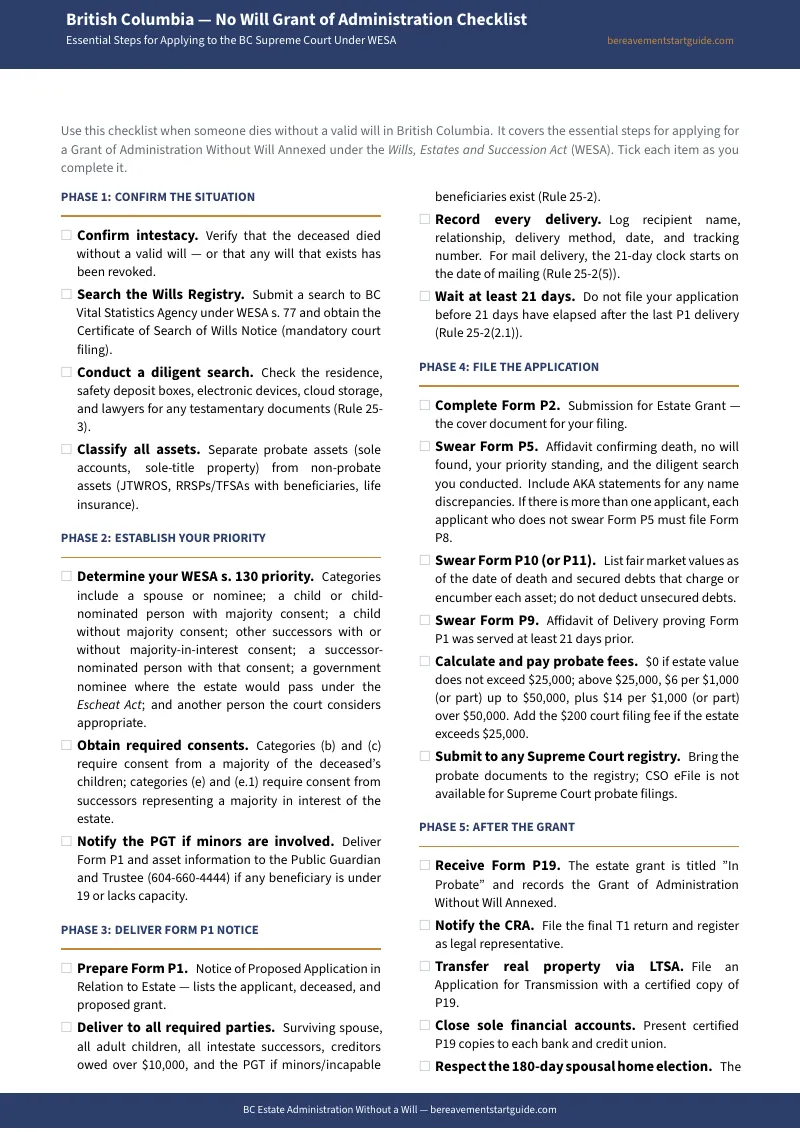
- A printable checklist — the five-phase overview from initial Wills Registry search to final distribution, with every milestone and statutory deadline in one document
- Seven standalone worksheets and tools — a P-form filing sequence card, a probate fee calculator, a Form P10 asset and liability inventory worksheet, a P1 notice and service tracker, a WESA intestacy share calculator, a court requisition prevention checklist, and a post-grant timeline tracker — each designed to print and use alongside the official forms
Who This Is For
This guide is for the surviving spouse, adult child, or other relative who has to apply for a grant of administration in BC without a lawyer — or who wants to understand the full process before deciding whether to hire one.
- Surviving spouses with first priority under WESA who need to understand both the application and their intestacy share — including the preferential share, the residue split, and the 180-day right to acquire the spousal home
- Adult children coordinating siblings to secure majority consent and filing the application for the first time
- Out-of-province relatives managing a BC estate from another province, who need to know which steps can be completed remotely
- Families weighing DIY against hiring a lawyer — the guide makes the uncontested-filing path clear for straightforward estates, and identifies exactly when professional legal help is worth the fee
Why Not Just Use the Free Court Forms?
The Supreme Court forms are free, and the government website links to all of them. That part is true. What the government website does not provide is a filing sequence, completion instructions, an asset-classification method for Form P10, or any strategy for avoiding the registry requisitions that send self-represented applicants back to the start.
Law firm websites explain the legal concepts — but they are written to sell retainers that cost thousands of dollars. Dial-A-Law and People's Law School cover the statutory shares and the basic administrator responsibilities — but they stop at general education and do not walk you through filling out a single form.
The BC Intestacy Filing System bridges the gap. It takes the official forms, puts them in order, and explains every step in the language of someone who has never filed a court document — while keeping the official free routes and legal help services visible at every stage.
Satisfaction Guarantee
If the guide does not deliver what you expected, email hello@bereavementstartguide.com for a full refund, no time limit. We read every message.
Get Started
Download the free checklist to see the five-stage filing overview. If you need the full filing sequence, the form-by-form walkthrough, the WESA shares with worked examples, and the probate fee calculation — the complete guide is available for .
This guide is an independent informational publication. It is not published by, affiliated with, or endorsed by the Supreme Court of British Columbia, the Government of BC, the Public Guardian and Trustee, or the Canada Revenue Agency. It provides process navigation only and does not constitute legal, tax, or financial advice.
Frequently Asked Questions
What if the rules change after I buy?
We update the guide when the rules change. Email us any time, even years later, and we'll send you the current edition free.